Concept
Seek & Destroy Profile
Seek & Destroy Profile is a Smart Money Concepts / ICT concept. The Library holds 1 implementation, a working definition you can pull into Quant.
Top Seek & Destroy Profile indicator
The top custom implementation, built on the original standard Seek & Destroy Profile formula.
1 total
From studying Seek & Destroy Profile to trading it: take the implementation below into Quant and backtest it instantly.
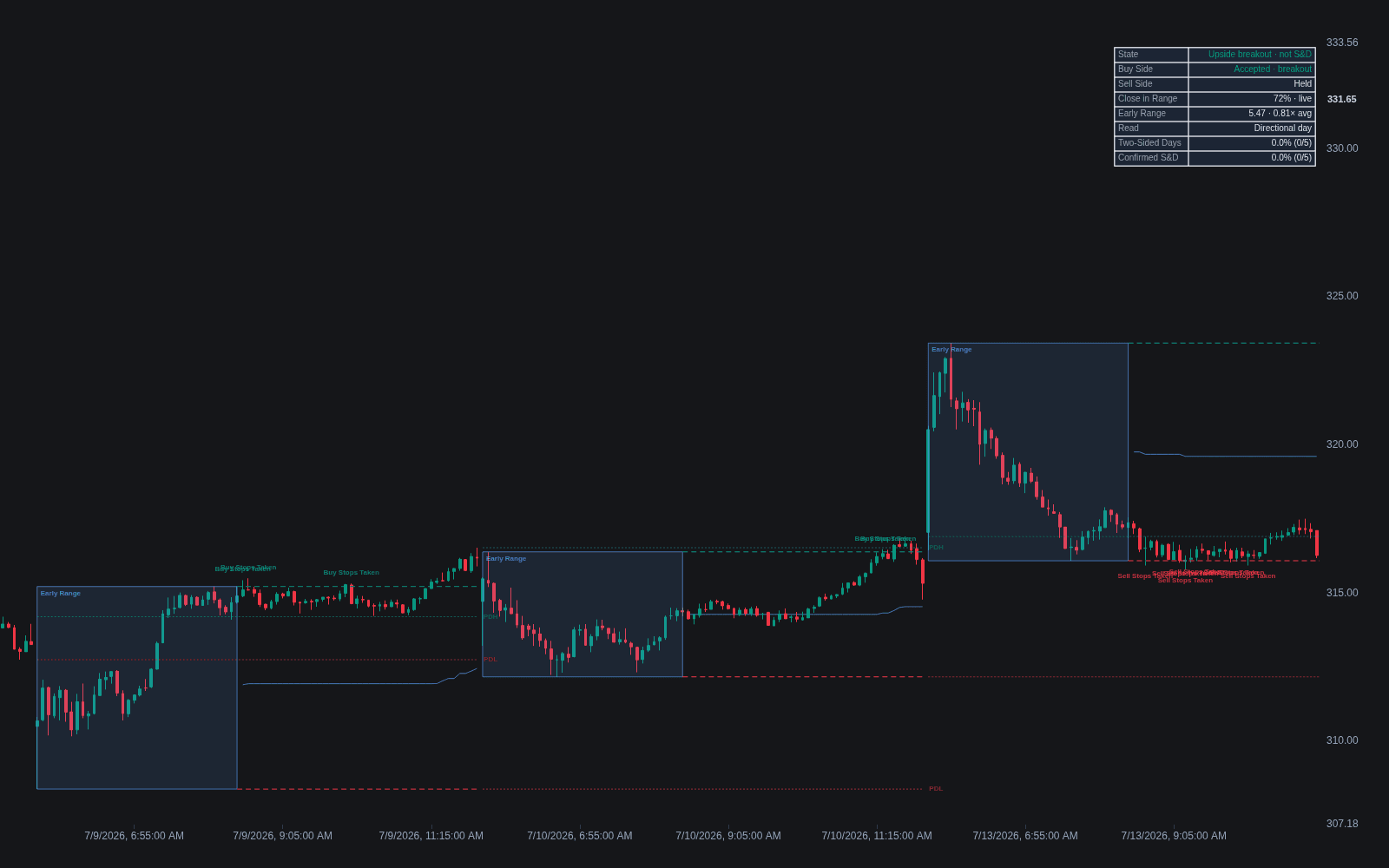
What is the Seek & Destroy Profile?
The seek-and-destroy profile is ICT's name for a day that runs both sides and rewards neither: price pushes above a recent high to take buy stops, rotates down through a recent low to take sell stops, and finishes back inside the range without committing to a direction. Instead of one liquidity sweep that starts a trend, the session is a sequence of sweeps in both directions, a whipsaw environment where breakout entries and sweep-reversal entries both get stopped out.
It belongs to the ICT taxonomy of session and weekly profiles, recurring day shapes traders try to classify early. Seek-and-destroy conditions are conventionally associated with low-conviction tape: sessions on or just before major data releases, holiday-thinned liquidity, and consolidation days with no obvious higher-timeframe draw nearby. The profile's practical value is mostly defensive: it is the day type the playbook says to sit out.
The label comes from Michael J. Huddleston, the Inner Circle Trader, whose teaching names recurring day templates so students can classify the session in progress. Most templates in that set describe how a directional day should unfold, with manipulation one way and expansion the other, in the spirit of accumulation-manipulation-distribution. Seek and destroy is an exception: manipulation runs in both directions and the expansion leg never arrives, so the template's lesson is recognition and restraint rather than entry.
Structurally, the day consumes the liquidity pools on both sides of the range: buy stops above the overnight or prior-day high, sell stops beneath the matching lows, often taken during the London and New York killzones when participation peaks. Each run looks like the start of a real move, which is what makes the profile expensive. Entries keyed to fair value gaps or order blocks form and fail in both directions, session liquidity is spent symmetrically, and the day closes near where it opened.
How to identify a seek and destroy day on a chart
The profile is confirmed as it develops; the evidence accumulates in a recognizable order.
- 1Mark the reference levels before the session: the prior day's high and low, the overnight range, and the week's opening range.
- 2Watch the first breakout attempt: a push through one side that stalls without expansion or follow-through is the first warning.
- 3Watch for the rotation through the opposite reference level, which converts a single failed breakout into a both-sides run.
- 4Note wicks through levels with closes back inside the range; acceptance beyond a level argues for a genuine breakout instead.
- 5Check the calendar: a major release later in the session or a holiday-thinned tape raises the prior odds of the profile.
- 6Confirm by the close: a finish near the middle of the range after both extremes were taken is the completed signature.
How it's calculated
An ICT session template in which price raids the liquidity resting on both sides of the range and then closes back near the open.
A discretionary profile classification from ICT teaching, not a fixed formula; the weekly variant, Seek and Destroy Friday, sweeps both sides of the Monday through Thursday range.
ICT flags it as most likely on major news days such as Non-Farm Payrolls and in holiday-thinned liquidity.
The defining trait is stop runs on both sides with no follow-through, so breaks of the range extremes are treated as traps rather than entries.
How traders use it
- As a stand-aside filter: once both sides of the opening range or prior day have been run without displacement or follow-through, the profile becomes the working assumption, and further intraday signals are treated with skepticism rather than re-entered.
- As calendar anticipation: sessions around high-impact releases are the classic candidates (macro event days, with nonfarm payrolls the textbook example), so the profile is something to expect in advance rather than diagnose after three stop-outs.
- As a loss-control rule: a fixed cap on attempts fits this profile. If the first setups fail in opposite directions, the day is reclassified and trading stops, since the profile's defining feature is that it punishes persistence.
- As a scheduling rule: many intraday traders size down or skip sessions with the worst prior odds, such as the day before top-tier releases, using ICT time anchors to structure what remains.
- In review: tagging each session against the profile taxonomy, with ICT session ranges as the measuring frame, builds a personal base rate for how often a market prints two-sided runs.
Seek & destroy vs related concepts
Liquidity Sweep: A sweep is a single engineered run that often starts a move; seek and destroy is a day of sweeps in both directions that starts nothing. The sweep is tradable, the profile is a warning.
Accumulation-manipulation-distribution: AMD completes with a distribution leg, the real move that manipulation set up. Seek and destroy is manipulation both ways with no distribution, the template that never resolves.
Session Liquidity: Session liquidity maps where each session's stops rest; the seek-and-destroy day is what it looks like when those pools are consumed on both sides without a directional payoff.
Concept family
Smart Money Concepts / ICT
54 concepts mapped · 54 in the Library
Seek & Destroy Profile FAQ
Turn Seek & Destroy Profile into a trading strategy.
Take the implementation from this page into Quant, then build on it, backtest it on real data, and keep refining it in conversation.