Concept
Balanced Price Range
Balanced Price Range is a Smart Money Concepts / ICT concept. The Library holds 1 implementation, a working definition you can pull into Quant.
BPR
Top Balanced Price Range indicator
The top custom implementation, built on the original standard Balanced Price Range formula.
1 total
The Balanced Price Range implementation below can become a backtested trading strategy — describe your rules and Quant writes the code.
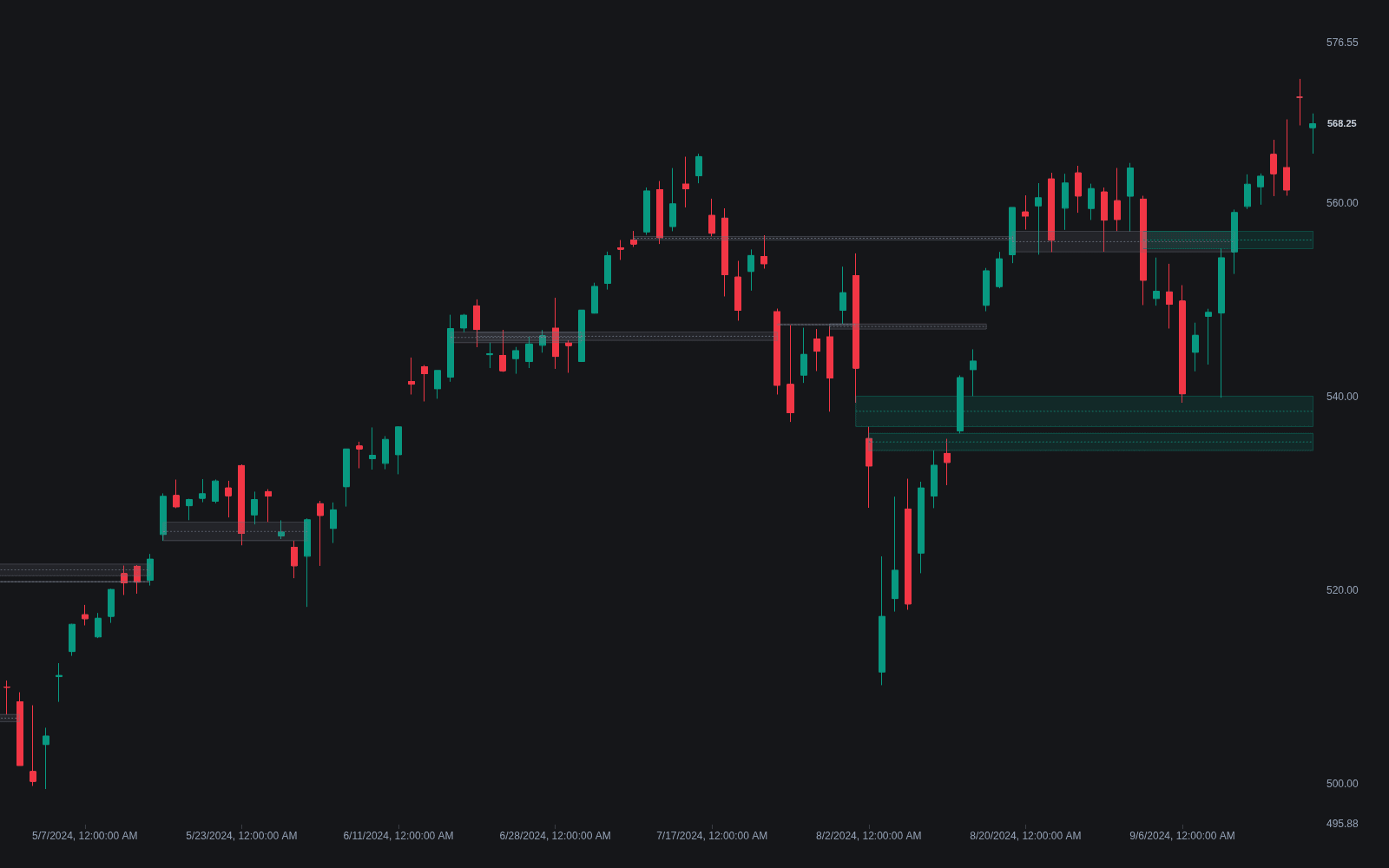
What is a Balanced Price Range?
A balanced price range (BPR) is the overlap of two opposing fair value gaps. Price displaces one way and leaves a gap; shortly after, it displaces back through the same area and leaves a gap in the opposite direction. The span where the bullish and bearish gaps overlap has now been delivered both up and down (bought and sold at speed), which is why ICT vocabulary calls it balanced.
The more recent displacement sets the zone's expected role: a bullish gap overrun by a bearish one is watched as resistance, and the mirror sequence as support. Because two opposing bursts of delivery in quick succession usually mark a violent rejection, BPRs concentrate around sharp reversals, and the overlap is kept as the zone to trade back to. Like any zone it is a scenario, not a promise: a clean break and hold through the overlap reads as the balance resolving the other way.
The drawing is precise: only the intersection of the two gaps counts, not their union, so the BPR is often a thin slice inside two larger imbalances, marked by its two edges and its midpoint. Formation context does most of the qualifying. The classic sequence begins with a liquidity sweep through a prior extreme, displacement away that leaves the first gap, and a second displacement cutting back, which is reversal anatomy told in gaps. Detectors like tradeforopp's BPR study and TradingFinder's FVG-and-inversion build automate the overlap detection, and volume-graded variants weight zones by the participation behind each displacement.
In the playbook the BPR behaves like a premium reference zone: bias from the newer gap, entries staged at the near edge or midpoint, invalidation past the far side. Its rank rises with confluence, a BPR overlapping a breaker block or an order block marks the same violent transition twice, and with timing, since returns during active killzones meet the participation the zone needs to act. The honest footing is the same as the rest of the ICT inventory: coherent auction logic and clean definitions, no audited statistics, so displacement quality and location have to do the sorting.
How to identify a balanced price range
The construction is two gaps and an intersection; the judgment is whether the sequence marks a genuine rejection.
- 1Find the first fair value gap: a three-candle imbalance left by directional displacement.
- 2Find the opposing gap: a displacement back through the same area soon after, leaving a gap in the other direction.
- 3Mark the overlap only, the span where the two gaps intersect, with its edges and midpoint.
- 4Assign the bias from the newer gap: bearish gap over bullish gap reads as resistance, the mirror as support.
- 5Watch the first return: rejection at the overlap in the newer gap's direction is the zone working, and a decisive close through the far edge retires or flips it.
How traders use it
- As a reversal reference: a sharp turn that leaves opposing gaps gets its overlap marked, and the first return to that overlap is watched for continuation in the direction of the newer gap.
- As an entry zone: orders staged at the near edge or midpoint of the overlap, with invalidation beyond its far side, trading in the direction of the more recent displacement.
- As a strength read: price slicing through a BPR and holding beyond it suggests the earlier rejection has been absorbed, and many traders then treat the zone as pointing the other way.
- In confluence stacks: a BPR that coincides with an order block, a breaker, or a session extreme carries the weight of independent evidence agreeing, and such zones are prioritized over lone overlaps.
- With session timing: returns into the zone during active trading windows are trusted more than drifts into it during dead hours, since the rejection thesis needs real participation to be tested.
Balanced price range vs related imbalances
Fair Value Gap: A fair value gap is a single three-candle imbalance delivered in one direction. A balanced price range requires two opposing gaps whose spans overlap; that overlap has traded both ways, which changes what a return to it is expected to do.
Inversion FVG: An inversion FVG is one gap that failed: price closed through it and its role flipped. A BPR involves no failure (both gaps delivered), and the newer gap's direction, not a violation, sets the bias.
Breaker Block: A breaker is a failed order block flipped to the other side, defined by candle bodies; a BPR is defined by overlapping gaps. Both mark the scene of a violent transition, and their frequent overlap at real reversals is why the two are stacked as confluence.
Concept family
Smart Money Concepts / ICT
54 concepts mapped · 54 in the Library
Balanced Price Range FAQ
Turn Balanced Price Range into a trading strategy.
Take the implementation from this page into Quant, then build on it, backtest it on real data, and keep refining it in conversation.