Concept
Equal Highs/lows As Liquidity
Equal Highs/lows As Liquidity is a Smart Money Concepts / ICT concept. The Library holds 1 implementation, a working definition you can pull into Quant.
Top Equal Highs/lows As Liquidity indicator
The top custom implementation, built on the original standard Equal Highs/lows As Liquidity formula.
1 total
The Equal Highs/lows As Liquidity implementation below can become a backtested trading strategy — describe your rules and Quant writes the code.
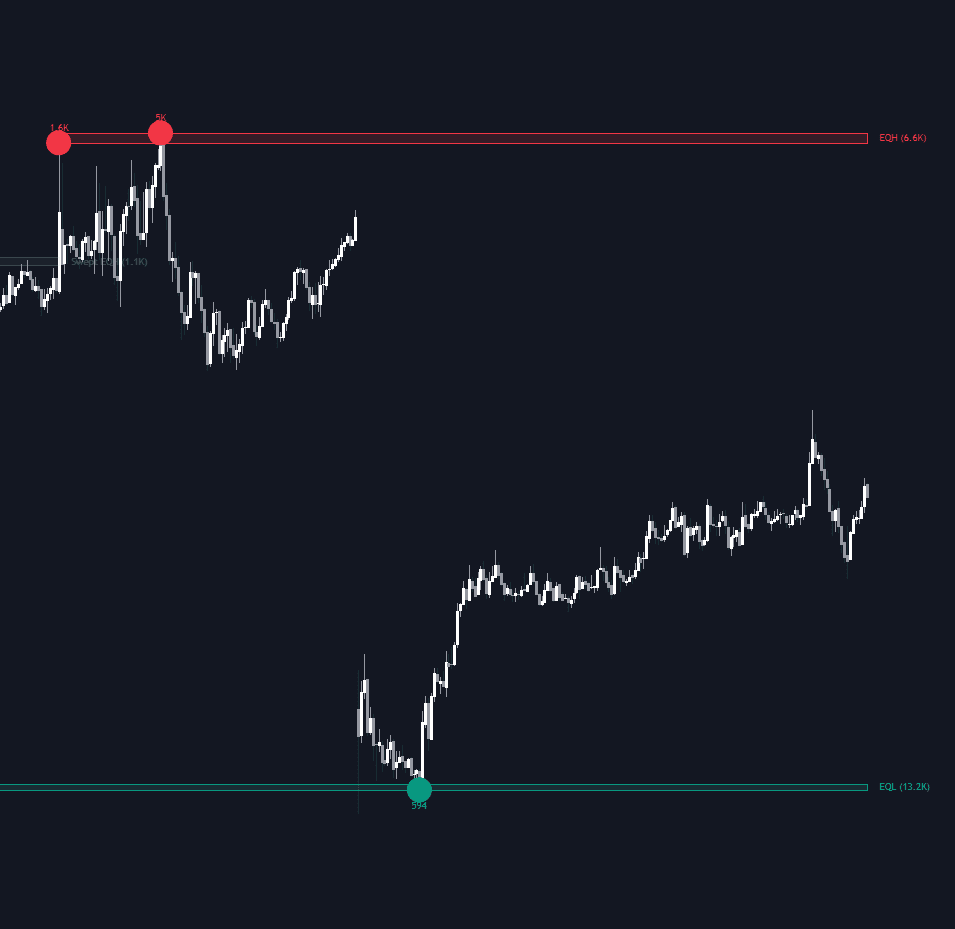
What are Equal Highs/lows As Liquidity?
Equal highs are two or more swing highs stalling at nearly the same price; equal lows are the mirror image. Classical charting reads the pattern as strength: a double top or bottom proving a level. The Smart Money Concepts reading inverts that: every rejection parks more stop-losses and breakout orders just past the level, so relatively equal highs mark resting buy-side liquidity and equal lows mark sell-side liquidity. The cleaner and more visible the level, the larger the pool, and the more it behaves like a magnet rather than a wall.
The reading comes from the Inner Circle Trader (ICT) teachings of Michael J. Huddleston, whose EQH and EQL shorthand spread through the Smart Money Concepts community during the 2010s and 2020s. The mechanical rationale: stops fire as market orders, so a push through equal highs converts resting orders into a burst of buying that larger participants can sell into. The level is then not support or resistance but a liquidity pool, fuel stored where the most traders can see it. Whether any given run is deliberate engineering or ordinary order-flow mechanics is unknowable from a chart; the pattern's usefulness does not depend on settling that.
'Equal' rarely means identical to the tick. Most traders accept highs within a few ticks (or a small fraction of ATR) of each other, because stops gather in a band rather than at one price; slightly ascending 'equal' lows count too. The honest caveat: some equal levels are genuinely defended and simply hold. The SMC bias is that obvious pools eventually get run, but eventually can outlast any single trade, so the pool is a scenario to plan around, not a promise.
Equal levels also sit inside a session map: pools above an overnight or prior-session extreme tie into session liquidity, and SMC practice expects runs on them during the London and New York killzones. In the accumulation-manipulation-distribution template, the raid on equal lows is the manipulation leg before the intended move, which is why many SMC traders wait for the sweep rather than trading the level's first test.
How to Identify Equal Highs and Lows on a Chart
The pattern itself is simple; the discipline is in the tolerance and the context:
- 1Find two or more swing highs (or lows) that stall within a few ticks of one another, or within a small fraction of ATR on your timeframe.
- 2Require separation: a meaningful pullback between the swings, so they read as distinct tests rather than one drawn-out top.
- 3Draw a band, not a line, covering the slightly uneven extremes where stops actually rest.
- 4Prefer levels obvious at a glance that survive on a higher timeframe; visibility is what makes a pool large.
- 5Track the pool's status: untouched, it acts as a draw; once price closes beyond it with acceptance, it is spent.
How traders use it
- As targets: an untouched pool above equal highs is a natural take-profit for longs, on the logic that price gravitates toward dense resting orders before it reverses.
- As sweep-and-reverse setups: a push through equal lows that fails and closes back inside the range is read as a liquidity sweep, and entries are taken against the raid once structure confirms the reclaim.
- As a stop-placement warning: a stop resting just beyond an obvious equal high sits inside the pool everyone can see; traders either give it room beyond the likely sweep distance or accept the risk of being the liquidity.
- As an entry-refinement map: after a sweep reverses, traders look for displacement back into the range and stalk entries at a fresh order block or fair value gap created by the reversal, the sequence behind the optimal trade entry template.
Equal Highs/Lows vs related concepts
Liquidity Pool: The general concept: any location where resting orders accumulate, under a swing low, along a trendline, at a round number. Equal highs and lows are the most visible, most teachable species of pool.
Liquidity Sweep: The event to this concept's location: equal highs mark where resting orders sit; the sweep is the moment price runs them and either reverses or keeps going.
Session Liquidity: Pools defined by time rather than pattern: the highs and lows of Asia, London, or the prior day. A session extreme that is also an equal high is usually treated as a higher-priority draw.
Concept family
Smart Money Concepts / ICT
54 concepts mapped · 54 in the Library
Equal Highs/lows As Liquidity FAQ
Turn Equal Highs/lows As Liquidity into a trading strategy.
Take the implementation from this page into Quant, then build on it, backtest it on real data, and keep refining it in conversation.