Concept
Immediate Rebalance
Immediate Rebalance is a Smart Money Concepts / ICT concept. The Library holds 2 implementations, each one a working definition you can pull into Quant.
ICT
Top Immediate Rebalance indicators
The top custom implementations, built on the original standard Immediate Rebalance formula.
2 total
Every Immediate Rebalance implementation here is strategy-ready: open one in Quant, set your rules, and it backtests automatically.
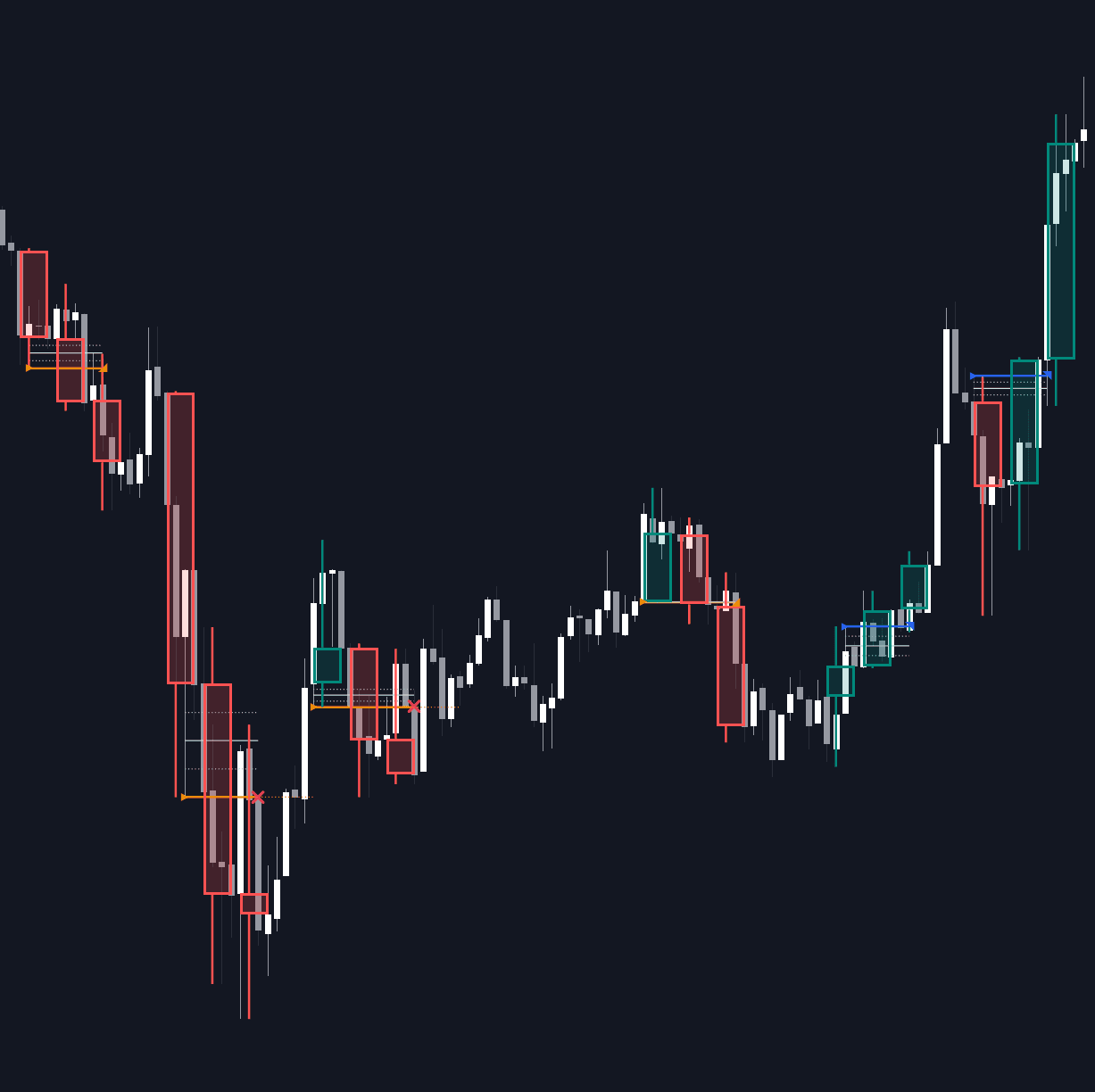
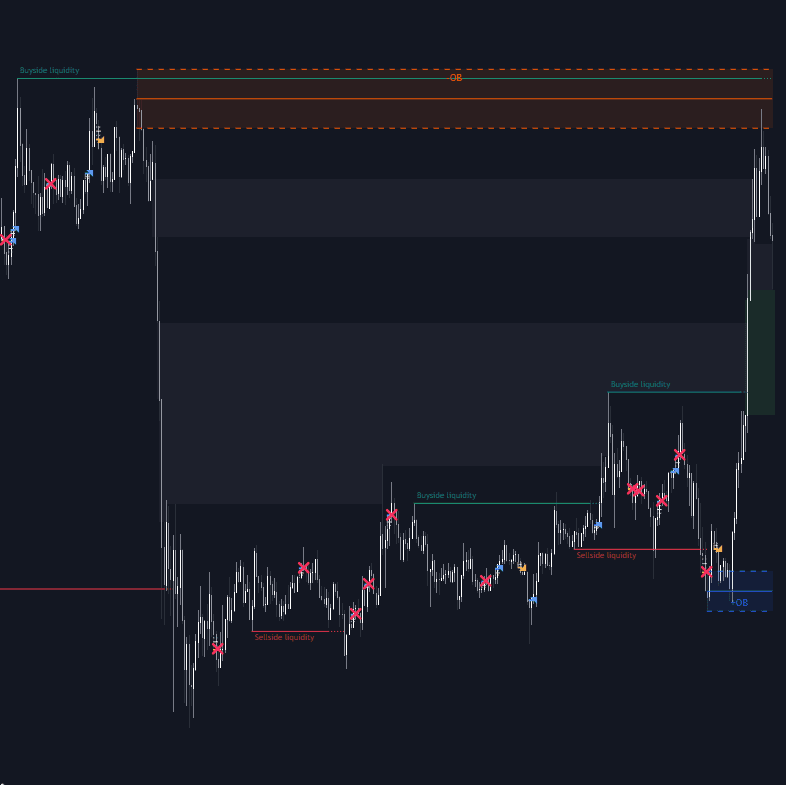
What is an Immediate Rebalance?
An immediate rebalance is the opposite outcome to a fair value gap. Where a fast move would normally leave a gap (a span traded in one direction only that the market may later revisit), an immediate rebalance means the very next candle trades straight back through the boundary just made, re-auctioning it at once. A common working rule requires the new candle's wick to retrace at least the midpoint of the prior candle's wick, its consequent encroachment, before the level counts as rebalanced. Either way, nothing is left unfilled, so there is no inefficiency for price to come back and repair later.
The concept matters mostly for what it removes. Traders who map unfilled imbalances as candidate magnets can take an immediately rebalanced level off that map, and the displacement that produced it reads as efficient rather than overextended. The commonly taught expectation is that continuation follows more often than a deep retracement (the auction was repaired on the spot, leaving one less reason for price to trade back), though that is a tendency to verify on your own market, not a rule.
The candle-pair anatomy is worth spelling out. A strong candle closes; the question is what its successor does to the boundary they share. Trading onward without looking back leaves a gap; trading back through the shared boundary, with the working rule asking the new wick to reach at least halfway into the prior candle's wick, re-auctions the span immediately. The strongest version of the read is the sequence where the rebalance prints and the move then resumes: the market paused to repair its own delivery and continued, which is efficiency, not weakness. Detection tooling automates the wick arithmetic, and toolkit builds extend the event into reference levels and projections drawn from where the rebalance occurred.
The distinction that keeps the concept clean: an immediate rebalance is the market repairing its own just-made move, not a raid on resting orders, so it reads with, not against, the direction of travel, unlike a liquidity sweep, which takes out other people's stops beyond a level. In playbook terms the event shifts pullback expectations shallow, entries hunted at nearby retracement zones in the optimal trade entry spirit rather than at distant unfilled gaps that no longer exist, and the running mix of gaps versus rebalances doubles as a tape read: one-sided delivery leaves gaps, two-sided efficient delivery keeps repairing itself.
How to identify an immediate rebalance
One candle pair, one wick measurement, one map edit.
- 1Locate a strong directional candle whose extension would normally threaten to leave an imbalance behind.
- 2Watch its successor: the event requires the very next candle to trade back through their shared boundary.
- 3Apply the working rule: the new candle's wick should retrace at least to the midpoint of the prior candle's wick before the span counts as rebalanced.
- 4Edit the map: the re-auctioned span comes off the list of open imbalances, since nothing there remains unfilled.
- 5Read the context: in a directional move, a rebalance followed by resumption is the efficiency signature, and pullback expectations shift shallow accordingly.
How traders use it
- As a continuation cue, an immediate rebalance printing during a directional move is commonly read as strength: the level was re-auctioned instantly and the move carried on, so pullback entries are sought shallow rather than at distant unfilled gaps.
- As map hygiene: spans that rebalanced immediately come off the list of open imbalances. Expecting price to return and fill a level it already re-traded is a mis-read of the concept; pruning those levels keeps retracement targets honest.
- As a read on the tape: candles that keep rebalancing each other show two-sided, efficient delivery, while a sequence that keeps leaving gaps shows one-sided delivery; the mix is a quick gauge of which kind of market is in front of you.
- For shallow-entry planning: with no gap left behind to act as a magnet, retracement entries are staged at nearby zones in the direction of travel rather than waiting for deep fills that have no reason to occur.
- Through toolkit levels: detection builds mark where rebalances occurred and project reference levels from those events, giving the efficient stretches of a move their own tradeable map.
Immediate rebalance vs related delivery events
Fair Value Gap: The two outcomes of the same moment: the successor candle either leaves the span untraded, printing a gap that joins the map of open imbalances, or trades straight back through it, repairing the auction instantly. One creates a future reference; the other removes the need for one.
Liquidity Sweep: A sweep raids resting orders beyond a level and reads as manipulation or completion against the prior move; an immediate rebalance repairs the mover's own delivery and reads with it. Both involve fast two-way trade, but the object differs: other people's stops versus your own imbalance.
FVG Behavior Rules: The behavior rules govern how open gaps are graded, respected, filled, inverted. The immediate rebalance is the event that keeps a span out of that rulebook entirely: repaired at birth, it never becomes a gap for the rules to adjudicate.
Concept family
Smart Money Concepts / ICT
54 concepts mapped · 54 in the Library
Immediate Rebalance FAQ
Turn Immediate Rebalance into a trading strategy.
Take any implementation from this page into Quant, then build on it, backtest it on real data, and keep refining it in conversation.