Concept
Rejection Block
Rejection Block, also known as vacuum block, is a Smart Money Concepts / ICT concept. The Library holds 1 implementation, a working definition you can pull into Quant.
Top Rejection Block indicator
The top custom implementation, built on the original standard Rejection Block formula.
1 total
This Rejection Block implementation is strategy-ready: open it in Quant, set your rules, and it backtests automatically.
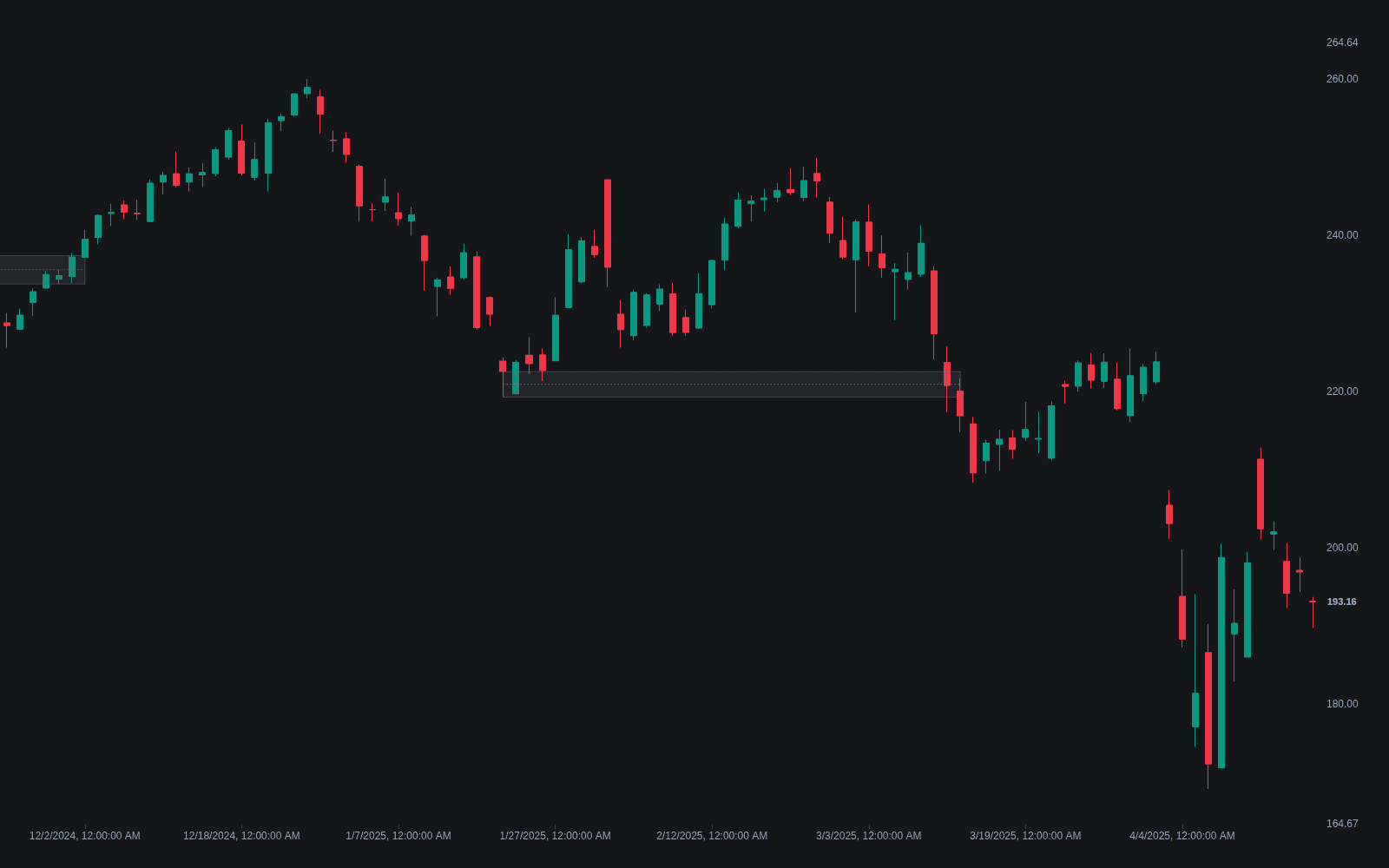
What is a Rejection Block?
A rejection block is the ICT array built from a wick rather than a candle body. When a swing high forms on a long upper wick, typically as the stops resting above an old high get taken, the span from the top of the candle's body to the extreme of the wick is marked as a bearish rejection block. The bullish version mirrors it: a swing low with a long lower wick, marked from the bottom of the body down to the low.
The concept belongs to the ICT catalogue of premium and discount arrays, the framework's inventory of zones price is expected to respect, where it fills the wick-shaped gap in a set otherwise built from bodies and imbalances. Its natural habitat is the aftermath of a raid: an old high swept, a liquidity pool drained, and the wick left behind as the record of who bought the top and got stranded there.
The read is that the wick is where late participants were filled at the worst prices and immediately stranded; if price trades back into that span, those levels may be defended: resistance inside a bearish rejection block, support inside a bullish one. One naming caution: the vacuum block is not a synonym; in ICT vocabulary that name refers to a separate, gap-based array, not a wick zone.
Grading follows the usual SMC logic. A rejection block earns weight from the prominence of its swing, the size of its wick relative to recent bars, the quality of the sweep that produced it, and the company it keeps, a wick zone overlapping a fair value gap or sitting at the right side of the dealing range reads better than one floating alone. Like every array, it is a candidate reaction zone with a defined invalidation, not a promise; wicks get run through like any other level when the flow disagrees.
How to identify a rejection block
The bearish case at a swept high is described; mirror every step for the bullish case at lows.
- 1Find a prominent swing high whose candle (or adjacent candles) printed a long upper wick, ideally the wick that swept an obvious prior high or session extreme.
- 2Mark the zone from the top of the candle body to the wick's extreme; that span is the rejection block.
- 3Wait for the market to leave the area and establish the new direction; the zone is traded on return, not on formation.
- 4Stage entries inside the wick span on the revisit, with the stop just beyond the wick's extreme, the zone's natural invalidation.
- 5Prefer revisits that occur inside a favored time window such as a killzone and agree with higher-timeframe bias.
- 6Treat body acceptance beyond the wick extreme as the failure case: the zone is spent, and the old extreme's role likely flipped.
How traders use it
- As an entry refinement after a sweep: once a liquidity sweep of an old high or low is in, entries are staged inside the wick zone on the return, with the stop just beyond the extreme. The wick gives a tighter band, and a tighter invalidation, than a full-candle zone.
- As a target near old extremes: rather than demanding the exact old high or low trade, profit objectives are trimmed to the near edge of the prior extreme's wick, on the view that a reaction can arrive before the precise level prints.
- As a wick-based cousin of the order block, the same defended-zone logic with different anatomy: the order block uses the body of the last opposite candle at a move's origin, the rejection block uses the wick at a rejected extreme, and some traders use it to tighten entries where a full order block would be too broad.
- In confluence stacks: a rejection block overlapping a fair value gap or the deep end of an optimal trade entry retracement concentrates several of the model's reasons at one price band.
- For framing continuation targets: once the zone holds and the reversal leg runs, standard-deviation projections of the leg that formed the wick give the model its measured objectives.
Rejection Block vs neighboring ICT arrays
Bullish/bearish Order Block: The order block is the body of the last opposing candle at a move's origin; the rejection block is the wick at a refused extreme. One marks where the move launched, the other where the raid died, and the wick version usually offers the tighter zone.
Breaker Block: A breaker is a failed order block reclaimed by the other side, a role-reversal structure. The rejection block involves no failure and reclaim; it is the direct residue of an extreme being rejected, traded from the same side that rejected it.
Fair Value Gap: The FVG is a three-candle imbalance inside a fast leg; the rejection block is a single extreme's wick span. They frequently overlap after a sweep-and-reverse, and the overlap, wick plus imbalance at one band, is exactly what SMC confluence stacking looks for.
Concept family
Smart Money Concepts / ICT
54 concepts mapped · 54 in the Library
Rejection Block FAQ
Turn Rejection Block into a trading strategy.
Take the implementation from this page into Quant, then build on it, backtest it on real data, and keep refining it in conversation.