Concept
Judas Swing
Judas Swing is a Smart Money Concepts / ICT concept. The Library holds 1 implementation, a working definition you can pull into Quant.
Top Judas Swing indicator
The top custom implementation, built on the original standard Judas Swing formula.
1 total
The Judas Swing implementation below can become a backtested trading strategy — describe your rules and Quant writes the code.
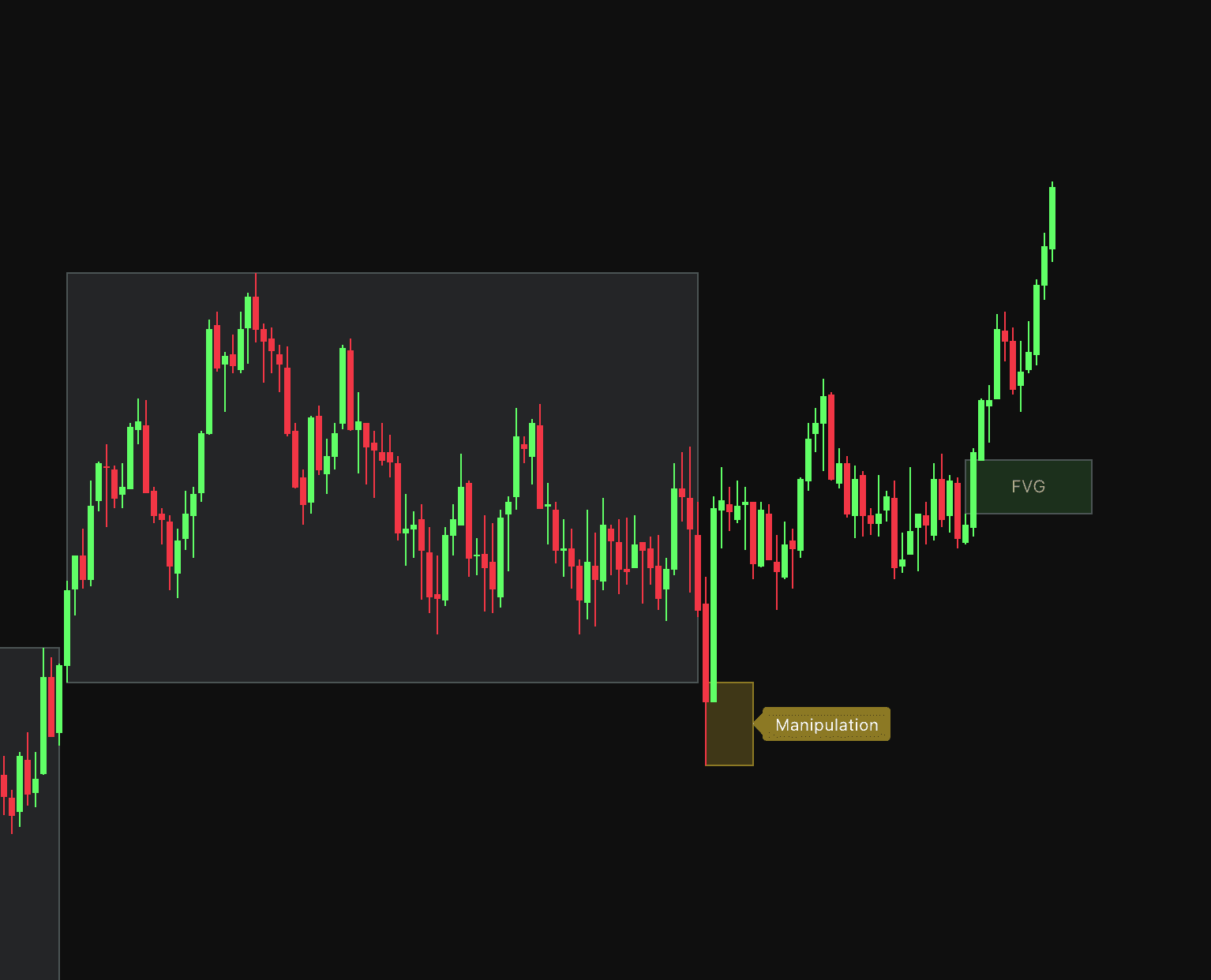
What is a Judas Swing?
A Judas swing is ICT's name for the false move early in a session: a push in one direction, usually shortly after a session open, that runs resting stops before the day's real move develops the other way. The name is the metaphor: the first move betrays the traders who follow it. Mechanically it is a liquidity sweep with a timing claim attached. It occurs in the opening portion of a session, most commonly discussed around the London and New York opens and measured against the midnight New York opening price.
The term comes from Michael J. Huddleston, the mentor behind Inner Circle Trader (ICT), whose price-action framework spread through free video teachings in the 2010s and 2020s. He models the trading day as a template he calls the power of three, or accumulation-manipulation-distribution: a quiet build-up around the open, an engineered false move, then the genuine directional leg. The Judas swing is his name for the middle act, and the label is now standard vocabulary in smart money trading circles.
Within that daily template the Judas swing is the manipulation leg: the session opens, price is pushed to where orders rest, and the true directional move follows once they are filled. Opens give it a reference point, with the midnight New York open serving as the primary time anchor in ICT's framework: in a bullish scenario the Judas leg trades below the open to collect sell stops, leaving price at a discount before the move up, and the bearish version mirrors it above the open.
The raw material is resting orders. Overnight ranges, the prior day's high and low, and session liquidity at obvious extremes mark where stops accumulate, and the Judas swing is the visit that collects them. Timing narrows the search to the London and New York killzones, the opening hours where the model expects engineered moves. What follows matters as much as the sweep: the model wants displacement back through structure before trusting the reversal.
How to identify a Judas swing
The pattern is defined by time, level, and failure, in that order:
- 1Mark the references in advance: the midnight New York open, the session open, the prior day's high and low, and the overnight or Asian extremes from the session ranges.
- 2Wait for the opening window of London or New York; under the model, a midafternoon move does not qualify however it looks.
- 3Watch for an early push through one of the marked levels, the side where stops predictably rest.
- 4Require failure: price rejects beyond the level, then breaks back through short-term structure with displacement, often leaving a fair value gap in the return leg.
- 5Read direction off the open: the bullish version puts in the day's low below the open early, the bearish version the day's high above it.
- 6If price holds beyond the swept level and builds on it, there is no Judas swing, just a trending open that should not be faded.
How traders use it
- As directional framing: once the early move sweeps a session extreme or the overnight range and structure shifts back, the Judas leg defines the side to avoid; in this model the day's bias becomes the opposite direction, with the swept extreme as the invalidation line.
- As an open-relative filter: with a bullish higher-timeframe read, traders look for the Judas move below the midnight or session open and treat longs chased above the open as poorly priced; the mirror applies for shorts.
- As a timing expectation: the pattern is looked for in the first hours of London or New York rather than all day, which keeps a trader from labeling every intraday reversal a Judas swing.
- As an entry framework: rather than chasing the reversal bar, traders wait for the retracement into the displacement leg, commonly an optimal trade entry level or the fair value gap it left, stop beyond the swept extreme.
- As a target map: once the manipulation leg is in, the liquidity pool on the opposite side of the range becomes the draw; some practitioners project the day's reach with standard-deviation projections of that leg.
Judas swing vs related ICT concepts
Liquidity Sweep: The sweep is the general mechanic: a run through a level that fails to hold. The Judas swing is the scheduled special case: a sweep expected near a session open, misdirecting the day's first participants.
Accumulation-manipulation-distribution: AMD is the whole-day template; the Judas swing is only its middle act. Sweeps can be traded without the daily template, but the Judas label only makes sense inside it.
Killzones: Killzones answer when, the Judas swing answers what. The killzone is the window in which the false move is expected; outside it, the same price action does not earn the name.
Concept family
Smart Money Concepts / ICT
54 concepts mapped · 54 in the Library
Judas Swing FAQ
Turn Judas Swing into a trading strategy.
Take the implementation from this page into Quant, then build on it, backtest it on real data, and keep refining it in conversation.