Concept
Breaker Block
Breaker Block is a Smart Money Concepts / ICT concept. The Library holds 5 implementations, each one a working definition you can pull into Quant.
Top Breaker Block indicators
The top custom implementations, built on the original standard Breaker Block formula.
5 total
Any of the 5 Breaker Block implementations below can become a backtested trading strategy — describe your rules and Quant writes the code.
.png&w=3840&q=75)
.png&w=3840&q=75)
What is a Breaker Block?
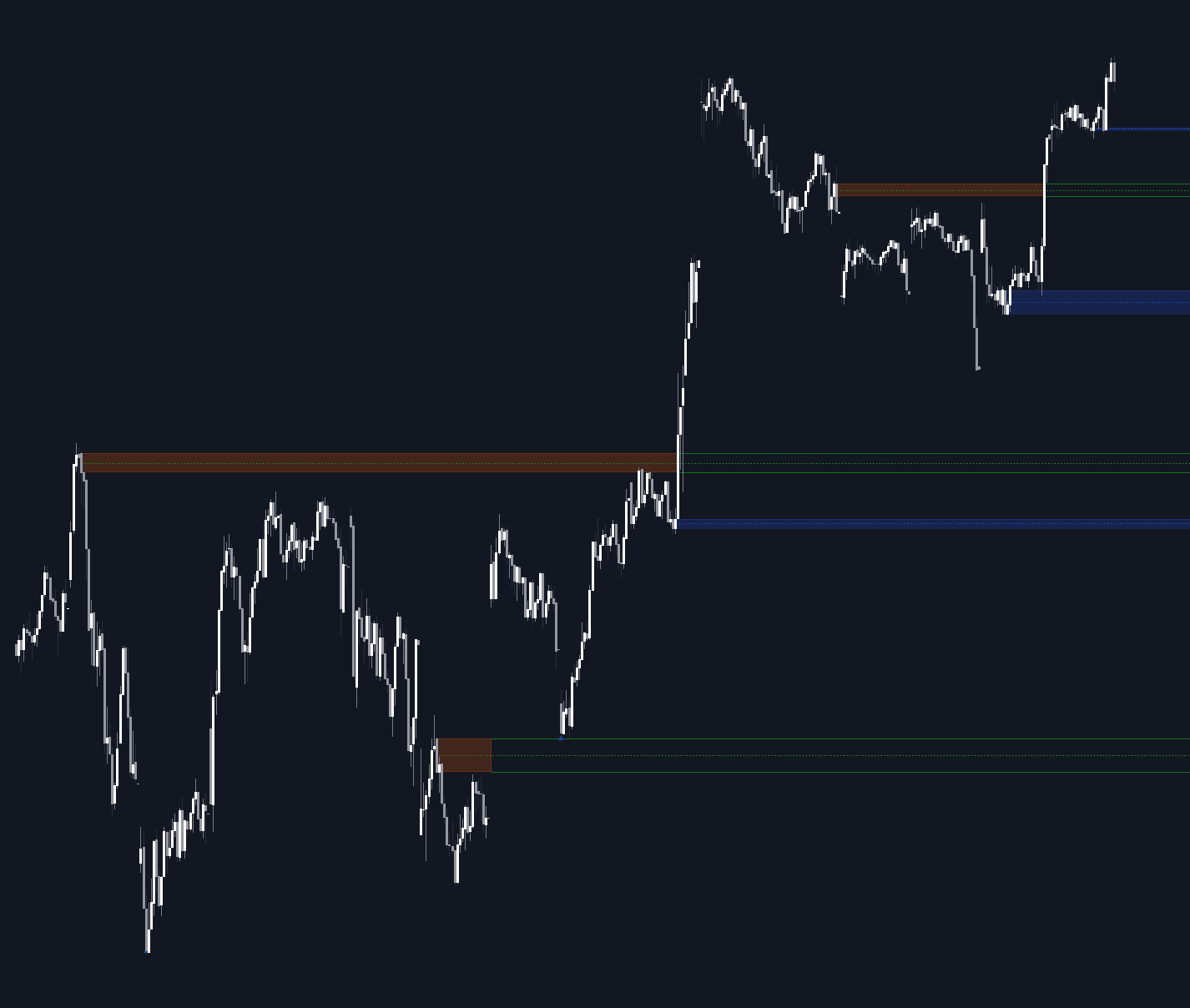
A breaker block is an order block that failed and flipped roles. In the canonical ICT sequence (the bullish case), price runs below a prior low to take out the stops resting there, then reverses and breaks back above the swing high that preceded the run. The down-closing candle or series that drove the failed move lower is the breaker: a former supply zone price has now traded straight through, expected from that point on to act as the opposite polarity (old resistance behaving as support). The bearish breaker mirrors everything: a run above a prior high, a reversal down through the swing low, and the up-closing candles of the failed rally left overhead as resistance.
Two readings circulate, and it helps to know which one a chart marking follows. The strict ICT definition requires the liquidity run: the failing swing must first trade beyond a prior high or low, and that raid is what separates a breaker from a mitigation block, the same role-flip without the stop run. The looser retail reading treats any violated order block as a breaker. Both agree on the core mechanic: a zone one side defended, overrun by the other, which is the Smart Money Concepts version of the classic support-resistance flip.
How to identify a bullish breaker block
The bullish case is described here; mirror every step for a bearish breaker.
- 1Find the raid: price sets a swing low, rallies to a swing high, then sells off through that swing low, a liquidity sweep of the stops beneath it.
- 2Wait for the failure to confirm: price reverses and drives back up through the swing high with real displacement, a break of structure that stamps the down-leg as a failed move.
- 3Mark the breaker: the down-closing candle or series inside that failed leg, typically from its high to its low. Marking conventions vary; some traders use bodies only, others the full range.
- 4Trade the retest, not the break: the zone's job starts when price returns to it from above. A hold suggests the flip is being defended; a clean trade back through the whole zone invalidates the idea.
How traders use it
- As a retest entry after the flip: price returns to the broken zone from the other side and the trader looks for old supply to act as new demand (or the mirror), usually with lower-timeframe confirmation rather than a blind limit order.
- As evidence of control, an order block that fails under displacement is information in itself: the side that built the zone got run over, which supports directional bias the way of the break.
- For stop placement, the far side of the breaker is the natural invalidation; if price trades back through the entire zone, the failed-move logic that justified the trade is wrong.
- In confluence stacks, a breaker overlapping a fair value gap left by the breaking move narrows two zones into one tighter, higher-interest area.
Breaker block vs nearby concepts
Bullish/bearish Order Block: An order block is the zone while it still holds: the last opposing candles before a move, expected to be defended on return. A breaker is what remains after that defense fails: the same candles, opposite polarity, traded from the other side.
Inversion FVG: The same failure-and-flip logic applied to a gap instead of a candle zone: a fair value gap that trades through and then acts as the opposite polarity. Breakers flip order blocks; inversions flip imbalances.
Role Reversal: Classical technical analysis' support-becomes-resistance principle. The breaker is the SMC-specific instance: it names the exact candles to mark and, in its strict form, requires a liquidity run before the flip.
More Breaker Block implementations
Concept family
Smart Money Concepts / ICT
54 concepts mapped · 54 in the Library
Breaker Block FAQ
Turn Breaker Block into a trading strategy.
Take any implementation from this page into Quant, then build on it, backtest it on real data, and keep refining it in conversation.