Concept
PD Arrays
PD Arrays are Smart Money Concepts / ICT concepts. The Library holds 3 implementations, each one a working definition you can pull into Quant.
ordered institutional reference points
Top PD Arrays indicators
The top custom implementations, built on the original standard PD Arrays formula.
3 total
From studying PD Arrays to trading it: take any implementation below into Quant and backtest it instantly.
.png&w=3840&q=75)
.png&w=3840&q=75)
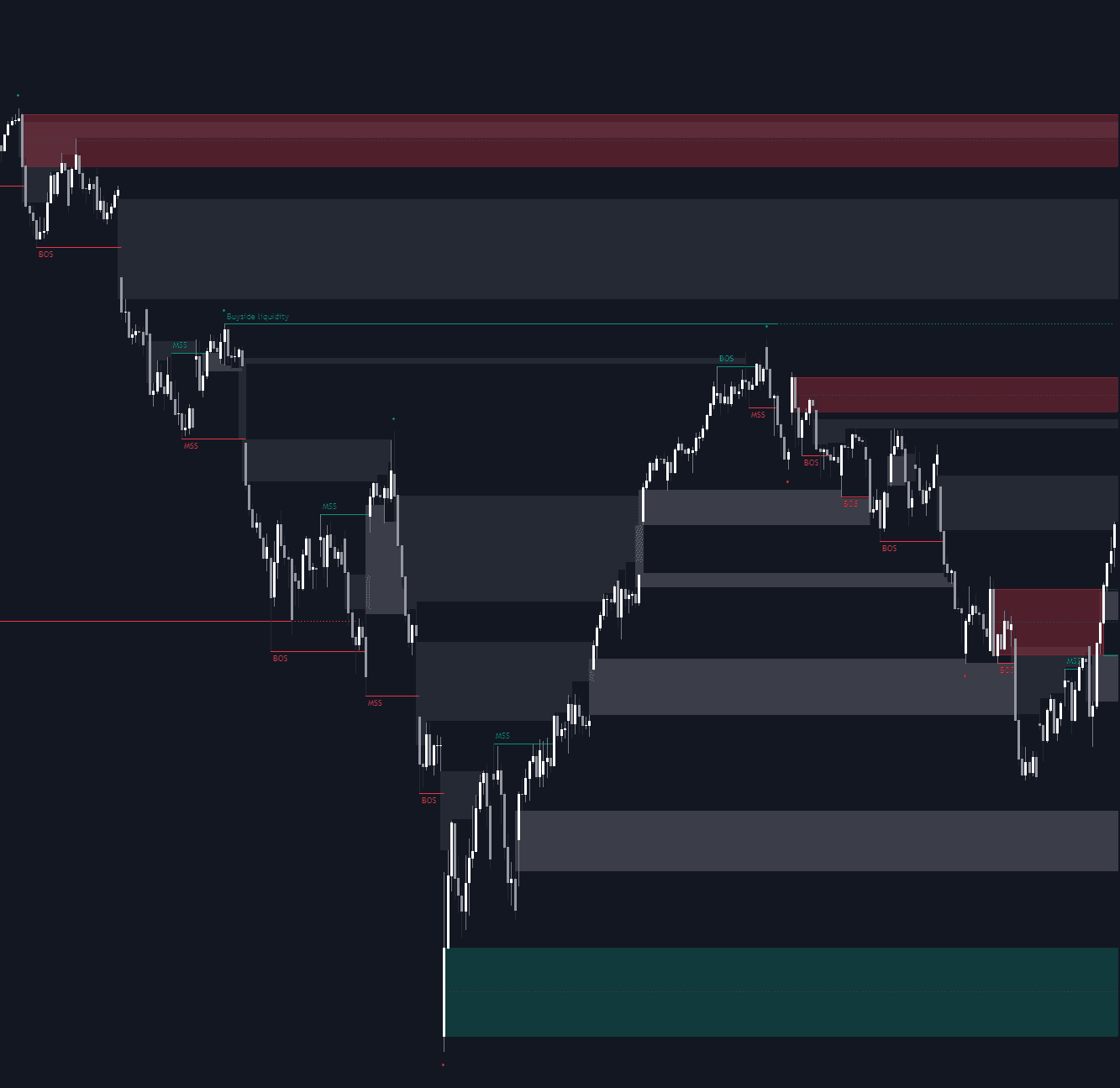
What are PD Arrays?
PD arrays (premium/discount arrays) are ICT's collective name for the reference points a market leaves behind as it trades: old highs and lows, order blocks, fair value gaps, liquidity voids, breakers, mitigation and rejection blocks. "Array" is used in the sense of an ordered arrangement, not a vague zone. Take the dealing range (the swing high and swing low bracketing current price) and split it at equilibrium, the 50% mark: every array then sits in either the premium or the discount half. The claim built into the term is that price is delivered from one institutional reference point to the next, so the arrays in a range read as an ordered ladder of destinations rather than a scatter of zones.
The framework matters because it makes the arrays do two jobs. Ahead of price they are draws (candidate targets ranked by proximity and importance); behind price they are entry inventory (levels to trade from when price returns to them). With a bullish higher-timeframe read, the playbook is to buy from discount arrays and aim at premium arrays, mirrored when bearish. None of it is mechanical certainty: an array is a candidate reaction point, not an obligation, and the commonly cited matrix ordering shifts across different eras of the teaching. The stable core is buy-from-discount, sell-from-premium, and treat untouched arrays as open objectives the market may come back for.
How traders use it
- To structure a dealing range: mark the bounding swing high and low, drop equilibrium at 50%, and inventory the arrays in each half. The output is a ranked map of where price is likely to react on the way up and on the way down, before any trade is considered.
- To locate entries in line with bias: with a bullish read, entries are hunted where price drops into a discount array (an unmitigated order block, an open gap), often refined with the optimal trade entry retracement; premium arrays serve the mirrored role for shorts.
- To set targets: the opposing arrays supply the draw on liquidity. The nearest untapped premium array is a first objective for a long, the range extreme a fuller one, and partials are commonly planned array-to-array rather than at arbitrary distances.
- To align timeframes: a higher-timeframe array (a daily gap or order block) defines the zone worth trading, and the lower-timeframe arrays that form inside it refine the actual entry, keeping execution and narrative on the same map.
PD arrays vs nearby concepts
Premium & Discount: Premium/discount is the frame: the halving of the dealing range at equilibrium. PD arrays are the contents: the specific reference points sitting inside each half. You can read premium versus discount with no arrays marked at all; the arrays tell you where within each half a reaction is actually expected.
Optimal Trade Entry: OTE is one specific entry technique, a retracement into the 62–79% zone of an impulse leg. PD arrays are the whole catalog of levels, and an OTE is generally considered strongest when it lands on one of them. One is a measurement; the other is the inventory it's checked against.
Supply & Demand Zones: Supply and demand zones come from a different school and are drawn more loosely around areas price departed from. PD arrays are a stricter taxonomy: named structures with defined anatomy, explicitly ranked within a premium/discount split. The chart areas often overlap; the classification and the rules attached don't fully match.
Concept family
Smart Money Concepts / ICT
54 concepts mapped · 54 in the Library
PD Arrays FAQ
Turn PD Arrays into a trading strategy.
Take any implementation from this page into Quant, then build on it, backtest it on real data, and keep refining it in conversation.