Concept
Unicorn
Unicorn is a Smart Money Concepts / ICT concept. The Library holds 1 implementation, a working definition you can pull into Quant.
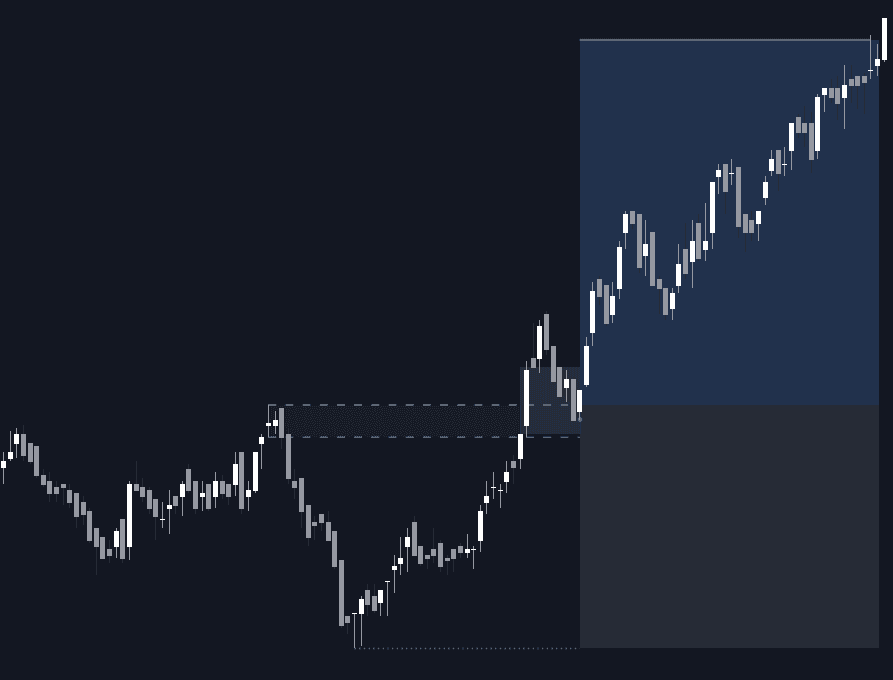
breaker + FVG overlap
Top Unicorn indicator
The top custom implementation, built on the original standard Unicorn formula.
1 total
The Unicorn implementation below can become a backtested trading strategy — describe your rules and Quant writes the code.
What is the Unicorn?
The unicorn is an ICT entry model defined by one specific confluence: a breaker block overlapping a fair value gap. The sequence that builds it runs sweep, shift, overlap: price runs a swing level (creating the trapped positions a breaker is made of), then a displacement, an energetic push through structure in the opposite direction, leaves a gap sitting on top of the breaker candles. The slice of chart where the two zones coincide is the unicorn zone, and the model treats a return to that slice as a higher-interest entry than either element alone.
The appeal of the overlap is that two distinct reasons to react occupy one price: the breaker marks where trapped traders' exits turn into fuel, and the gap marks one-sided delivery the market may come back to rebalance. Like most ICT constructs the pattern is fractal, and it is a template, not a promise: unicorn zones do get traded straight through, so the model is normally taken with time-of-day and higher-timeframe context rather than on the overlap alone.
The name and template come from Michael J. Huddleston, who teaches as the Inner Circle Trader (ICT) and presents the confluence as the Unicorn Model within his vocabulary of order blocks, liquidity, and delivery. In that framework the sequence reads as engineered: the liquidity sweep collects stops parked at an obvious liquidity pool, and the displacement that follows reveals which direction larger participants intended. The unicorn zone is the most surgical place to join that revealed intention.
ICT teaching is time-sensitive as well as price-sensitive, so the model is usually run inside preferred windows such as the London and New York killzones, with ICT time anchors framing when a sweep-and-shift sequence is most likely genuine. The overlap idea itself is scale-free, working from a one-minute raid on session liquidity to a daily-chart run on an old low; the timeframe changes the zone's size, not its meaning.
How to Identify a Unicorn Setup on a Chart
The bullish sequence is described; mirror it for the bearish version.
- 1Start with the sweep: price trades below an obvious prior low, collecting the sell-side liquidity resting there, then recovers above it.
- 2Demand displacement: the recovery must break a prior swing high with energetic candles that leave a fair value gap; a grinding recovery does not qualify.
- 3Mark the breaker: the bearish candles that carried price down into the sweep, which the displacement has now closed back through.
- 4Draw both zones and keep only their intersection; if they do not overlap, you have two separate ideas, not a unicorn.
- 5Wait for the retrace into the overlap, ideally inside a favored session window, and treat a decisive close through the breaker's far side as invalidation.
How traders use it
- As a refined entry after a structure shift: wait for a swing to be swept and for displacement to break structure, then set a limit order inside the breaker-gap overlap, with the stop beyond the breaker's far extreme or the swept swing itself.
- As a quality filter on breaker trades: some traders only take breakers that carry an overlapping gap, using the unicorn criterion to discard breakers formed without real displacement.
- As a nested reference in the path of a trade: an opposing unicorn zone left on a higher timeframe is a natural candidate for a reaction, so trades running toward one often use it as a take-profit reference.
- As part of the session narrative: the model slots into the accumulation-manipulation-distribution template with the sweep as the manipulation leg, so traders framing sessions that way want the raid landing where that phase belongs, not at a random hour.
- As one of several post-sweep entries: it competes with the optimal trade entry retracement for the same trade, and when the breaker-gap overlap sits inside that band, many practitioners treat the agreement as added confluence.
Unicorn vs Related ICT Concepts
Breaker Block: A breaker on its own marks where trapped traders' exits should appear, with no gap required. The unicorn insists the breaker carry an overlapping fair value gap born of displacement, narrowing the entry zone and screening out breakers formed without real force.
Fair Value Gap: A fair value gap is any three-candle imbalance, and they appear constantly at every scale. The unicorn uses only gaps carved by the displacement that follows a sweep and shifts structure, anchoring the imbalance to a breaker so the zone carries structural context, not raw imbalance alone.
Optimal Trade Entry: Optimal trade entry defines the entry as a retracement band, roughly the 62-79% pullback of the impulse. The unicorn defines it structurally as the breaker-gap overlap, wherever that sits. On clean sequences the two coincide.
Concept family
Smart Money Concepts / ICT
54 concepts mapped · 54 in the Library
Unicorn FAQ
Turn Unicorn into a trading strategy.
Take the implementation from this page into Quant, then build on it, backtest it on real data, and keep refining it in conversation.