Concept
One-shot-one-kill
One-shot-one-kill is a Smart Money Concepts / ICT concept. The Library holds 1 implementation, a working definition you can pull into Quant.
Top One-shot-one-kill indicator
The top custom implementation, built on the original standard One-shot-one-kill formula.
1 total
This One-shot-one-kill implementation is strategy-ready: open it in Quant, set your rules, and it backtests automatically.
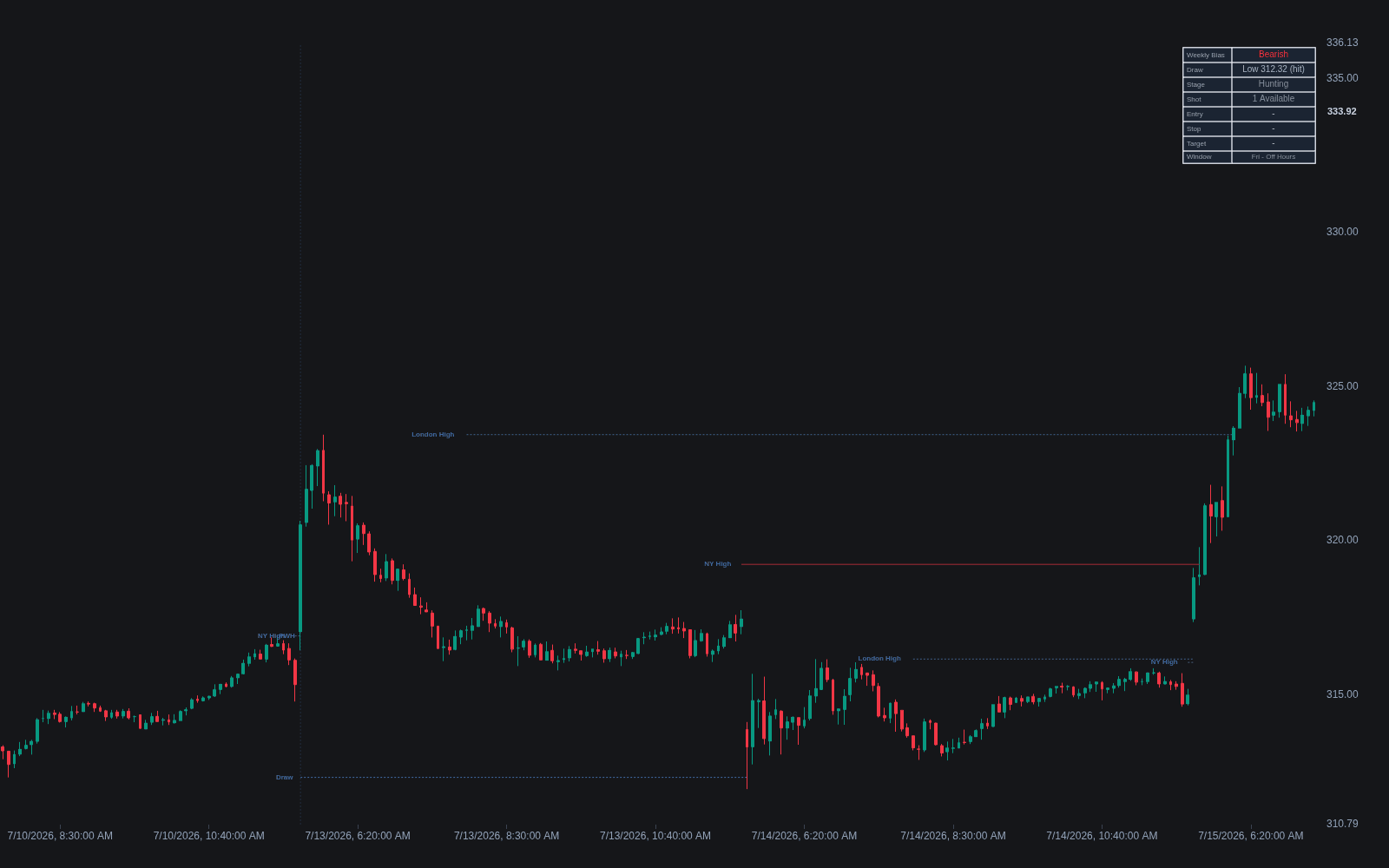
What is One-shot-one-kill?
One Shot One Kill (OSOK) is an ICT weekly-range model built on sniper discipline: frame one directional idea for the week, take one precision entry, and stand down. The trader sets a weekly bias from higher-timeframe levels, waits for the week's low (in a bullish week) or high (in a bearish week) to form, anticipated Monday through Wednesday and often during the London session, then enters on an optimal trade entry retracement inside a killzone, targeting the far side of the projected weekly range.
The name and template come from Michael J. Huddleston, the Inner Circle Trader, whose early mentorship and forum-era material framed OSOK as the cure for overtrading: a sniper fires once. It predates ICT's later, tightly specified releases such as the 2022 model, so no canonical rulebook exists and students reconstruct it with different confirmation tools. The versions share a skeleton: weekly bias, day-of-week timing for the weekly extreme, session timing for the entry, single execution.
The setup leans on the standard ICT stack. The weekly extreme is expected to arrive as a liquidity sweep of an obvious pool of resting orders, often the prior week's low or a build-up of session liquidity, mirroring the manipulation phase of the accumulation-manipulation-distribution template at weekly scale. Displacement away from the sweep shifts lower-timeframe structure and leaves the entry inventory behind: a fair value gap or order block inside the retracement zone.
The model is as much about frequency as tactics: one quality fill per week instead of many marginal ones. A missed window means a flat week, not a downgraded setup, which is the discipline the name encodes. Targets sit at the far side of the anticipated weekly range, sometimes refined with standard-deviation projections off the manipulation leg; the stop belongs beyond the weekly extreme, because the idea is wrong if that level trades again.
How to spot an OSOK setup on a chart
The checklist runs from the weekly chart down to execution timeframes.
- 1Set the weekly bias from the weekly and daily charts, anchored to the nearest draw: an old high or low, or an unfilled imbalance the week could plausibly reach.
- 2Mark the resting liquidity opposite that bias: the prior week's low in a bullish week, plus the early-week ICT session ranges whose extremes collect stops.
- 3Watch Monday through Wednesday, London especially, for a raid through one of those levels that fails to hold; that failure is the candidate weekly extreme.
- 4Demand displacement, a fast structure-shifting move away from the raid that ideally leaves an imbalance, before assuming the extreme is in.
- 5On 5- to 15-minute charts, wait for the retracement into the 62-79% zone of the displacement leg and take the single entry where it overlaps the gap or block left behind.
How traders use it
- As a weekly campaign template: bias is set on the weekly and daily charts, and execution drops to intraday timeframes only after the projected weekly extreme appears to be in.
- As a frequency discipline: the one-trade constraint filters out mid-week chop, overtrading and revenge entries; a missed shot means a flat week, not a chase.
- As a management frame: the target is the weekly objective, so intraday pullbacks are held through rather than managed reactively, and the stop belongs beyond the weekly extreme that defines the idea.
- As a time-and-price filter: the entry is honored only where retracement level, premium or discount location, and session window agree; many practitioners execute strictly inside London or New York.
- As a training regimen: with at most one trade per week every decision is reviewable in full, so some traders adopt OSOK temporarily to rebuild patience before returning to higher-frequency ICT models.
One-shot-one-kill vs related ICT concepts
Optimal Trade Entry: OTE is the entry technique: the 62-79% retracement zone that prices the single shot. OSOK is the campaign around it, dictating weekly bias, the days and sessions to hunt, and the one-trade limit that names the model.
Accumulation-manipulation-distribution: AMD describes the engineered sequence of quiet build-up, false move, then real delivery on any timeframe. OSOK is that sequence pinned to the weekly range: the manipulation is expected early in the week, and the distribution leg is the trade.
Killzones: Killzones are standing time-of-day windows shared by all ICT models. OSOK uses them as a filter: the weekly extreme and the entry are both expected inside one, usually London or New York, narrowing the week to a handful of tradable hours.
Concept family
Smart Money Concepts / ICT
54 concepts mapped · 54 in the Library
One-shot-one-kill FAQ
Turn One-shot-one-kill into a trading strategy.
Take the implementation from this page into Quant, then build on it, backtest it on real data, and keep refining it in conversation.