Concept
Order Block Anatomy & Refinement
Order Block Anatomy & Refinement, also known as wick vs body, mitigation/invalidation rules, stacking, last opposing candle, is a Smart Money Concepts / ICT concept. The Library holds 2 implementations, each one a working definition you can pull into Quant.
Top Order Block Anatomy & Refinement indicators
The top custom implementations, built on the original standard Order Block Anatomy & Refinement formula.
2 total
Want to trade Order Block Anatomy & Refinement? Any of the 2 implementations below is one prompt away from a backtested strategy in Quant.
.png&w=3840&q=75)
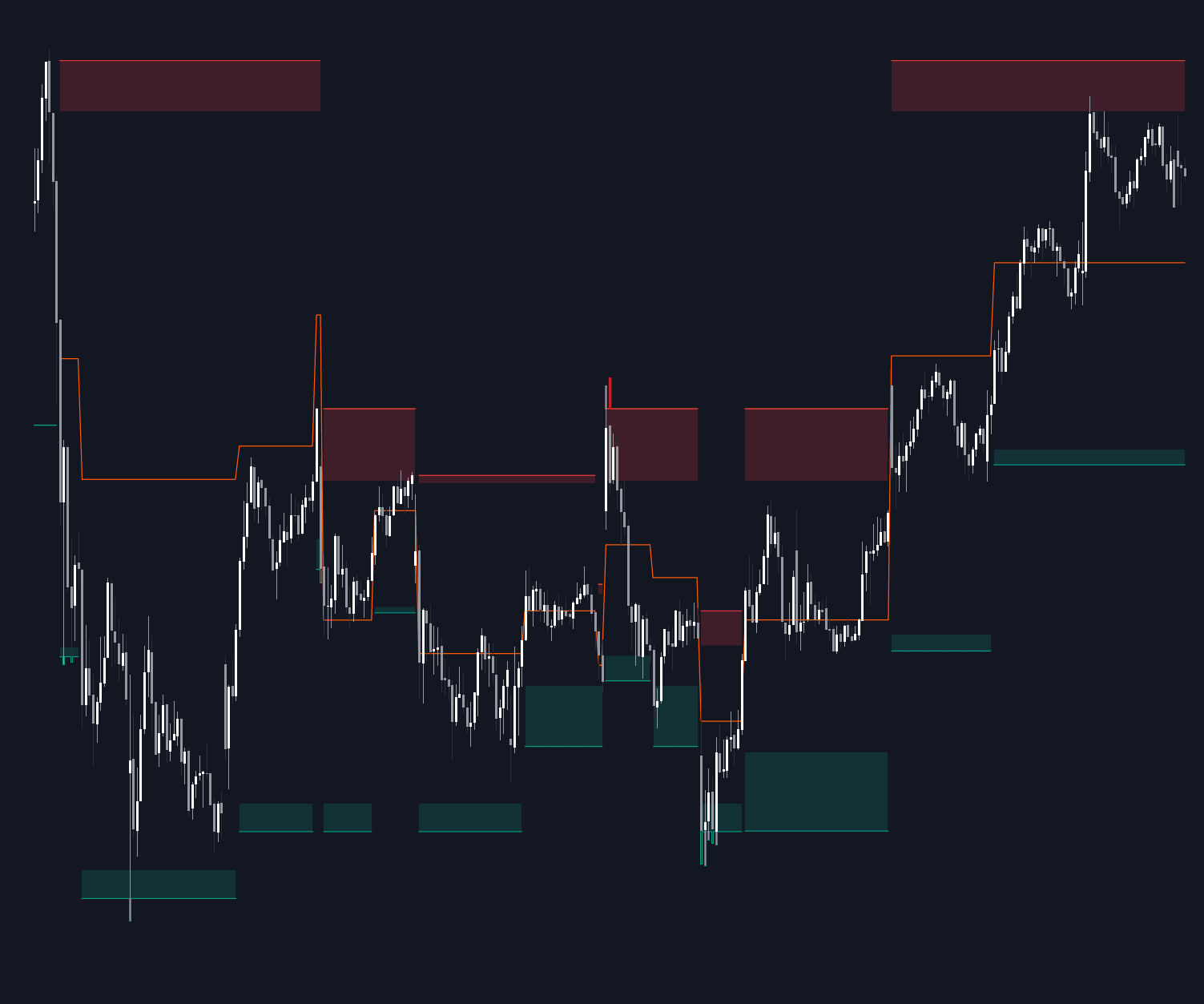
What is Order Block Anatomy & Refinement?
An order block is the last opposing candle before a displacing move (the final down candle before an impulsive rally, or the final up candle before a markdown), read as the footprint of the orders that launched the move (hence the older nickname "institutional candle"). Anatomy and refinement is the rules layer on top of the base bullish or bearish order block definition: exactly which prices bound the zone (the full range including wicks, or bodies only), which candle qualifies when several opposing candles stack together, and what must happen next (displacement away, ideally breaking structure or leaving a fair value gap) for the zone to be worth keeping.
The refinement half is lifecycle management, and conventions genuinely differ here. A block is commonly called mitigated once price has returned and traded into it (used once, and downgraded on later visits), and invalidated once price closes through its far side, at which point many traders re-label it a breaker block rather than deleting it. Popular filters: mark the block's 50% line (its mean threshold) and prefer entries in the deeper half; favor blocks whose formation followed a liquidity sweep of a prior high or low; merge stacked opposing candles into one zone; and rank fresh, untested blocks above mitigated ones. None of this is standardized: treat the rules as filters to test, not laws.
How to mark an order block precisely
The base pattern is quick to spot; the refinement is in the bounds you choose and the disqualifiers you enforce.
- 1Work backward from the move: find a displacement leg first (an impulsive run that breaks a swing point or leaves an imbalance), and only then look for the candle that launched it.
- 2Select the last opposing candle before that leg. When several opposing candles sit together, either take the one nearest the move's origin or merge the cluster into a single zone; pick one convention and keep it.
- 3Set the bounds: wick-to-wick is the widest honest zone; bodies-only is tighter but misses more touches. A common hybrid plans entries off the body while keeping the wick extreme as invalidation, with the 50% line marked as the mean threshold.
- 4Enforce the lifecycle: skip candles with no real displacement away, downgrade a block after its first mitigation, and retire it (or re-read it as a breaker) once price closes through the far side.
How traders use it
- As zone-construction rules: wick-to-wick bounds for the conservative zone, body bounds for precision, and the 50% mean threshold as the line separating a shallow test from a deep one.
- As a qualification filter: requiring genuine displacement away from the candle, and in stricter models a sweep of nearby liquidity just before the block formed, so ordinary pullback candles don't get promoted into zones.
- As entry refinement: dropping to a lower timeframe inside a higher-timeframe block to locate a smaller block or imbalance, tightening the stop while keeping the higher-timeframe context intact.
- As lifecycle bookkeeping: fresh, unmitigated blocks ranked above tested ones, mitigated blocks traded with reduced confidence, and invalidated blocks re-read as breaker candidates instead of support.
Order block refinement vs neighboring zone concepts
Bullish/Bearish Order Block: The base concept: what an order block is and which way it points. This page is the layer on top: how to bound the zone, qualify it, and retire it.
Breaker Block: Not a different drawing but a different state: an order block price has closed through, re-read in the opposite role. Refinement rules decide exactly when that re-label happens.
Supply & Demand Zones: The same chart real estate under a different grammar: zones drawn from basing-and-departure behavior, without the last-opposing-candle rule or the mitigation vocabulary.
Concept family
Smart Money Concepts / ICT
54 concepts mapped · 54 in the Library
Order Block Anatomy & Refinement FAQ
Turn Order Block Anatomy & Refinement into a trading strategy.
Take any implementation from this page into Quant, then build on it, backtest it on real data, and keep refining it in conversation.