Concept
Draw on Liquidity
Draw on Liquidity is a Smart Money Concepts / ICT concept. The Library holds 1 implementation, a working definition you can pull into Quant.
DOL
Top Draw on Liquidity indicator
The top custom implementation, built on the original standard Draw on Liquidity formula.
1 total
This Draw on Liquidity implementation is strategy-ready: open it in Quant, set your rules, and it backtests automatically.
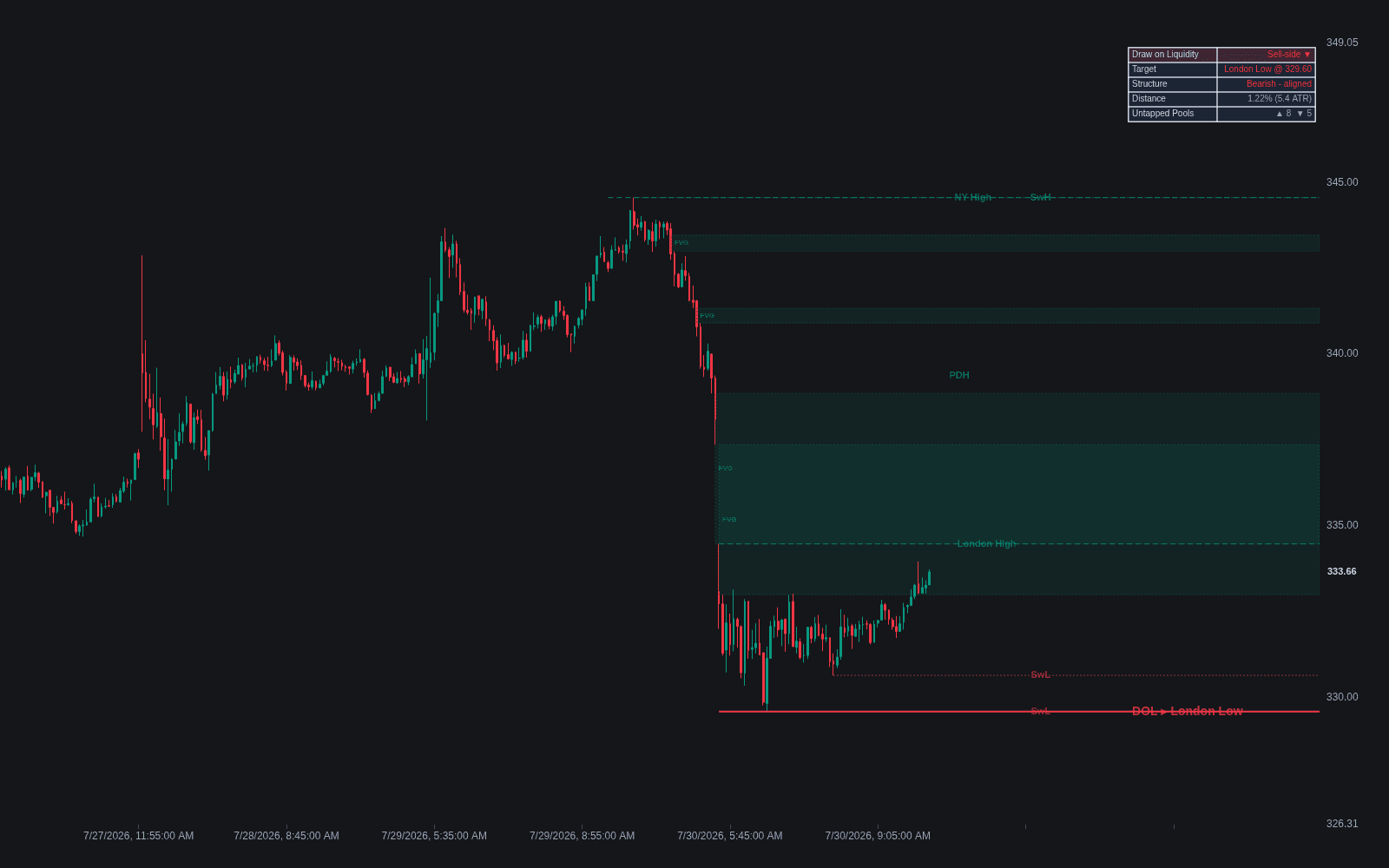
What is the Draw on Liquidity?
The draw on liquidity (DOL) is the level a market is currently reaching for: the pool of resting orders acting as the magnet for price delivery. In the ICT/SMC reading, price is always doing one of two things (seeking liquidity or rebalancing an inefficiency), so at any moment there is a working answer to "what is price drawing toward?" Buy-side liquidity resting above old and equal highs makes the draw higher; sell-side liquidity below lows makes it lower; an unfilled gap or void can play the same magnet role.
Naming the DOL puts the target before the entry, which is the point: bias flows from where the draw sits, and setups are only taken in its direction. It is a hypothesis rather than a fact (pools get partially taken, rejected short of, or blown through), so the read is rebuilt whenever a candidate pool is traded into or convincingly refused.
The candidate hierarchy has structure. External liquidity, the stops resting beyond range extremes and old highs or lows, competes with internal liquidity, the unfilled fair value gaps and imbalances inside the range, and ICT doctrine holds that delivery alternates between them: external taken, price rotates to internal; internal rebalanced, price reaches for external. Higher-timeframe pools outrank lower ones, engineered pools under equal highs or lows rank above single swing points because more orders congregate at obvious levels, and freshness matters, an untapped weekly extreme being a stronger magnet than one already probed.
The session workflow makes the concept operational. Pre-market, the candidates are inventoried and one working draw is named; the accumulation-manipulation-distribution template then predicts the path's shape, a manipulation leg against the draw before delivery toward it, with timing concentrated in the killzones. Visual tools like liquidity magnet and gravity-map studies render the candidate pools, and daily-bias indicators automate the inventory. The honest constraint is discipline: the DOL is a falsifiable hypothesis, and treating a refused draw as refuted rather than delayed is what separates the framework from confirmation bias.
How to identify the draw on liquidity
The read is an inventory, a ranking, and a standing willingness to be wrong.
- 1Inventory the pools on both sides: prior day, week and session highs and lows, equal highs or lows, and unfilled gaps or voids.
- 2Rank by timeframe and freshness: untapped higher-timeframe extremes and engineered equal-extreme pools outrank single intraday swings.
- 3Check structure agreement: the working draw should sit in the direction the higher-timeframe structure is already delivering.
- 4Name one working draw and let it set the session's bias; setups against it are skipped rather than argued with.
- 5Define the reassessment triggers in advance: the draw being swept, a hard rejection short of it, or a scheduled release that repositions the map each force the inventory to be rebuilt.
How traders use it
- As the daily bias driver: before the session, candidates are listed (prior day, week, and session highs/lows, untouched equal highs or lows, open gaps), and the nearest compelling pool in line with higher-timeframe structure sets the direction traded that day; setups against the draw are skipped.
- As the target of a setup: entries from other tools (order blocks, gaps, sweeps) are aimed at the current draw, with exits planned into the pool rather than beyond it, since delivery frequently stalls once the liquidity is taken.
- As a tripwire for re-evaluation. When the draw is reached, the question resets: does price displace through and re-price toward the next pool, or reject and flip the draw to the opposite side? Either answer restructures the session's plan.
- Through the internal-external alternation: after an external pool is purged, the next draw is often the unfilled imbalance back inside the range, and vice versa, a rotation that keeps the target list from going stale.
- Within the session template: the manipulation leg of the daily model runs against the draw first, so a sweep opposite the named DOL early in a killzone reads as the setup forming rather than the thesis failing.
Draw on liquidity vs related liquidity concepts
Liquidity Pool: Pools are the objects: every stack of resting orders beyond an obvious level. The draw is the selection: which pool currently governs delivery. A chart has many pools and, in this framework, one working draw at a time.
Session Liquidity: Session liquidity names the intraday candidate set, the highs and lows of Asia, London and New York that accumulate stops. The DOL framework ranks that set against higher-timeframe pools and picks the operative target, which may well be a weekly level no session chart shows.
Liquidity Sweep: The sweep is the event of a pool being taken; the draw is the designation of which pool the market is working toward. Sweeps against the draw are manipulation in this reading, sweeps of the draw itself are completion, and telling them apart is the whole game.
Concept family
Smart Money Concepts / ICT
54 concepts mapped · 54 in the Library
Draw on Liquidity FAQ
Turn Draw on Liquidity into a trading strategy.
Take the implementation from this page into Quant, then build on it, backtest it on real data, and keep refining it in conversation.