Concept
Two-bar Reversal
Two-bar Reversal is a Chart & Candlestick Patterns concept. The Library holds 2 implementations, each one a working definition you can pull into Quant.
Top Two-bar Reversal indicators
The top custom implementations, built on the original standard Two-bar Reversal formula.
2 total
Every Two-bar Reversal implementation here is strategy-ready: open one in Quant, set your rules, and it backtests automatically.
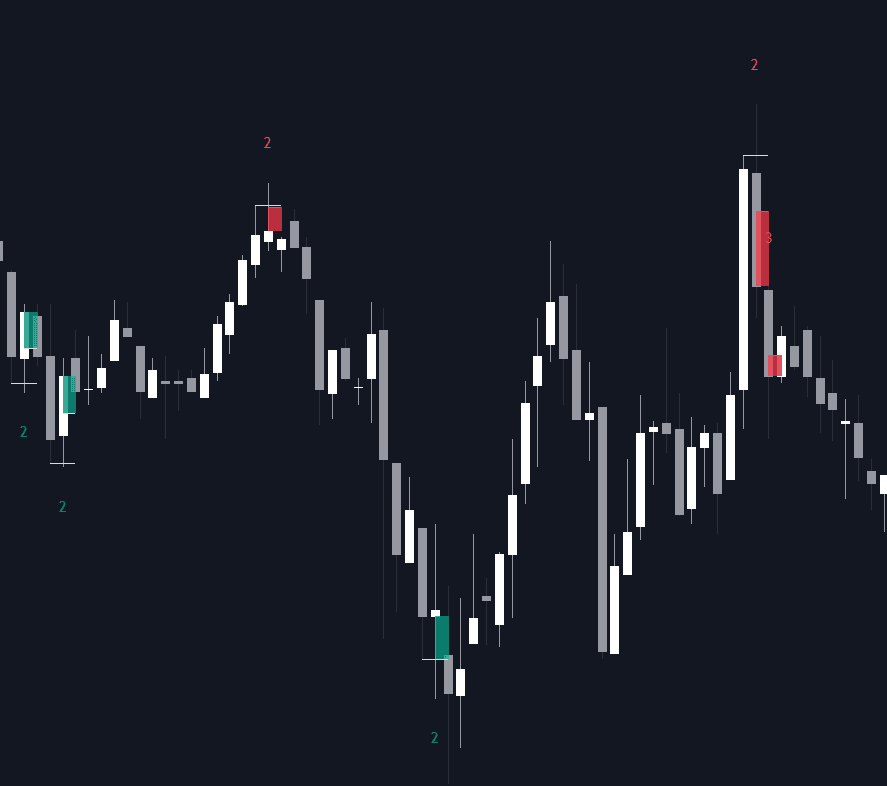
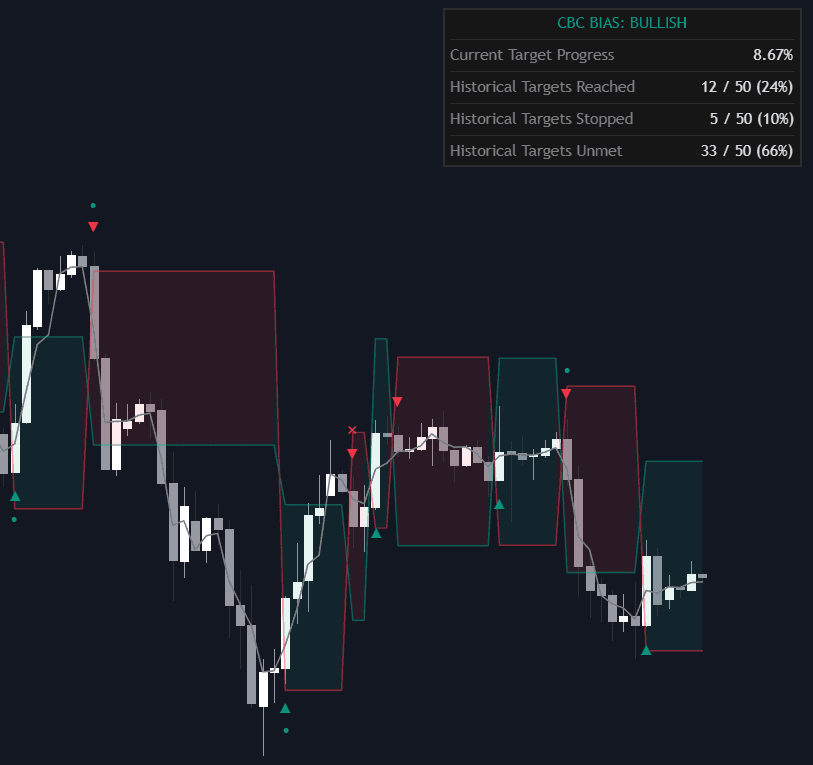
What is a Two-bar Reversal?
A two-bar reversal is a pair of consecutive, comparably strong bars that close at opposite ends of their ranges. At a low, a wide bear bar closing near its bottom is followed immediately by a wide bull bar closing near its top, retracing most or all of the first bar's ground; the bearish version mirrors this at highs. Together the two bars paint a V at the extreme: full commitment one way, then full commitment the other.
The formation is one of the one- and two-bar setups of classic bar-chart analysis, with Martin Pring's treatment among the better known. Pring lists what separates a meaningful print from routine chop: a preceding trend worth reversing, two bars noticeably wider than their neighbors, each approaching a wide-range bar, and closes near each bar's opposite extreme, ideally with expanding activity on the second. Al Brooks's price-action writing treats the same structure as a standard reversal unit at swing extremes.
The pattern's information is the trap. Anyone who sold the first bar's strong close is underwater within one bar, and their exits help fuel the reversal. Merged into a single candle on double the timeframe, the pair typically collapses into a pin bar or hammer, a useful cross-check that the two readings agree.
In candlestick vocabulary the same two bars often answer to other names. Depending on how far the second close carries, a bullish two-bar reversal can match the piercing line (a close above the midpoint of the first candle's body) or a bullish engulfing (a close beyond that body entirely), and the morning star is the same idea with a pause candle between the two committed ones. What the two-bar reversal adds to the broader catalogue of candlestick patterns is symmetry: both bars must be genuinely strong, so the print reads as an outright failure of one side rather than a hesitation.
How to Identify a Two-bar Reversal on a Chart
Steps describe the bullish version at a low; invert them for a high.
- 1Establish location first: an extended down leg, a test of a prior low, or a stop-run through an obvious level; without something to reverse, the shape is two-way traffic.
- 2Find a wide bear bar that closes in the bottom quarter of its range and is clearly larger than the bars around it.
- 3The next bar should open near the first bar's close, trade comparably wide, and finish in its top quarter, recovering most or all of the first bar's decline.
- 4Downgrade the signal if either bar is small, if the second closes mid-range, or if it is merely an inside bar never threatening the first bar's open.
- 5Set the trigger and invalidation: enter on a break of the second bar's high, with the stop beyond the lower of the two lows.
How traders use it
- As a reversal trigger at extremes: the pattern is traded at swing highs and lows, tested levels, or after a stop-run through a prior extreme; the common trigger is a break of the second bar's high (bullish case) with the stop beyond the pattern's opposite end.
- As a climax read after extended moves: a two-bar reversal at the end of a stretched, accelerating leg suggests the last sellers were absorbed at the low, while mid-range prints of the same shape carry far less information.
- As a strength gauge: the more of the first bar the second bar retraces, and the closer both closes sit to their opposite extremes, the cleaner the read; a second bar that closes mid-range downgrades the pattern.
- As a scanner cross-reference: many two-bar reversals also register as engulfing or outside bar signals, so scanners may flag one event under several names; quality still comes down to genuine range and committed opposite closes.
- As the rejection leg inside larger traps: the sequence powers failure patterns such as the hikkake, where the break of a small consolidation immediately reverses, turning trapped breakout traders into fuel.
Two-bar Reversal vs Similar Patterns
Engulfing Bar: An engulfing bar must wrap the prior bar's entire range and close beyond it. A two-bar reversal only demands two comparably strong bars with opposite committed closes, so each pattern catches prints the other misses.
Pin Bar: A pin bar compresses the rejection into one candle: long tail, small body. The two-bar reversal spreads the same auction event across two full-bodied bars and collapses into a pin-bar shape when merged on a doubled timeframe.
Morning Star: The morning star inserts a small pause candle, often a doji, between the committed down and up candles. It describes a gentler three-step turn, while the two-bar reversal is the abrupt, no-hesitation version.
Concept family
Chart & Candlestick Patterns
84 concepts mapped · 84 in the Library
Two-bar Reversal FAQ
Turn Two-bar Reversal into a trading strategy.
Take any implementation from this page into Quant, then build on it, backtest it on real data, and keep refining it in conversation.