Concept
Decycler
Decycler, also known as decycler oscillator, is a Statistics concept. The Library holds 1 implementation, a working definition you can pull into Quant.
Top Decycler indicator
The top custom implementation, built on the original standard Decycler formula.
1 total
This Decycler implementation is strategy-ready: open it in Quant, set your rules, and it backtests automatically.
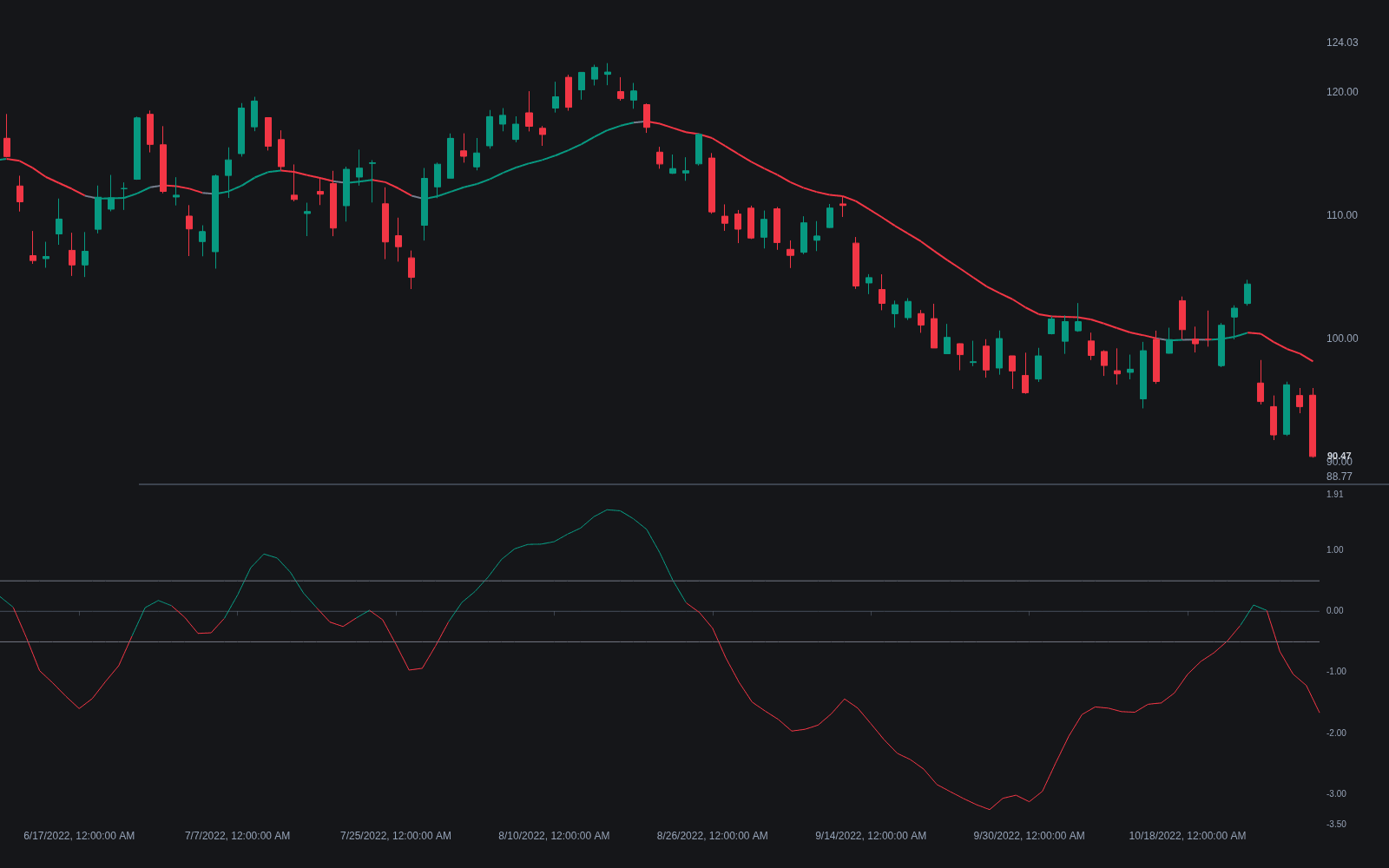
What is a Decycler?
The decycler is a smoothing filter introduced by John Ehlers in Cycle Analytics for Traders (2013). The idea is subtraction rather than averaging: run a high-pass filter to isolate the short-period cycle content of price, then subtract that output from price itself. What remains is everything slower than the chosen cutoff, the trend and long swings, with the cycle chatter removed. Because the subtraction is exact, the decycler tends to hug price more closely than a moving average of comparable smoothness.
Traders care because conventional smoothing buys noise reduction with lag. A long EMA is smooth but arrives late; a short one is timely but jittery. The decycler attacks the problem from the frequency side: instead of averaging everything, it removes only the components shorter than the cutoff period, so the slow components pass through with very little delay. In trending markets the result is a smooth line that often turns close to where price actually turns.
A companion construction, the decycler oscillator, takes the difference between two decyclers (or high-pass filters) with different cutoffs and plots it as an oscillator around zero. Crossings and slope changes of that difference are used as trend-change signals. Both tools sit in the Ehlers DSP toolbox alongside the Ehlers SuperSmoother and the roofing filter, which approach the same noise problem from complementary directions.
How it's calculated
Ehlers defines the simple decycler as price minus a high-pass filter of price. Algebraically this reduces to a one-pole smoothing recursion:
The decycler oscillator variant plots the difference between two decyclers or high-pass filters with different cutoffs, often expressed as a percentage of price.
Some published versions use a second-order high-pass filter; the shape is similar but the exact coefficients differ.
How traders use it
- As a trend baseline: price holding above a rising decycler is treated as an uptrend, below a falling one as a downtrend, with the line acting as dynamic support or resistance in the same way traders use a long moving average but with less lag.
- Decycler oscillator crossings of zero, or of a signal band, are used as trend-change triggers; some implementations pair a fast and a slow version and act on their agreement.
- As a pre-filter: removing cycle content before feeding price into other studies can reduce whipsaw in downstream signals, similar in spirit to how the roofing filter conditions data for oscillators, but keeping the low frequencies instead.
- Its limitation is the mirror of its strength: because it deliberately discards cycle-period swings, it is a poor tool for timing entries inside a trading range, and the cutoff period still has to be chosen, often guided by dominant cycle measurement.
Decycler vs related concepts
Ehlers SuperSmoother: The SuperSmoother is a low-pass filter that attenuates high frequencies directly; the decycler reaches a similar goal by subtracting a high-pass output from price, which tends to preserve the trend component with even less lag at long cutoffs.
Roofing Filter: The roofing filter keeps the middle band of frequencies for cycle trading and discards the trend; the decycler does the opposite, keeping the trend and discarding the cycles.
EMA: An EMA smooths by weighting all past prices, which delays every component; the decycler removes only the fast components, so slow moves come through with noticeably less delay than an EMA of similar smoothness.
Concept family
Statistics
46 concepts mapped · 46 in the Library
Decycler FAQ
Turn Decycler into a trading strategy.
Take the implementation from this page into Quant, then build on it, backtest it on real data, and keep refining it in conversation.