Concept
Change-point Detection
Change-point Detection, also known as CUSUM, is a Statistics concept. The Library holds 1 implementation, a working definition you can pull into Quant.
Top Change-point Detection indicator
The top custom implementation, built on the original standard Change-point Detection formula.
1 total
From studying Change-point Detection to trading it: take the implementation below into Quant and backtest it instantly.
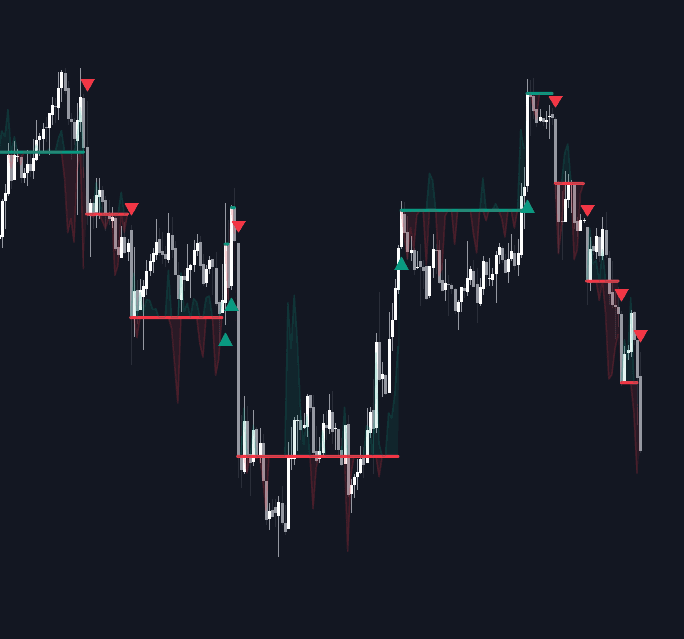
What is Change-point Detection?
Change-point detection is the statistical problem of locating when a time series' generating process shifted: a change in mean, in variance, or in distribution, as opposed to where price is heading next. The classic sequential detector is CUSUM (Page, 1954), built for industrial quality control. It maintains running sums of deviations above and below a reference level, subtracts a small slack allowance each bar so pure noise decays back toward zero, and raises an alarm when an accumulated sum crosses a decision threshold. Because evidence accumulates, a persistent small drift eventually trips the detector even when no single bar looks unusual.
CUSUM is one member of a larger family. Offline methods segment a completed history into regimes after the fact, which suits research and backtest hygiene; online methods like CUSUM and Bayesian change-point detectors update bar by bar and are the ones that can run on a live chart. All of them formalize the same question a discretionary trader asks loosely: does recent data still look like it came from the same market as before?
Applied to returns, an alarm marks a candidate shift in drift (a trend starting or dying); applied to squared or absolute returns, it flags volatility regime switches. The tuning is an explicit trade-off: tighter thresholds detect changes sooner but fire more false alarms, looser ones are quieter but slower. Detection is also inherently after the fact, since a change must accumulate evidence before it becomes visible, which is why change points pair naturally with persistence gauges like the Hurst exponent rather than acting as standalone entries.
The reason the idea earns chart space is that almost every indicator assumes the recent past is representative. A Z-score needs a stable mean and deviation, a percentile rank needs a comparable history, and any distribution-of-returns profile blends regimes if the window spans a break. A detected change point says where representativeness ended, which is often more valuable than any single forecast.
How to read a change-point detector on a chart
The detector plots as an auxiliary series with alarms; reading it is about knowing what was fed in and how sensitive it is.
- 1Check the input series first: detectors run on returns flag drift changes, while those on squared or absolute returns flag volatility shifts; the alarm means nothing without knowing which.
- 2Note the tuning: the reference level, the slack allowance, and the alarm threshold jointly set how fast it reacts and how often it cries wolf.
- 3Watch the cumulative sums build: a one-sided sum grinding away from zero shows evidence accumulating even before any alarm prints.
- 4Treat the alarm bar as a timestamp, not a signal: it says the recent stretch no longer resembles the reference regime, and the sums typically restart from there.
- 5Cross-check the flagged date against the chart and other regime reads, such as an autocorrelation shift or a volatility break, before changing behavior.
How traders use it
- As a regime alarm: CUSUM on returns timestamps candidate shifts in drift, prompting a re-read of structure and bias or an update to a trend regime label, rather than triggering trades by itself.
- As a volatility monitor: run on squared or absolute returns to flag transitions between quiet and turbulent conditions that sizing and stop rules should respond to.
- As an adaptive anchor: restart lookbacks, distributions, or averages from the most recent detected change point so statistics describe only the current regime instead of blending regimes.
- As backtest hygiene: segmenting a history at detected change points keeps parameter fits and distribution profiles from being estimated across regime boundaries, and shows how a rule behaves regime by regime.
- As a normalization guard: recomputing Z-scores or percentile ranks from the last change point instead of a fixed window keeps those readings from mixing the old regime's scale into the new one.
Change-point Detection vs related statistics
Z-score: A Z-score says how unusual the latest value is under the assumption the regime is stable. Change-point detection questions that assumption, accumulating evidence that the mean or spread itself has moved. One grades a data point; the other grades the process.
Autocorrelation: Autocorrelation describes a regime's internal texture, how strongly returns echo their own past, and it needs a stable window to mean anything. A change point marks where such descriptions stop applying, so the two are naturally chained: segment first, then characterize.
Distribution-of-returns Profiling: Profiling summarizes the shape of returns over a window: tails, skew, dispersion. Run across a regime break it averages two different markets into one misleading picture, which is exactly the failure change-point detection exists to prevent.
Concept family
Statistics
46 concepts mapped · 46 in the Library
Change-point Detection FAQ
Turn Change-point Detection into a trading strategy.
Take the implementation from this page into Quant, then build on it, backtest it on real data, and keep refining it in conversation.