Malaysian SnR
Malaysian SnR, also known as Malaysian support and resistance, MSNR, is a Support/Resistance & Levels concept. The Library holds 1 implementation, a working definition you can pull into Quant.
Top Malaysian SnR indicator
The top custom implementation, built on the original standard Malaysian SnR formula.
1 total
This Malaysian SnR implementation is strategy-ready: open it in Quant, set your rules, and it backtests automatically.
What is Malaysian Support & Resistance (MSNR)?
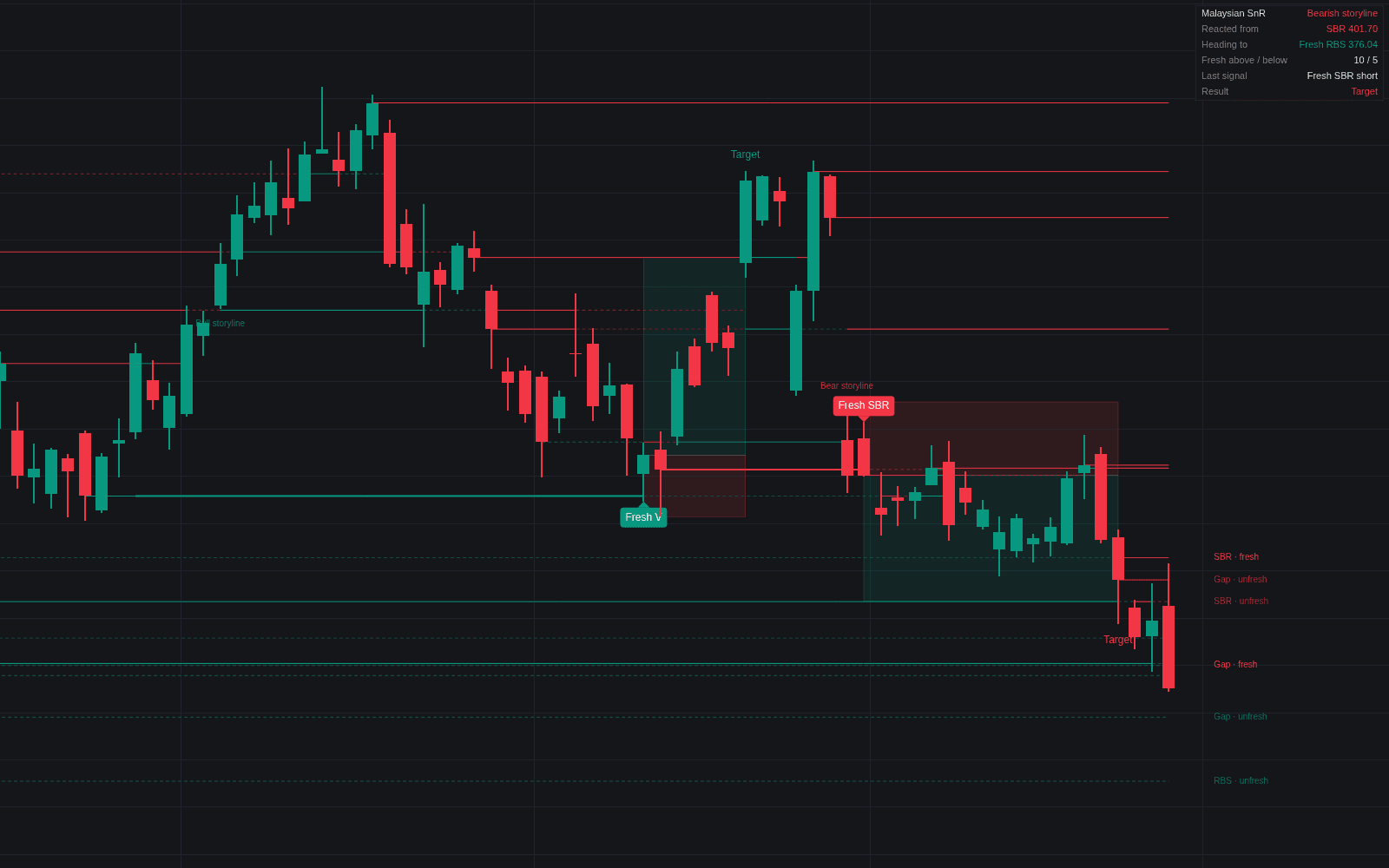
Malaysian Support and Resistance (Malaysian SnR, MSNR) is a method that draws support and resistance from candle closes and opens rather than from wicks. Its levels sit at the turns of a line chart: an A-level at a peak (shaped like the letter A) acts as resistance, a V-level at a valley acts as support, and a gap level marks the space between one candle's close and the next candle's open when two consecutive candles of the same color do not share a price. Each level is a single price, not a zone.
The name points to the Malaysian retail forex community the approach is generally associated with, and it is taught through courses, social media and community scripts rather than a book. Its distinctive rule is freshness. A level is fresh until a wick touches it; once touched it is unfresh, and the method expects unfresh levels to react less and break more readily. A candle body closing through an unfresh level makes it fresh again, so the bookkeeping runs in both directions. The underlying claim, that untouched levels still hold unfilled orders, is the same one behind level freshness and decay in other schools.
Levels are read inside a storyline: the higher-timeframe narrative of which fresh level price last reacted from and which one it is travelling toward. A weekly, daily or 4-hour storyline sets direction, and the execution timeframe is consulted only when price reaches a fresh level in line with it. Teachers add their own confirmations, and there is no independent published test of how often MSNR levels react.
How to draw Malaysian SnR levels
The method works from closing prices, so start by taking the wicks out of the picture.
- 1Switch to a line chart (closes only), or read candle bodies only, on the storyline timeframe, usually daily or 4-hour.
- 2Mark A-levels at line-chart peaks and V-levels at valleys. On a candle chart the level sits at the body price of the turn, the close of the candle that made it, not at the wick.
- 3Mark gap levels where two consecutive same-colored candles leave a gap between the first candle's close and the second candle's open.
- 4Grade freshness: untouched by any wick since it formed is fresh, a wick touch makes it unfresh, and a body closing through an unfresh level makes it fresh again.
- 5Write the storyline (where price last reacted, and which fresh level is next in the higher-timeframe direction), then trade only fresh levels in that direction, waiting for a reaction on a lower timeframe.
How traders use it
- As reaction levels: fresh A-levels are sold and fresh V-levels bought on the first revisit, with the stop beyond the level and confirmation taken on a lower timeframe.
- As break levels: a level that has already been wicked is treated as a likely breakout point rather than a fade, and a break that holds sets up the role reversal trade on the retest.
- As targets: the next fresh level in the storyline's direction is the natural objective, so one map supplies entry, invalidation and target.
- In top-down form: the storyline is set on a higher timeframe and executed on a lower one, the top-down workflow with close-based levels. Community indicators automate the A-, V- and gap-level drawing and show fresh and unfresh levels in different styles.
Malaysian SnR vs other level methods
S/R Zone: Zones span a band, often from wick to body, to absorb overshoots. MSNR insists on a single close-or-open price and treats a wick through it as a touch that spends the level, not as part of the level.
Supply & Demand Zones: Supply and demand zones are drawn around the base candles before a strong departure and graded on that departure. MSNR levels come from line-chart turns and gaps with no base or departure criterion. Both schools prefer levels that have not been revisited.
Level Freshness & Decay: The general bookkeeping of touches and age across all level types. MSNR's rule is a specific, binary version of it: one wick touch spends a level, one body close through it renews it.
Concept family
Support/Resistance & Levels
39 concepts mapped · 39 in the Library
Malaysian SnR FAQ
Turn Malaysian SnR into a trading strategy.
Take the implementation from this page into Quant, then build on it, backtest it on real data, and keep refining it in conversation.