Concept
Volatility Switch
Volatility Switch is a Volatility concept. The Library holds 1 implementation, a working definition you can pull into Quant.
Top Volatility Switch indicator
The top custom implementation, built on the original standard Volatility Switch formula.
1 total
The Volatility Switch implementation below can become a backtested trading strategy — describe your rules and Quant writes the code.
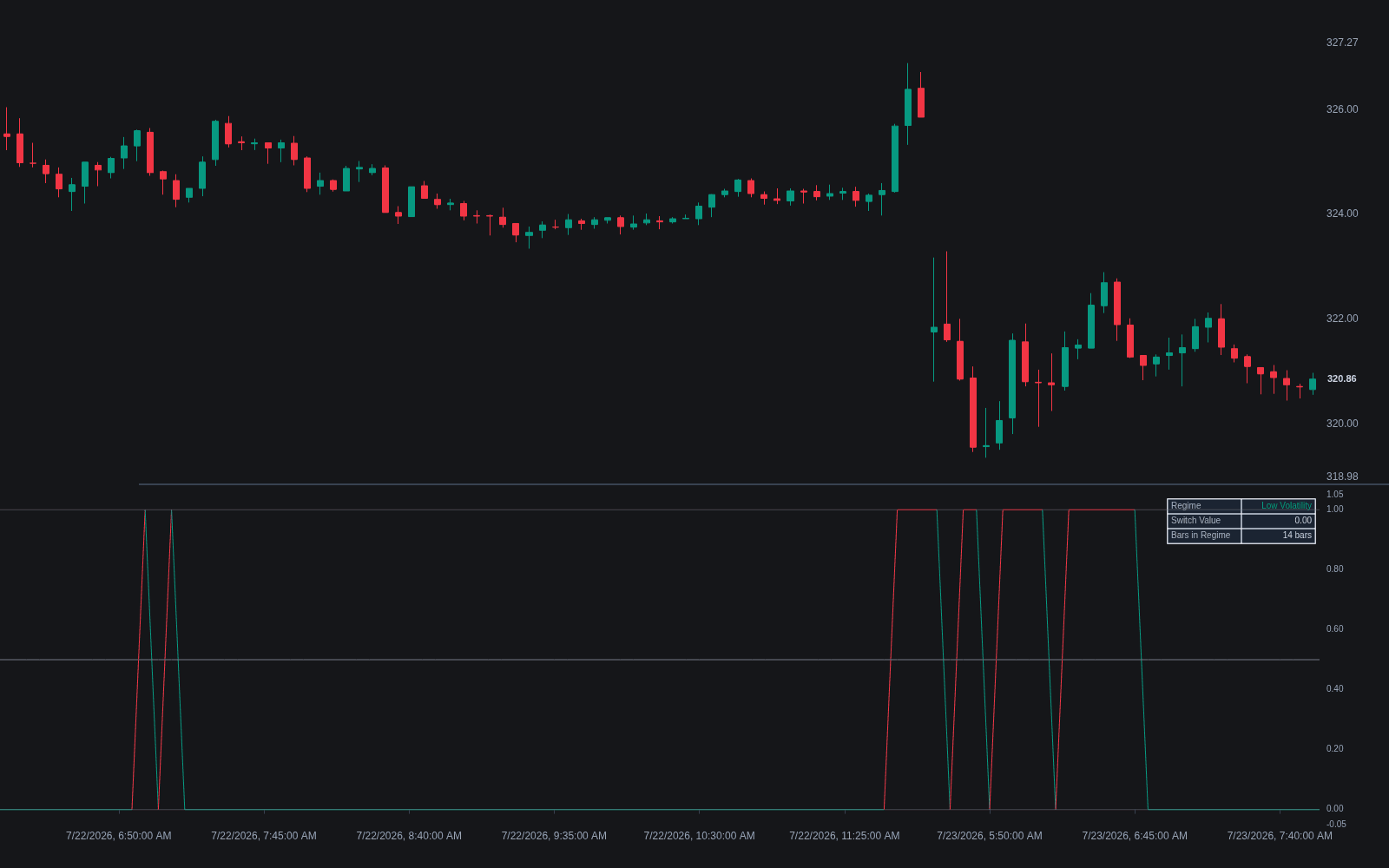
What is the Volatility Switch?
The Volatility Switch is a bounded volatility-regime gauge proposed by Ron McEwan (Technical Analysis of Stocks & Commodities, 2013). It measures short-horizon volatility from one-bar relative price changes, then expresses the current value as a percentile rank within its own trailing history. The output therefore lives between 0 and 1 on any instrument: readings above 0.5 mean volatility is elevated relative to its recent past, readings below 0.5 mean it is subdued.
The bounded scale is the point. In the common reading, high values mark regimes where price action turns choppy and mean-reverting tactics have the stronger claim, while low values mark quiet conditions in which trends are more likely to persist. That makes the switch a compact form of volatility regime classification: one normalized line that routes strategy selection. Like any regime filter it is backward-looking, lags at transitions, and says nothing about direction.
Mechanically the calculation has three steps. Each bar's change is measured relative to the average of the current and prior price, a symmetric one-bar return; the standard deviation of those changes over a short window forms a compact realized volatility estimate; and that estimate is percentile-ranked against its own recent readings, with common implementations defaulting to 21 bars, roughly a month of daily data, for both windows. The output is the fraction of recent readings at or below today's, which pins the scale between 0 and 1.
Its appeal is portability. Because the output is a rank, the 0.5 line means the same thing on an index future, a currency pair, or a small-cap stock, with no per-symbol tuning, which is why the switch drops easily into larger systems as a regime filter. The design also has a blind spot: it knows nothing about absolute movement, so practitioners keep a price-denominated gauge such as ATR alongside it for stop distances and sizing. The same normalization applied to any input is the broader volatility percentile approach; the switch is that idea with fixed ingredients and a published decision line.
How to read the Volatility Switch on a chart
The indicator draws one line between 0 and 1 in its own pane; the reading is about level and persistence.
- 1Add a Volatility Switch indicator (community ports are widely available) and mark the 0.5 midline.
- 2Read the side: above 0.5 is a relatively high-volatility regime, below 0.5 a relatively quiet one.
- 3Weight persistence over single crossings; a line holding one side for many bars is a regime, a one-bar poke is noise.
- 4Sanity-check extremes against the chart: readings near 1 should coincide with wide, gappy candles, readings near 0 with tight ranges and narrowing Bollinger Bands.
- 5Avoid cross-symbol comparisons; the scale is relative to each instrument's own recent history, not to any absolute level.
How it's calculated
A bounded gauge that percentile-ranks current short-horizon volatility within its own trailing history.
Published by Ron McEwan as The Volatility (Regime) Switch Indicator (Technical Analysis of Stocks & Commodities, February 2013); the midpoint denominator keeps the one-bar change symmetric, though some ports use a plain percent change.
The output is a percentile rank of volatility against itself, so it is comparable across instruments; McEwan's read favors mean reversion above 0.5 and trend following below.
Population (1/n) versus sample (1/(n-1)) standard deviation barely changes the rank, and both appear in implementations.
How traders use it
- As a strategy router, the use McEwan proposed: run mean-reversion logic while the switch reads above 0.5 and trend-following logic below it, rather than trading the line as a signal in itself.
- As a gate on signal type: some systems only honor breakout and momentum entries while the switch sits in the low-volatility half of its range, on the logic that elevated readings mark conditions where follow-through is less reliable.
- As a quiet-market flag: extended stretches near the bottom of the scale mark compression, the setup condition range expansion traders watch for, though the switch says nothing about when the expansion comes or in which direction.
- As sizing and stop context: persistent high readings argue for smaller size and wider stops even when tactics stay unchanged; pairing the switch with ATR bands converts the regime call into concrete distances.
- As a bounded confluence input: living on a fixed 0-1 scale, the switch drops cleanly into composite scores beside other normalized gauges, adding a volatility dimension without rescaling.
Volatility Switch vs. related volatility gauges
Volatility Percentile/rank: The percentile approach ranks any volatility measure over any window; the Volatility Switch is one specific recipe, one-bar relative changes and roughly a month of history, with 0.5 as the published line. Same normalization, fixed ingredients and defaults.
ATR: ATR states typical bar range in price units, so it feeds stops and targets directly but needs a baseline before it says whether volatility is unusually high. The switch answers high-or-low natively while carrying no price-unit information; many systems run both.
TTM Squeeze: The TTM Squeeze flags one condition, Bollinger Bands inside Keltner Channels, and aims to anticipate expansion out of compression. The switch grades the entire regime continuously and aims at routing tactics rather than timing breakouts.
Concept family
Volatility
57 concepts mapped · 57 in the Library
Volatility Switch FAQ
Turn Volatility Switch into a trading strategy.
Take the implementation from this page into Quant, then build on it, backtest it on real data, and keep refining it in conversation.