Concept
Acceleration Bands
Acceleration Bands are Volatility concepts. The Library holds 1 implementation, a working definition you can pull into Quant.
Headley
Top Acceleration Bands indicator
The top custom implementation, built on the original standard Acceleration Bands formula.
1 total
This Acceleration Bands implementation is strategy-ready: open it in Quant, set your rules, and it backtests automatically.
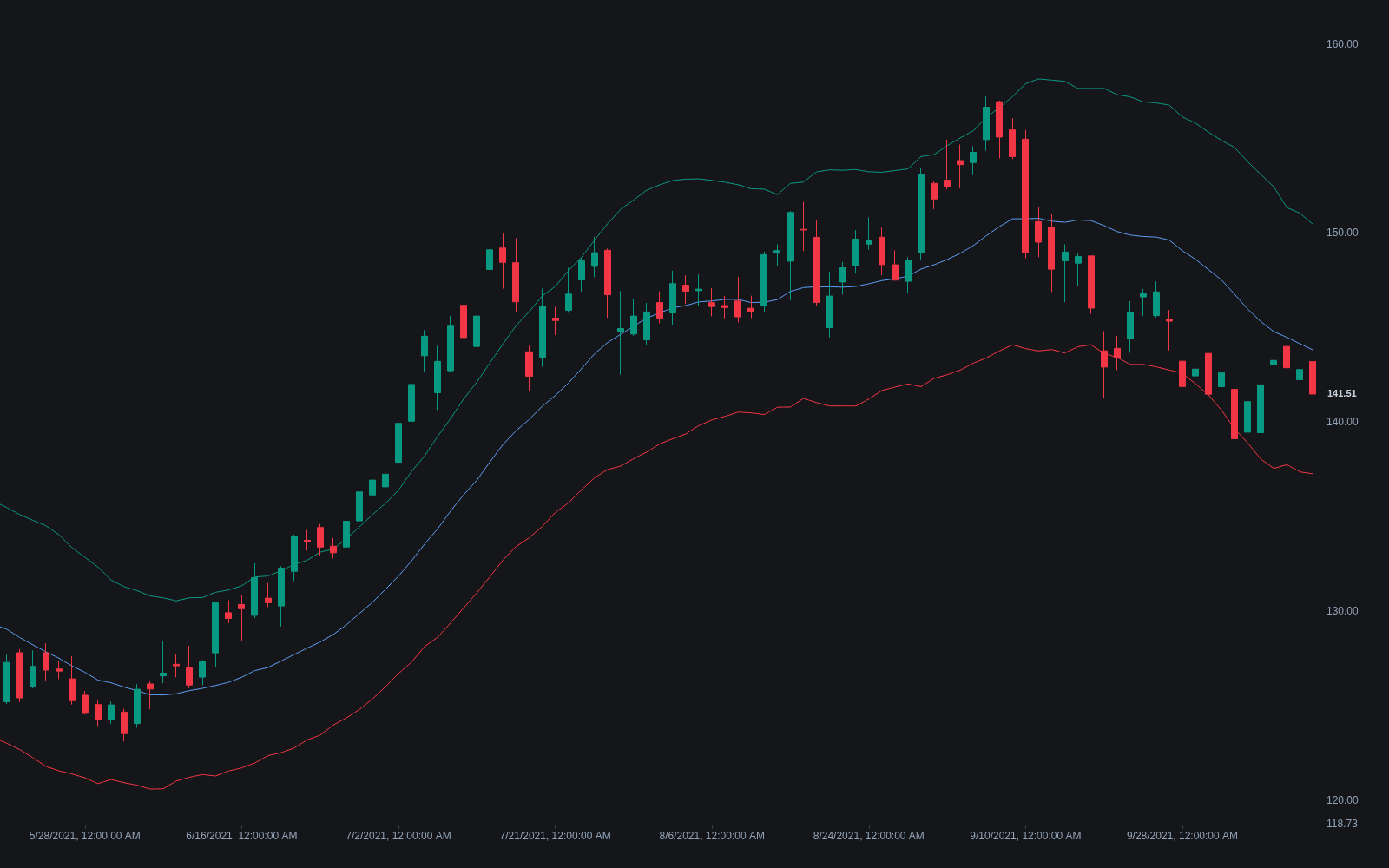
What are acceleration bands?
Acceleration bands are a price envelope developed by Price Headley in which the band width at each bar is driven by that bar's own high-low range, normalized by its midpoint. The upper band is a moving average of highs pushed up in proportion to the bar's relative range, and the lower band is a moving average of lows pushed down the same way, typically over 20 periods with a simple moving average of the close as the midline.
The design reflects Headley's premise that the strongest moves accelerate: when price closes outside the bands for consecutive bars, the move is expanding faster than its own recent range structure, which he treated as evidence of a genuine directional breakout rather than noise. That is the opposite orientation of many band systems, where a touch of the outer band is read as stretched. Acceleration bands were built as a breakout tool first.
Traders care because the range-proportional construction makes the bands widen on volatile bars and hug price on quiet ones without relying on a standard-deviation window the way Bollinger Bands do, or on an ATR multiple the way Keltner Channels do. The behavior sits somewhere between an envelope and a volatility channel.
How it's calculated
The standard published form uses a 20-period simple moving average and a scaling factor of 4:
The term (high - low) / (high + low) is half the bar's range expressed as a fraction of its midpoint, so wide bars push the bands apart before averaging.
How traders use it
- Breakout entries: the classic rule takes a position after two consecutive closes outside a band, treating the acceleration as the start of a strong leg; a close back inside the band is the standard exit.
- Trend riding: while price keeps closing beyond or near the outer band, the move is considered in its acceleration phase, a behavior closely related to a band walk.
- Midline management: the 20-period midline serves as a trailing reference for partial exits once the acceleration fades.
- With honest limits: like all breakout logic, consecutive closes outside the bands occur at the end of moves too, so many users add volume or momentum confirmation and accept whipsaws in ranging markets.
Acceleration bands vs other band systems
Bollinger Bands: Bollinger Bands scale by the standard deviation of closes over the window; acceleration bands scale each bar by its own normalized range before averaging, and are conventionally traded as breakout signals rather than reversion references.
Keltner Channels: Keltner Channels offset a moving average by a multiple of ATR, producing smoother, steadier width. Acceleration bands respond bar by bar to range, so they flare faster on volatile bars.
Donchian Channels: Donchian Channels mark the raw n-bar extreme, so price can never close outside them until a new extreme prints. Acceleration bands sit inside recent extremes often enough for closes beyond them to be a usable signal.
Concept family
Volatility
57 concepts mapped · 57 in the Library
Acceleration Bands FAQ
Turn Acceleration Bands into a trading strategy.
Take the implementation from this page into Quant, then build on it, backtest it on real data, and keep refining it in conversation.