Concept
Band Walk
Band Walk is a Volatility concept. The Library holds 1 implementation, a working definition you can pull into Quant.
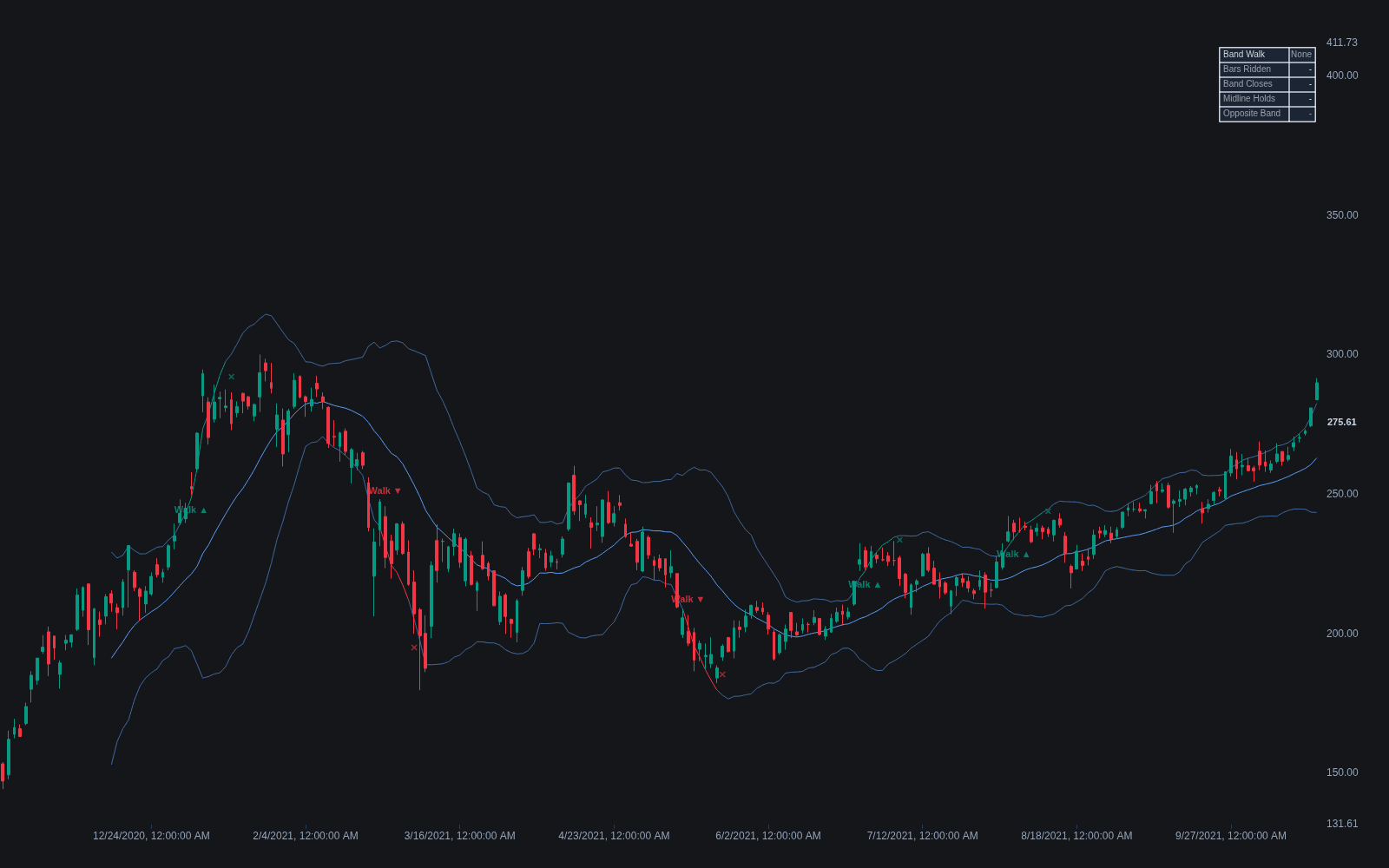
Top Band Walk indicator
The top custom implementation, built on the original standard Band Walk formula.
1 total
This Band Walk implementation is strategy-ready: open it in Quant, set your rules, and it backtests automatically.
What is a band walk?
A band walk is the behavior of price repeatedly closing on or beyond one outer band of a volatility channel, bar after bar, during a strong trend. On Bollinger Bands it is often called walking the band: in a powerful uptrend price rides the upper band, pulling back only to the midline, while the opposite band bends away. The same behavior appears on Keltner Channels and other envelopes.
The concept matters because it corrects the most common misreading of band systems: that touching an outer band means overbought or oversold. In a trending market the outer band is not a ceiling but a track. Statistically, closes near the upper Bollinger Band are expected to occur in sequences during sustained directional moves, because the band is only about two standard deviations from a lagging mean that keeps chasing price. Fading each tag during a walk tends to be costly, because trends often persist far longer than reversion logic allows for.
Traders therefore use the band walk as a trend-strength diagnostic. Its presence argues for continuation tactics, buying pullbacks toward the midline rather than shorting strength, and its ending, when price stops reaching the band and closes back around the middle of the channel, is often the first quiet evidence that momentum is fading.
How to identify a band walk
The signature is persistence, not any single bar.
- 1Look for a sequence of closes at or beyond one outer band, commonly three or more within a handful of bars, with the channel itself sloping in the direction of travel.
- 2Check the pullbacks: during a healthy walk, dips hold at or above the midline (the moving average) rather than crossing the channel.
- 3Confirm with band geometry: in a strong walk the opposite band often turns away from price, reflecting expanding volatility in the trend's favor.
- 4Watch for the walk to end: closes that fail to reach the band, or a first close below the midline, mark deceleration rather than instant reversal.
How traders use it
- As a fade filter: an active band walk vetoes reversion trades against the trend, including classic band-tag reversion setups that work well in ranges.
- For continuation entries: pullbacks to the midline during a walk are treated as trend entries with the stop beyond the recent swing or the opposite side of the channel.
- For exit timing: trend followers often hold while closes keep hugging the band and begin scaling out when price stops reaching it.
- Using %b as a proxy: readings of %b pinned near 1 (or 0) quantify a walk without eyeballing the chart.
- With honest limits: walks end without warning, and the strongest walks sometimes terminate in climactic bars, so the pattern describes present strength, not future duration.
Band walk vs related behaviors
Bollinger Band Tag Reversion: Tag reversion treats an outer-band touch in a range as a stretched price to fade. A band walk is the regime where that logic fails; distinguishing the two is mostly a trend-versus-range judgment.
One-Timeframing: One-timeframing describes the same persistence in auction terms (each bar holding the prior bar's extreme). A band walk expresses it relative to a volatility envelope instead of bar-by-bar structure.
Concept family
Volatility
57 concepts mapped · 57 in the Library
Band Walk FAQ
Turn Band Walk into a trading strategy.
Take the implementation from this page into Quant, then build on it, backtest it on real data, and keep refining it in conversation.