Concept
ATR Expansion/contraction
ATR Expansion/contraction, also known as range-vs-ATR ratio, is a Volatility concept. The Library holds 1 implementation, a working definition you can pull into Quant.
Top ATR Expansion/contraction indicator
The top custom implementation, built on the original standard ATR Expansion/contraction formula.
1 total
Want to trade ATR Expansion/contraction? The implementation below is one prompt away from a backtested strategy in Quant.
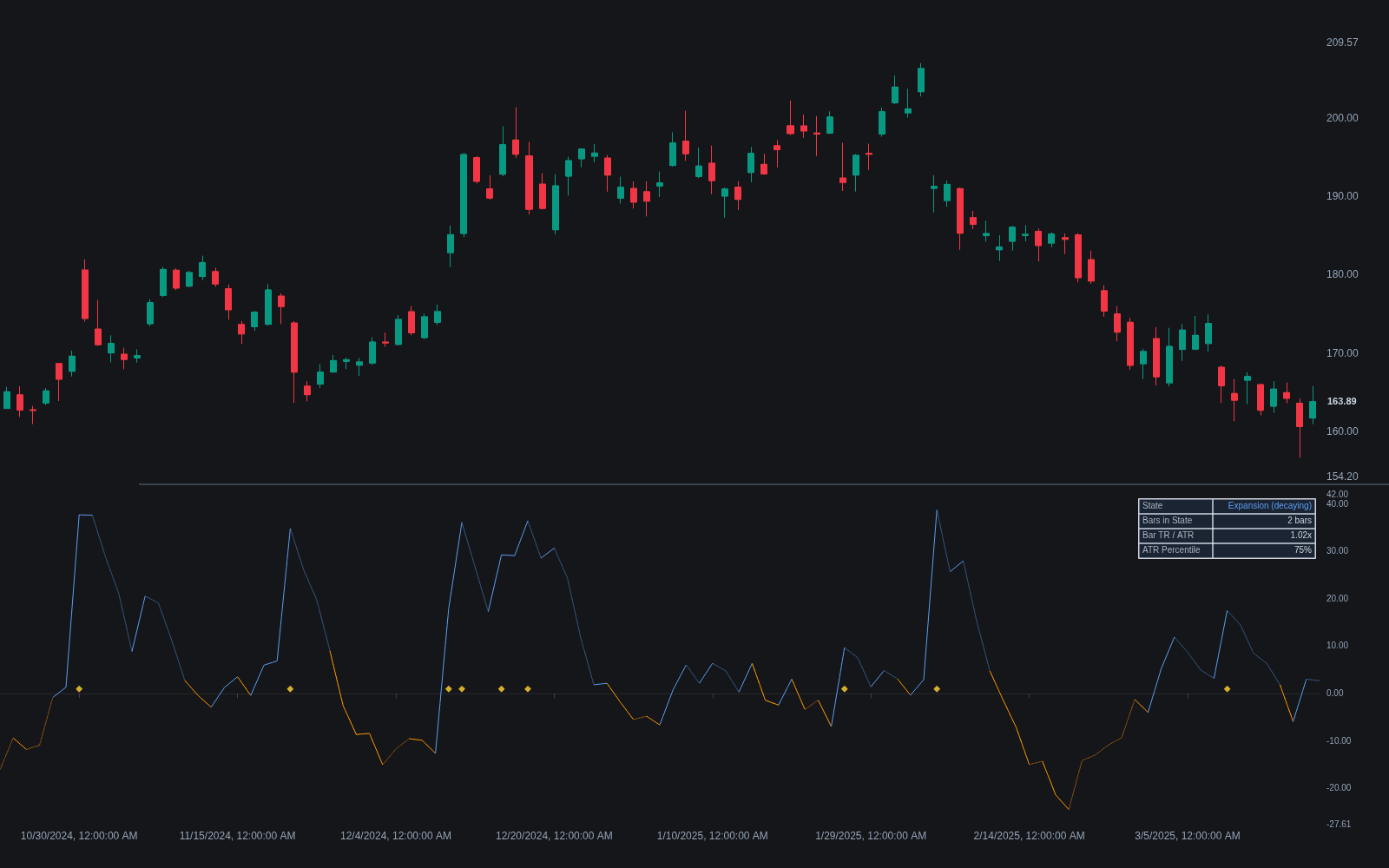
What is ATR Expansion/Contraction?
ATR expansion/contraction reads the direction of change in ATR, Wilder's smoothed measure of true range. Rising ATR means each bar is covering more ground (expansion); falling ATR means ranges are compressing (contraction). Common constructions include comparing ATR to its own moving average, dividing a short-lookback ATR by a long-lookback one, or taking the current bar's true range as a ratio of prevailing ATR to flag individual expansion bars.
The read matters because volatility runs in cycles: contractions tend to resolve into expansions, and expansions eventually decay, while ATR itself says nothing about direction. Because ATR is heavily smoothed it turns slowly, so the per-bar range-versus-ATR ratio is the fast, noisy version of the read and the ATR slope is the slow, stable one.
The concept is the range-based wing of the squeeze family. Where the Bollinger squeeze and TTM squeeze infer compression from band geometry, ATR expansion/contraction measures it directly from bar travel, gaps included, which keeps the read meaningful on gappy daily charts and instruments where close-based deviation understates movement. The two wings usually agree; when they diverge, the difference is almost always gap or intrabar behavior that only true range sees.
Reading it well is mostly a matter of context. An ATR level means little in isolation, so practitioners frame the current reading against its own history with a volatility percentile, watch how long each state has persisted (fresh expansion behaves differently from a mature one), and remember the asymmetry of the cycle: contractions build slowly and resolve abruptly, while expansions decay in stages as the market digests its move.
How to read ATR expansion/contraction
The state is read from ATR's own behavior, not from any fixed level.
- 1Plot ATR alongside a reference: its own moving average, or a short-ATR-to-long-ATR ratio pane, so rising and falling states are explicit.
- 2Classify the state: ATR above its average and rising is expansion; below and falling is contraction; the crossings mark the transitions.
- 3Flag expansion bars separately: a single bar whose true range is a large multiple of prevailing ATR is an event within whatever state the market is in.
- 4Add percentile context: the same ATR value can be a high or low reading depending on the instrument's recent history, so rank it before judging it.
- 5Cross-check the band view: agreement with BandWidth or a squeeze indicator confirms the read; disagreement usually traces to gaps that only true range captured.
- 6Take direction from elsewhere: the state says how much the market is moving, never which way.
How it's calculated
Compares the current bar's true range to its recent average to flag widening (expansion) or narrowing (contraction) volatility.
Other variants divide a fast ATR by a slow ATR (e.g. ATR_5 / ATR_20) or simply read rising ATR as expansion and falling ATR as contraction.
Thresholds such as Ratio_t > 1.5 or > 2 are often used to flag outsized breakout bars.
Some versions use the plain high-low range in the numerator instead of true range.
How traders use it
- As breakout preparation: a sustained contraction, often alongside patterns like NR4/NR7 narrow-range bars, marks compressed conditions under which breakout entries are armed.
- As risk calibration: ATR-based stop distances and targets naturally widen during expansion and tighten during contraction, keeping risk proportional to current conditions.
- As a conviction flag: a bar whose true range is a large multiple of prevailing ATR is the wide-range-bar signature, and many systems treat such bars as evidence of genuine participation behind a move.
- As a strategy switch: systems gate breakout tactics to contraction-into-expansion transitions and mean-reversion tactics to mature, decaying expansions, the ATR-side version of the general range expansion/contraction regime logic.
- As a sizing modulator: exposure scaled inversely to ATR keeps risk per trade steady across regimes, the bar-range cousin of sizing from realized volatility.
ATR expansion/contraction vs neighboring volatility reads
Range Expansion/contraction: The general concept covers any measure of ranges growing or shrinking; the ATR version pins it to Wilder's smoothed true range, gaining gap-awareness and a standard vocabulary of constructions (slope, ratio, expansion bars).
BandWidth: BandWidth measures Bollinger envelope spread, a close-based standard-deviation read that flares and pinches quickly. ATR-based reads move more gradually and fold gaps in through true range; the pair disagreeing usually means a gap did the moving.
TTM Squeeze: The squeeze is a two-band state machine (Bollinger inside Keltner) that fires discrete on/off signals. ATR expansion/contraction is the continuous dial underneath such machines, readable at every bar rather than only at state changes.
Concept family
Volatility
57 concepts mapped · 57 in the Library
ATR Expansion/contraction FAQ
Turn ATR Expansion/contraction into a trading strategy.
Take the implementation from this page into Quant, then build on it, backtest it on real data, and keep refining it in conversation.