Concept
Gap-volatility Relation
Gap-volatility Relation is a Volatility concept. The Library holds 1 implementation, a working definition you can pull into Quant.
Top Gap-volatility Relation indicator
The top custom implementation, built on the original standard Gap-volatility Relation formula.
1 total
This Gap-volatility Relation implementation is strategy-ready: open it in Quant, set your rules, and it backtests automatically.
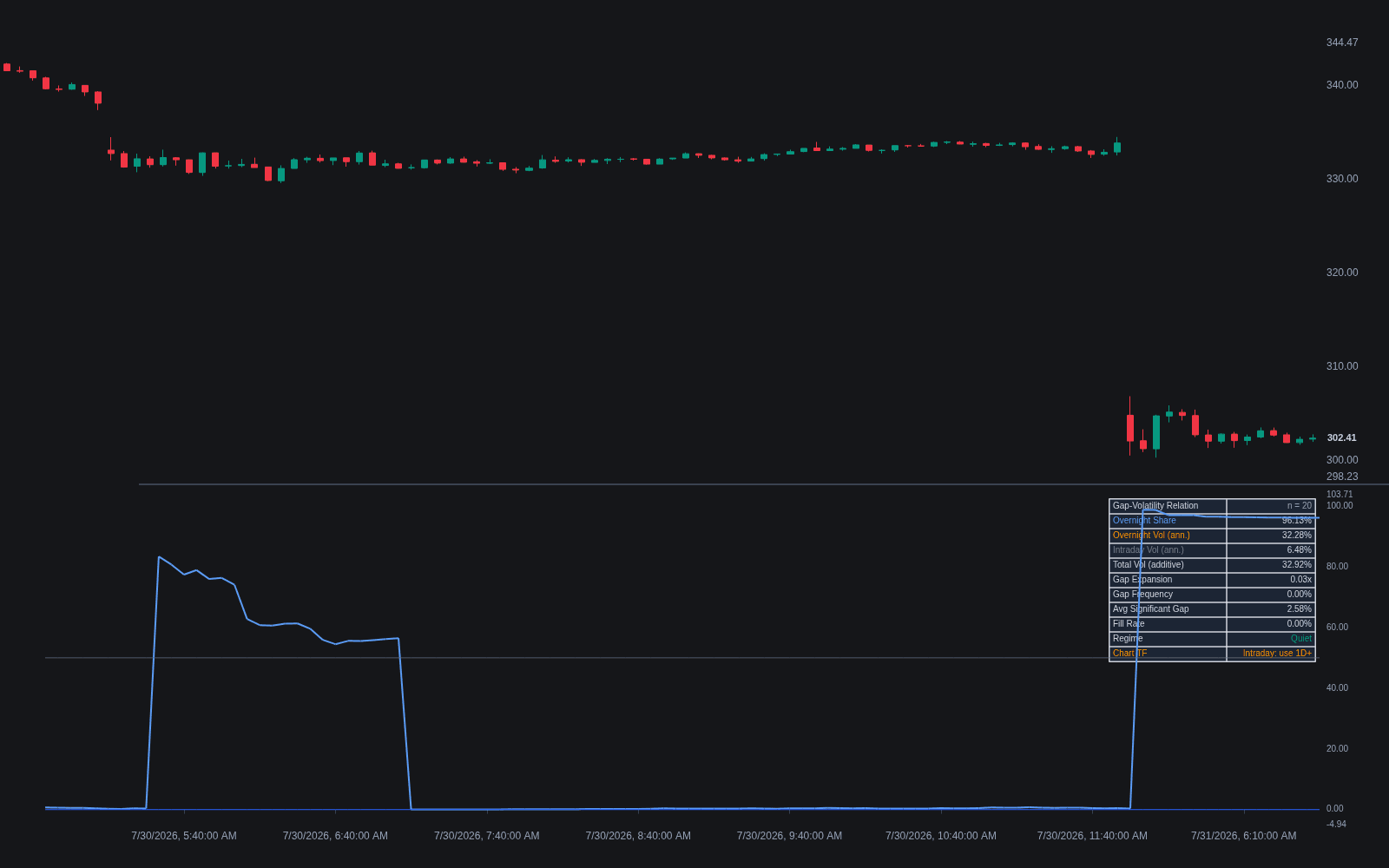
What is the gap-volatility relation?
The gap-volatility relation is the two-way link between opening gaps and volatility: gaps are both a component of an instrument's total volatility and a symptom of its current volatility regime. Whenever a market closes, information keeps arriving, and the next open reprices it all at once as an opening gap. That overnight jump carries real variance, often a substantial fraction of total variance for single stocks, yet it is invisible to any measure built only from intraday ranges.
This is why the relation matters mechanically for measurement. Range-based tools such as the Parkinson estimator see only movement inside the session, so they understate risk on gapping instruments (true-range measures partially correct for this by spanning the prior close), while close-to-close volatility captures gaps but mixes them indistinguishably with intraday movement. The Yang-Zhang estimator was designed around exactly this decomposition, estimating overnight and open-to-close variance separately and combining them.
The relation also runs the other way as a regime signal. Gap frequency and gap size tend to expand and contract with the broader volatility environment: quiet regimes produce small, frequently filled gaps, while stressed regimes produce large gaps that more often extend rather than fill. Traders watch the character of recent gaps as an early, tangible read on regime shifts and on event-driven volatility around earnings and macro releases.
How it's calculated
The standard decomposition separates overnight from intraday returns:
The additive variance split ignores any covariance between overnight and intraday returns; Yang-Zhang handles the combination formally.
For near-24-hour markets the overnight term shrinks toward zero and the relation matters mainly around weekend closes and exchange halts.
How traders use it
- Choosing estimators honestly: traders check an instrument's overnight variance share before trusting range-based volatility numbers; a high share argues for close-inclusive or Yang-Zhang estimates.
- Sizing around holds: overnight and weekend position sizing is scaled to gap risk rather than intraday risk, since stops cannot protect through a weekend gap.
- Reading regime from gap character: a run of larger, unfilled gaps is treated as evidence of regime escalation, consistent with broader range expansion in other volatility measures.
- Conditioning gap trades: the odds of a gap fill versus continuation shift with the volatility backdrop, so gap-fade strategies are typically throttled in high-volatility regimes.
- With honest limits: overnight variance shares drift over time and differ sharply between asset types, so any fixed assumption about gap risk should be re-measured rather than carried across instruments.
Gap-volatility relation vs adjacent concepts
Event-Driven Volatility: Event-driven volatility is about scheduled catalysts producing predictable variance spikes. The gap-volatility relation is the structural accounting of where overnight variance lives, whatever its cause.
Weekend / Overnight Volatility Profile: The overnight profile describes how variance accrues across closed and thin hours. The gap-volatility relation focuses on the measurement and regime consequences of the jump printed at the open.
Breakaway Gap: Gap taxonomy classifies individual gaps by their role in a pattern. The gap-volatility relation is statistical, treating gaps in aggregate as a variance component and a regime indicator.
Concept family
Volatility
57 concepts mapped · 57 in the Library
Gap-volatility Relation FAQ
Turn Gap-volatility Relation into a trading strategy.
Take the implementation from this page into Quant, then build on it, backtest it on real data, and keep refining it in conversation.