Concept
Volatility Estimators
Volatility Estimators, also known as Parkinson volatility, Garman-Klass, Rogers-Satchell, close-to-close estimator, are Volatility concepts. The Library holds 1 implementation, a working definition you can pull into Quant.
The standard Volatility Estimators indicator
Volatility Estimators exactly as classically defined: the faithful reference build of the original formula, free to run in Quant.
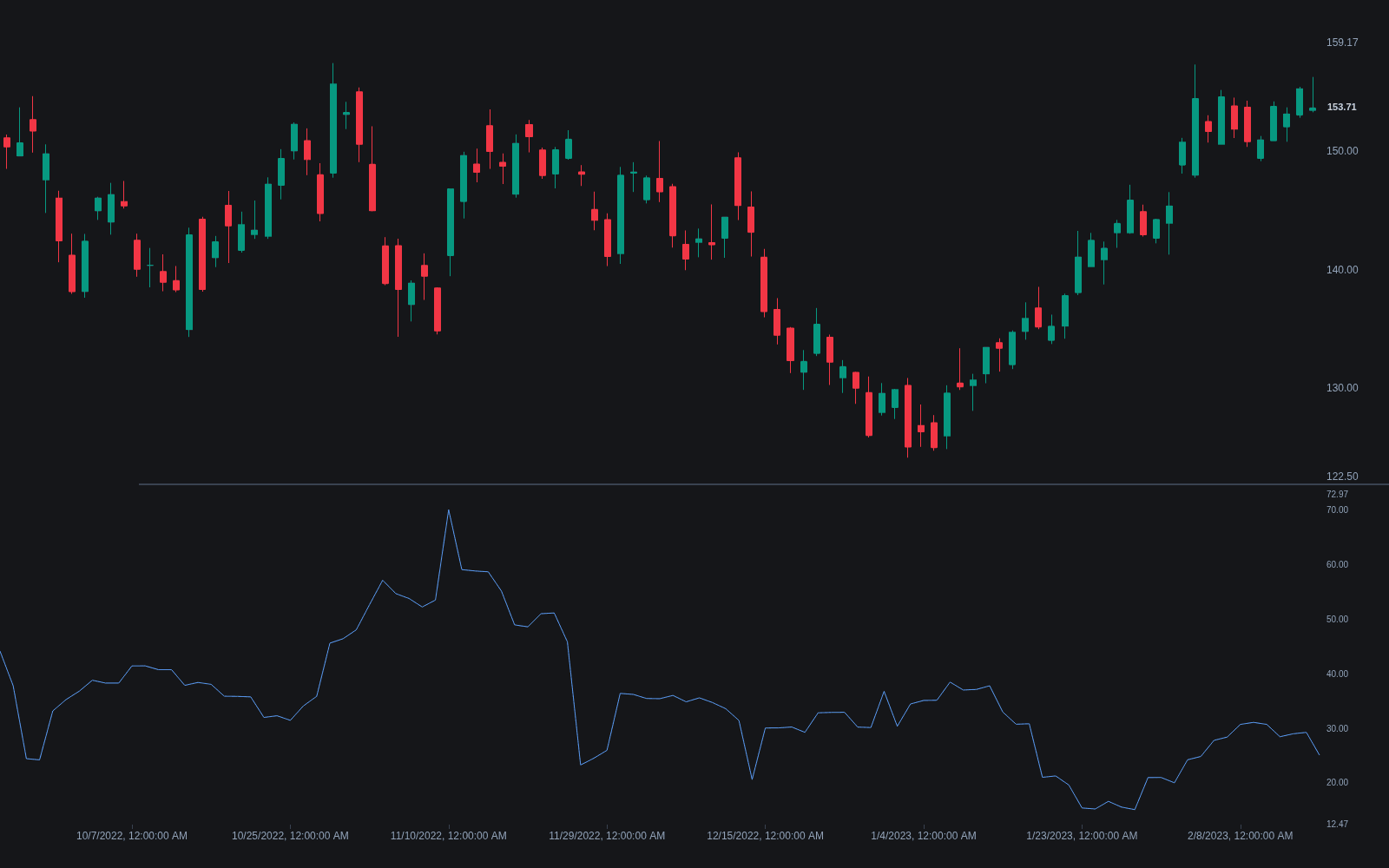
What are volatility estimators?
Volatility estimators are the family of formulas that turn a window of price history into a number for realized (historical) volatility. The oldest member is the close-to-close estimator: the standard deviation of log returns computed from closing prices only. The range-based members, including Parkinson volatility, the Garman-Klass estimator, and the Rogers-Satchell estimator, also use the open, high, and low of each bar, extracting information the close-only method throws away.
The family exists because the close-to-close estimator is statistically inefficient: with one data point per bar it needs long windows to stabilize, which makes it slow to react. A bar's high-low range says a great deal about how violently price moved inside the bar, so range-based estimators reach a given accuracy with far fewer bars. The trade-off is assumptions. Parkinson assumes no drift and no opening gaps; Garman-Klass adds the open and close but still assumes no gaps; Rogers-Satchell tolerates drift but not gaps; the Yang-Zhang estimator combines overnight and intraday components to handle both.
Traders care because the estimator choice changes the number, sometimes materially, and every downstream use inherits that choice: position sizing, stop distances, regime filters, and comparisons against implied volatility. For gap-prone markets such as equities, close-only or Yang-Zhang estimates tend to be more honest; for near-continuous markets, range-based estimators offer smoother, faster readings.
How it's calculated
All members work on log prices over a window of n bars and are annualized the same way. Standard forms:
Parkinson and Garman-Klass assume zero drift and no opening gaps, so they tend to understate volatility for gapping instruments.
Rogers-Satchell is drift-independent; Yang-Zhang extends it with an overnight variance term.
How traders use it
- For volatility-aware sizing and stops: a stable estimate feeds position sizing and stop distances more smoothly than raw bar ranges, complementing ATR-based approaches.
- For regime work: comparing a short-window estimate to a long-window one flags expansion and compression phases earlier when range-based estimators are used.
- For options context: realized estimates are compared against implied volatility to judge whether options look rich or cheap, often via volatility cones.
- With awareness of bias: estimators that ignore gaps systematically understate volatility for stocks over earnings and weekends, so estimator choice should match the instrument's session structure.
- For cross-checking: practitioners often compute two or three estimators; large disagreement between them is itself information about gaps or drift in the window.
Volatility estimators vs adjacent measures
ATR: ATR is a smoothed average of true ranges in price units, built for stops and sizing. Volatility estimators produce an annualized standard deviation of returns, comparable across instruments and against option markets.
Realized Volatility: Realized volatility usually refers to the quantity being estimated, often computed from intraday returns. The estimators here approximate the same quantity from daily OHLC data.
Implied Volatility: Implied volatility is the market's forward-looking price of volatility from options. Estimators are backward-looking measurements; the spread between the two drives volatility trading.
Concept family
Volatility
57 concepts mapped · 57 in the Library
Volatility Estimators FAQ
Turn Volatility Estimators into a trading strategy.
Take the implementation from this page into Quant, then build on it, backtest it on real data, and keep refining it in conversation.