Volatility Breakout
Volatility Breakout, also known as Larry Williams volatility breakout, LW volatility breakout, is a Volatility concept. The Library holds 1 implementation, a working definition you can pull into Quant.
Top Volatility Breakout indicator
The top custom implementation, built on the original standard Volatility Breakout formula.
1 total
From studying Volatility Breakout to trading it: take the implementation below into Quant and backtest it instantly.
What is a Volatility Breakout?
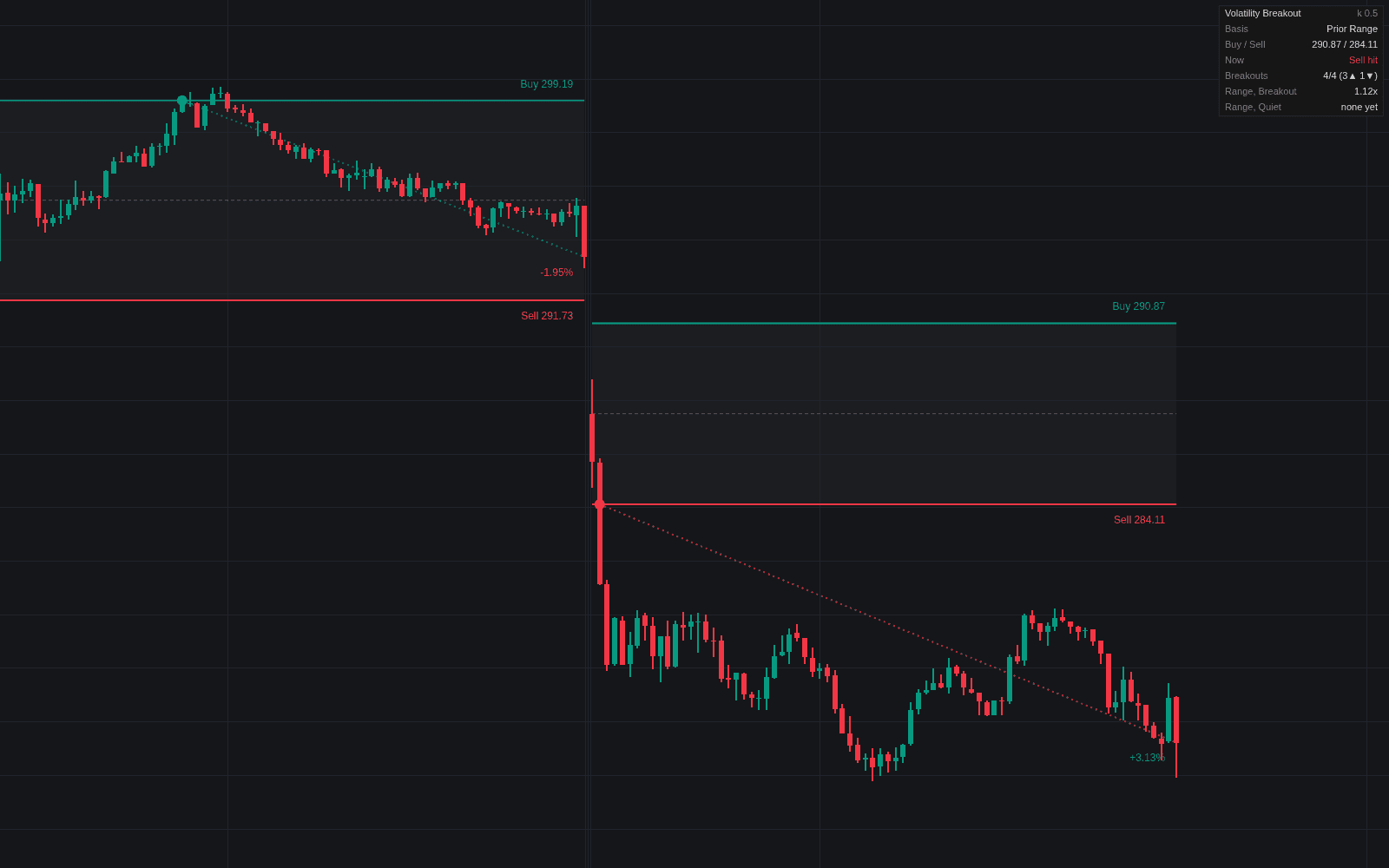
A volatility breakout is an entry rule that sets a buy stop above the session's open and a sell stop below it, each a multiple of the prior session's range away, and reads a move through either level as range expansion in that direction. In the classic form the long trigger is the open plus k times yesterday's high-minus-low and the short trigger the open minus the same amount, with k a tuning constant that published versions usually set below 1.
Larry Williams developed the approach and dates it to 1982, describing it as buying an expansion of the current range, or of the last few days' average range, added to the open, the close or another reference price. He set it out in Long-Term Secrets to Short-Term Trading (1999), and has since written that it has not worked as well in recent years, a reminder that a published edge can fade as it spreads.
The premise is momentum, not prediction: a session that has already traveled a meaningful fraction of a normal range from its open is treated as more likely to continue than to reverse, the range expansion cycle seen from inside one day. The rule stays flat on days that never expand and accepts a worse price than the open as the cost of confirmation.
The same skeleton, a reference price plus a recent-range offset, runs through related methods: Toby Crabel's opening-range research set its offset with the stretch, the 10-day average distance from each open to its nearer extreme, and Mark Fisher's ACD method offsets its triggers from the opening range.
How to set volatility breakout levels
The daily version needs only yesterday's bar and today's open.
- 1Measure the prior session's range, high minus low. Variants use an average of the last few ranges, or true range so an overnight gap counts.
- 2Choose the multiplier k. Small values trigger on most days and catch more noise; large ones trigger rarely. Test it per market rather than borrowing a published value.
- 3At the open, place a buy stop at the open plus k times the range and a sell stop at the open minus k times the range. Whichever fills first sets the direction; most versions then cancel the other side.
- 4Fix the exit in advance: a protective stop, often a fraction of the same range, and a time exit at the session close or next open.
How it's calculated
Breakout triggers offset from the session open by a multiple of the prior session's range.
Williams allowed the reference price to be the open, the close or another value; the open-plus-prior-range form is the most cited.
On gap-prone markets, true range (extended to the prior close) is a common substitute for high minus low.
On 24-hour markets the session must be defined by a fixed daily cutoff, and the levels change with the cutoff chosen.
How traders use it
- As a mechanical day-trade entry: levels are set before the session, orders rest as stops, and the trade exits at the close or next open, so the rule is simple to backtest with costs.
- As a trend-day tell: an early fill, especially beyond the full prior range, shows a day already expanding, and discretionary traders use it to stop fading and start following.
- After compression: taking breakouts only after narrow sessions, such as NR4/NR7 bars or an inside bar, concentrates trades where expansion is due, the pairing Crabel's research made standard.
- With a directional filter: systems often take only the side that agrees with a higher-timeframe trend, turning the two-sided bracket into a one-sided entry.
Volatility Breakout vs related breakout methods
Opening Range & ORB: An ORB waits for the session's first minutes to form a range, then trades its break. A volatility breakout sets its levels at the open from the prior session's range, so it can trigger in the first minute.
Range Expansion/contraction: Range expansion is the phenomenon; the volatility breakout is a trading rule that enters once expansion is under way, measured as distance from the open in units of the prior range.
Donchian Channels: A Donchian breakout triggers at the highest high or lowest low of N bars, ignoring the open. The volatility breakout measures travel from today's open, so it fires on intraday expansion far from any multi-day extreme.
Concept family
Volatility
61 concepts mapped · 61 in the Library
Volatility Breakout FAQ
Turn Volatility Breakout into a trading strategy.
Take the implementation from this page into Quant, then build on it, backtest it on real data, and keep refining it in conversation.