Concept
Island Reversal
Island Reversal, also known as island gap pair, is a Chart & Candlestick Patterns concept. The Library holds 1 implementation — a working definition you can pull into Quant.
Top Island Reversal indicator
The top custom implementation, built on the original standard Island Reversal formula.
1 total
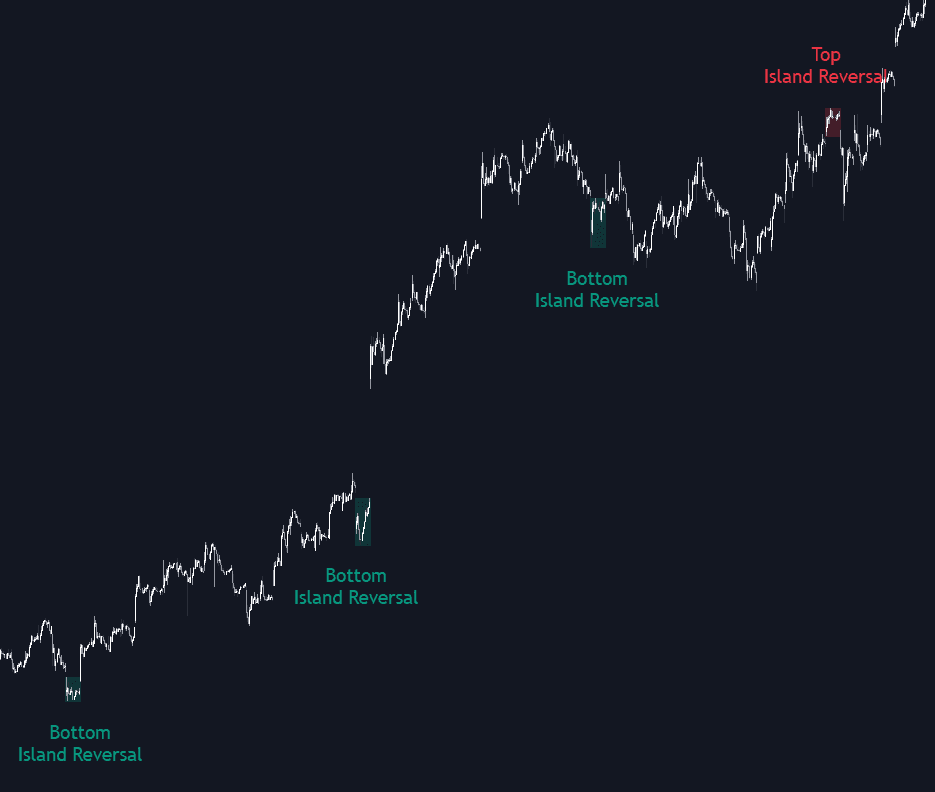
What is an Island Reversal?
An island reversal, sometimes called an island gap pair, is a compact group of price bars isolated from the surrounding trend by two gaps in opposite directions. In the topping version, price gaps up after an advance, trades for one or more bars at the elevated level, then gaps down through roughly the same price span; the bars left stranded above both gaps form the island. The bottoming version mirrors it: a gap down, a stall, then a breakaway gap back up. What makes the pattern is that the two gaps overlap in price, so the island's entire range sits detached from everything traded before and after it.
The pattern belongs to the gap analysis of classical Western charting. Edwards and Magee gave it a full treatment in Technical Analysis of Stock Trends, first published in 1948, reading the island as an exhaustion gap in the old direction answered by a breakaway gap in the new one. The candlestick tradition arrived at nearly the same structure independently: the abandoned baby, a doji isolated by gaps on both sides, is in effect a one-bar island, a useful reminder that the same behavior gets rediscovered under different names.
The signal logic is positional. Everyone who bought inside a topping island is underwater the moment the second gap prints, with no overlapping trade to exit into, and their liquidation pressure feeds the new direction. That is why the pattern is read as a reversal: it marks a pocket of trapped participants rather than a particular candle shape, unlike most candlestick patterns, which depend on the anatomy of one or two bars.
Islands vary in scale. A one-day island is a single stranded bar; multi-week islands strand far more volume and are classically read as more significant. The pattern is genuinely rare because it needs two opposing gaps at overlapping prices, and that rarity cuts both ways: it draws attention when it appears, and it gives any single trader few clean examples to calibrate against.
How to identify an island reversal
The defining test is isolation: the island's prices must not overlap the action on either side of it.
- 1Establish a clear trend into the pattern; an island in the middle of a directionless range has little to reverse.
- 2Find the first gap in the trend's direction, typically an exhaustion-flavored push after an extended run.
- 3Watch price stall at the new level for one or more bars, often small-bodied candles rather than continued expansion.
- 4Require a second gap in the opposite direction whose price range overlaps the first, and check the extremes: the island's entire high-to-low range, wicks included, should sit beyond both gaps.
- 5Treat the pattern as live only while the second gap stays open; a prompt fill puts price back inside the island and dissolves the logic.
How traders use it
- As a reversal signal after an extended move: entry on or after the second gap, with the stop beyond the island's extreme high or low.
- As an invalidation rule: if price re-enters the island by closing the second gap, the trapped-trader logic is gone and the pattern is treated as failed. Gap fill behavior is the tell to watch.
- As a session-market pattern: it needs true gaps, so it appears mostly on daily stock and futures charts and is rare in markets that trade nearly around the clock.
- As a weight-of-evidence gauge: islands after steep runs, with elevated volume on both gaps and several stranded bars, carry more weight than a single quiet bar; some traders also want rejection inside the island, a pin bar or two-bar reversal at the extreme.
- As a component of larger tops: an island at the second peak of a double top adds a tight invalidation line, the island high, to a structure whose own invalidation sits far away.
Island reversal vs related reversal patterns
Morning Star: In its ideal textbook form the morning star also gaps into and out of its middle candle. The difference is strictness: a morning star is accepted on most charts without true isolation; an island demands overlapping gaps on both sides.
Two-bar Reversal: Both mark a fast rejection of an extreme, but the two-bar reversal needs no gaps, which is why it prints in nearly continuous markets where islands almost never can.
Double Top/Bottom: A double top builds a reversal from two visits to a level over weeks; the island compresses the same verdict into one stranded pocket of trade. The island's stop is tighter, and its structure is far less common.
Concept family
Chart & Candlestick Patterns
84 concepts mapped · 84 in the Library
Island Reversal FAQ
What invalidates an island reversal?
Price trading back into the island's range, which means the second gap has filled. The pattern's logic rests on participants being stranded with no overlapping prices to exit into; once the gap closes they can exit near break-even, and the imbalance the pattern implied is neutralized. Most traders also discount islands whose second gap fills within a few bars.
Do island reversals appear in forex or crypto?
Rarely. The pattern requires two genuine gaps, and markets that trade almost continuously seldom gap outside weekends or exchange outages. It is primarily a daily-chart pattern in stocks and session-based futures. On intraday charts, opening gaps can create island-like structures, but the stranded portion is usually too brief to carry the same weight.
What is the difference between an island top and an island bottom?
Orientation only. The island top strands buyers above the market after an advance; the island bottom strands sellers below it after a decline. The mechanics are identical. Edwards and Magee added a caution that applies to both: islands tend to mark sharp but often minor reversals, and carry the most weight inside a larger topping or bottoming structure.
Is the abandoned baby the same as an island reversal?
It is the one-bar special case: candlestick literature defines the abandoned baby as a doji isolated by a gap on each side, with the strict version requiring even the shadows not to overlap. Western island reversals allow any number of bars and any candle shapes; isolation by overlapping gaps is the only requirement.
How reliable is the island reversal?
Evidence is thin because the pattern is rare, and formal pattern studies have not shown a strong, consistent edge. The honest case for it is not a win rate but risk definition: the island's extreme and the second gap give unusually clear lines for being wrong, so failed signals cost little relative to what a caught reversal pays. Treat any strong reliability claim skeptically.
Build Island Reversal your way.
Quant writes, tests, and refines it with you — then it runs on LuxAlgo charting or ports to TradingView.