Concept
Hikkake
Hikkake, also known as fakey, is a Chart & Candlestick Patterns concept. The Library holds 1 implementation, a working definition you can pull into Quant.
Top Hikkake indicator
The top custom implementation, built on the original standard Hikkake formula.
1 total
Want to trade Hikkake? The implementation below is one prompt away from a backtested strategy in Quant.
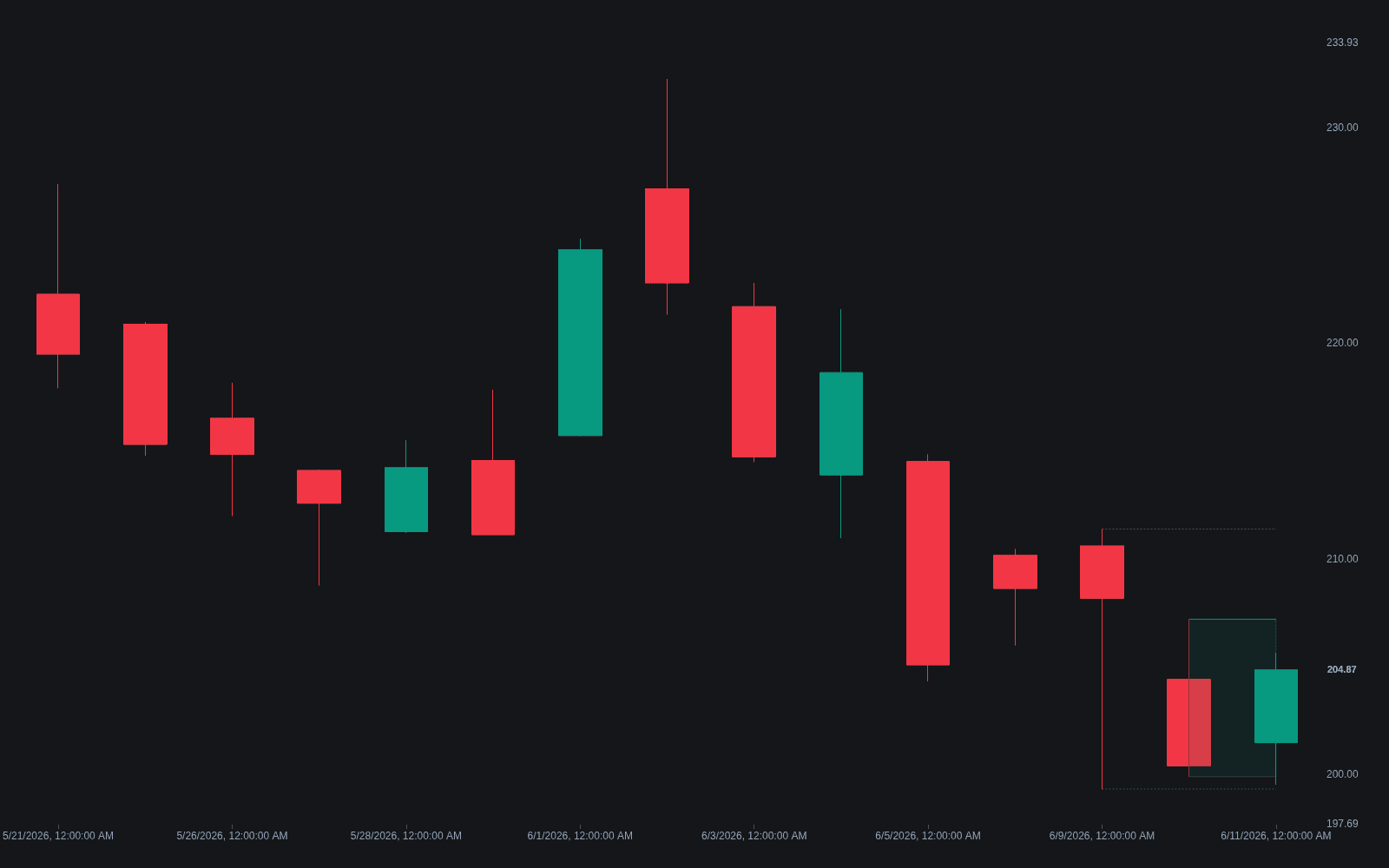
What is a Hikkake?
A hikkake is an inside-bar false breakout, described by technician Daniel Chesler in the early 2000s; the name is Japanese for 'trap'. The sequence: an inside bar forms, price breaks one side of it, the break fails to follow through, and within a few bars price snaps back through the opposite side of the inside bar. That opposite-side break is the trigger, taken in the direction of the snap-back. Retail price-action traders know the same structure as a 'fakey'.
The mechanism is a trap. An inside bar is a contraction, so breakout orders collect on both of its edges; the first break recruits one crowd, and its failure converts those positions into fuel for the move the other way. It is the bar-scale version of a false breakout at a level.
Chesler introduced the pattern in articles for technical-analysis publications, defining it as pure bar geometry with a built-in expiry: no indicator context, just the inside bar, the false break, and a trigger through the opposite extreme within a few bars. He described bullish and bearish versions and, notably, framed the pattern as serving both reversal and continuation depending on where it forms. The Library's implementations, including MLansky's Fakey pattern script and FxLowe's Inside Bar Breakout Failure, automate exactly this sequence detection.
The setup earns its keep at locations where breakout interest is concentrated: range edges, consolidation boundaries within trends, and mapped support or resistance. An inside bar at such a spot loads resting orders on both sides, and the failed first break supplies the trapped positions whose unwinding powers the snap-back. Quality tells include a false break that cannot even close beyond the mother bar, and a trigger bar that expands in range, showing the reversing crowd committing rather than drifting.
How to identify a hikkake pattern
Every element is objective bar geometry, which keeps the checklist short and mechanical.
- 1Locate an inside bar, ideally after a directional leg or at a mapped level where breakout orders accumulate on both sides of the contraction.
- 2Mark the four reference prices: the mother bar's high and low and the inside bar's high and low; every later decision keys off these.
- 3Watch the initial break of the inside bar stall within a bar or two, ideally without a wide-range bar closing beyond the mother bar.
- 4Take the trigger when price comes back through the opposite extreme of the inside bar within roughly three bars of the false break.
- 5Grade the setup: a rejection candle such as a pin bar at the false break, or alignment with the prevailing trend, upgrades it; a countertrend trigger far from any level downgrades it.
- 6Void the pattern if the trigger never fires inside the expiry window, and once entered, invalidate the trade beyond the false break's extreme.
How traders use it
- As an entry trigger: after the initial break stalls, a stop order beyond the opposite extreme of the inside bar catches the snap-back, with invalidation beyond the failed break's extreme.
- As a with-trend filter: many traders only take hikkakes that resolve in the direction of the prevailing trend or off a mapped level, treating countertrend triggers as lower quality.
- With an expiry: a common convention voids the setup if the opposite-side trigger has not fired within about three bars of the false break.
- As a location tool's confirmation layer: a hikkake that fires at prior support or resistance converts a static level into a triggered trade with defined invalidation.
- As a screening pattern in automated scans, where its fully mechanical definition, unusual among candlestick patterns, makes it easy to code, count and backtest by context before any discretionary layer is added.
Hikkake vs related bar patterns
Inside Bar: The straight inside-bar strategy trades the first breakout of the contraction. The hikkake exists because that first break so often fails: it stands aside, lets the break trap participants, and trades the resolution the other way.
Pin Bar: A pin bar is a single-bar rejection read from one wick. The hikkake is a multi-bar sequence that does not care about candle anatomy; the fakey variant taught in price-action courses is simply a hikkake whose false break happens to print a pin bar.
Two-bar Reversal: Both are trap-and-reverse structures. The two-bar reversal keys off two consecutive directional wide bars swapping control, while the hikkake keys off a contraction whose breakout fails; the hikkake therefore carries a built-in reference frame for stops and expiry.
Concept family
Chart & Candlestick Patterns
84 concepts mapped · 84 in the Library
Hikkake FAQ
Turn Hikkake into a trading strategy.
Take the implementation from this page into Quant, then build on it, backtest it on real data, and keep refining it in conversation.