Concept
Belt Hold
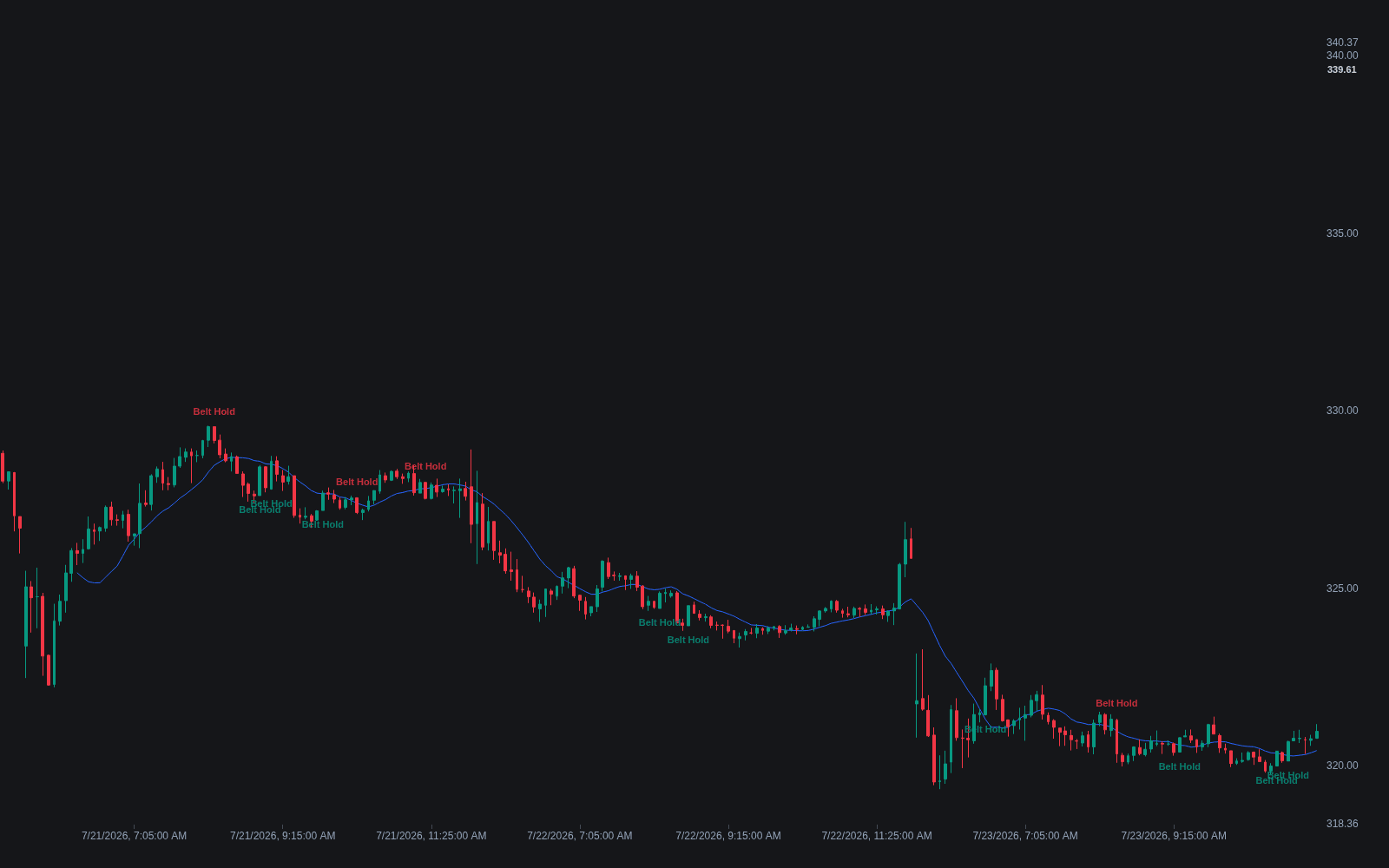
Belt Hold is a Chart & Candlestick Patterns concept. The Library holds 1 implementation, a working definition you can pull into Quant.
Top Belt Hold indicator
The top custom implementation, built on the original standard Belt Hold formula.
1 total
This Belt Hold implementation is strategy-ready: open it in Quant, set your rules, and it backtests automatically.
What is a belt hold?
The belt hold, from the Japanese yorikiri, a sumo term for forcing an opponent out of the ring while gripping his belt, is a single-candle reversal line that opens at its extreme and drives away from it. The bullish belt hold opens at the session low, ideally gapping below the prior close, and closes strongly higher, leaving no lower shadow. The bearish belt hold opens at the session high and closes strongly lower, leaving no upper shadow. In both cases a long real body with little or no shadow on the opening side is the signature.
In candlestick terms it is an opening marubozu: shaved at the open, with some tolerance for a small shadow at the closing end. What gives it meaning is context. Appearing after a decline, a bullish belt hold shows that the market opened at a fresh extreme and buyers controlled the session from the first print; after an advance, the bearish version shows sellers doing the same. Without a preceding trend it is just a strong directional bar.
Traders care about belt holds because they compress a rejection into one session: the open probed continuation, found no acceptance, and the entire body printed against the prior trend. That said, single-candle signals are among the weakest in the candlestick catalog, and most practitioners require confirmation from the next session or from surrounding structure before acting.
How to identify a belt hold on a chart
The line is simple; the discipline is in the context checks.
- 1Require a preceding trend: down for a bullish belt hold, up for a bearish one.
- 2Check the open: a bullish belt hold opens at or essentially at the session low, preferably below the prior close; the bearish version opens at or near the session high, preferably above the prior close.
- 3Require a long real body relative to recent candles, closing well into or beyond the prior candle's range.
- 4Confirm the shaved side: little or no shadow on the opening end; a small shadow at the closing end is acceptable.
- 5Weigh location: belt holds at established support or resistance, or after an extended run, carry more information than ones printing mid-range.
How traders use it
- As an early reversal alert: a belt hold after a sustained move flags a one-session shift in control, prompting traders to tighten stops on trend positions or begin watching for a base rather than immediately reversing.
- With next-bar confirmation: common practice is to act only if the following session closes in the belt hold's direction, since the single line by itself has modest forward evidence in pattern studies.
- For stop placement: the belt hold's opening extreme is the natural invalidation level, because trade back through it means the rejection failed.
- As a continuation filter in reverse: within a strong trend, a belt hold in the trend direction is simply a momentum bar; the reversal reading applies only against the prior move, and even then it often marks a pause rather than a full turn.
Belt hold vs similar single lines
Marubozu: A full marubozu is shaved at both ends and carries no directional-context requirement; the belt hold is an opening marubozu specifically read as a reversal line against the preceding trend.
Bullish and bearish engulfing: The engulfing pattern needs two candles, with the second body wrapping the first; a belt hold makes a comparable statement in one bar by opening at the extreme, but without the explicit takeover of the prior candle's range.
Piercing line: The piercing line also opens below the prior close after a decline, but it is defined by closing above the midpoint of the previous candle's body; the belt hold is defined by its shaved open and long body rather than by penetration depth.
Concept family
Chart & Candlestick Patterns
84 concepts mapped · 84 in the Library
Belt Hold FAQ
Turn Belt Hold into a trading strategy.
Take the implementation from this page into Quant, then build on it, backtest it on real data, and keep refining it in conversation.