Concept
Engulfing Bar
Engulfing Bar is a Chart & Candlestick Patterns concept. The Library holds 1 implementation, a working definition you can pull into Quant.
Top Engulfing Bar indicator
The top custom implementation, built on the original standard Engulfing Bar formula.
1 total
From studying Engulfing Bar to trading it: take the implementation below into Quant and backtest it instantly.
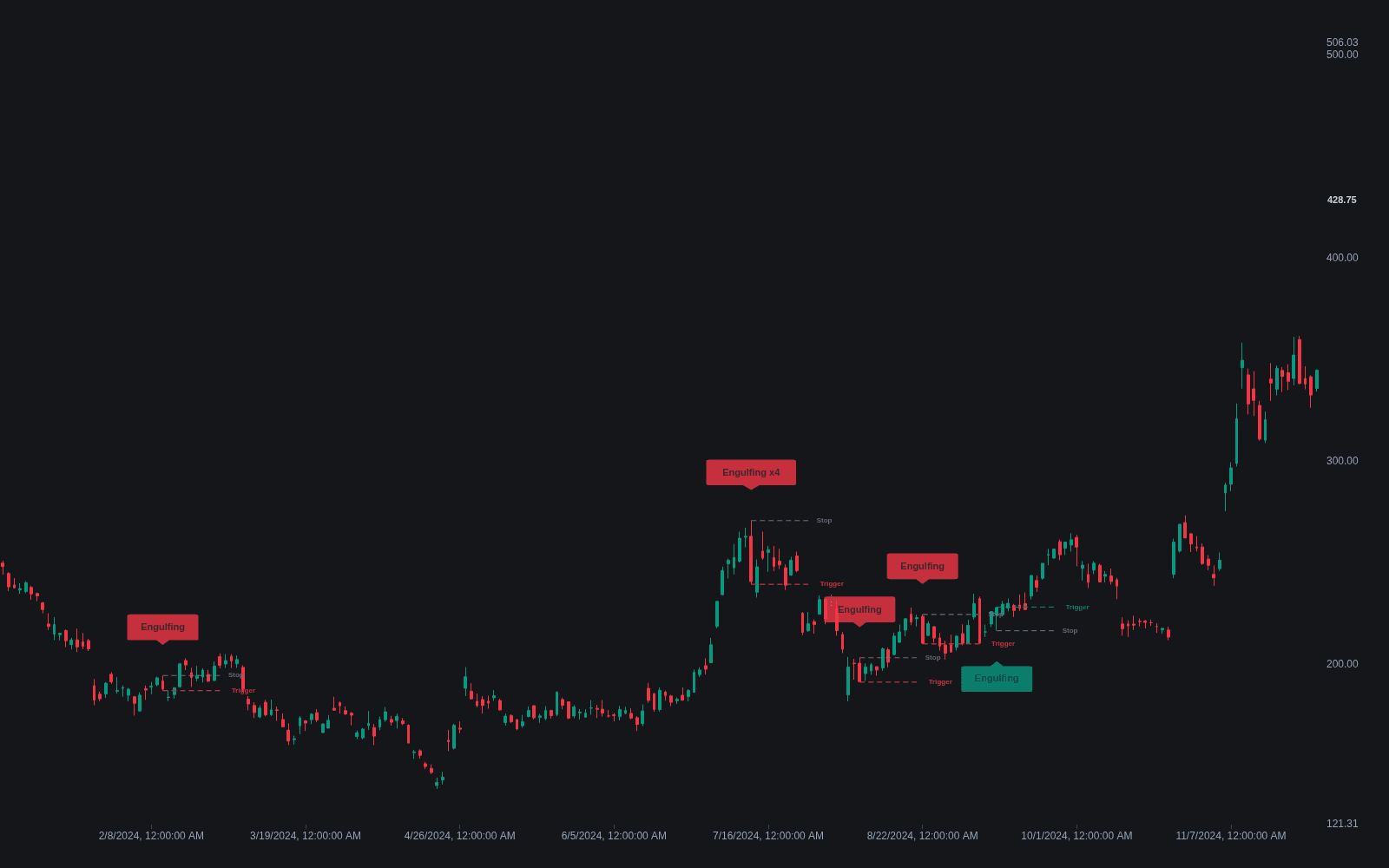
What is an Engulfing Bar?
An engulfing bar is a two-bar pattern in which the second bar's range completely swallows the first: its high exceeds the prior high, its low undercuts the prior low, and it closes beyond the prior bar's extreme in the new direction. A bullish engulfing bar trades below the previous bar's low yet closes above its high; the bearish version mirrors it. Definitions vary by tradition: bar-chart readers compare full high-to-low ranges, while the candlestick catalog's bullish/bearish engulfing compares real bodies and requires opposite-colored candles.
The pattern matters because of what the round trip implies. Price broke one side of the prior bar, found no acceptance, then traversed the entire bar to close beyond the other side, trapping anyone positioned off the first bar. Structurally it is a directional outside bar: the engulfment supplies the trap, and the close location supplies the bias.
The definitions descend from different traditions: the body-comparison version belongs to the Japanese candlestick patterns catalog Steve Nison popularized in the West in the early 1990s, while the range-comparison version comes from Western bar-chart practice, where outside days were tracked long before candlesticks arrived. Price-action traders often blend the two, keeping the full-range test and the candlestick emphasis on close location.
Mechanically, the engulfment is range expansion containing a failed excursion: the round trip runs resting stops on both sides of the prior bar, and late entrants from the first break become fuel for the move in the closing direction. Because the signal bar is usually also a wide-range bar, it says more than most bars about who won the period.
How to identify an engulfing bar on a chart
The pattern is defined by two bars and a handful of price comparisons, so it can be checked mechanically.
- 1Find a bar whose high exceeds the previous bar's high and whose low undercuts the previous bar's low.
- 2For a bullish engulfing bar, require a close above the previous bar's high; for a bearish one, a close below the previous bar's low.
- 3Compare the bar's range with the recent average; an engulfing bar smaller than typical bars carries little of the pattern's intended meaning.
- 4Check what was engulfed: swallowing a tiny doji is a low hurdle, while engulfing one or more full-sized bars says more.
- 5Note the location: at a swing extreme, a tested level, or a pattern boundary the signal has context; in the middle of a range it usually does not.
How traders use it
- As a reversal trigger at a location: an engulfing bar printed at a tested support level, a supply or demand zone, or after a sweep of a prior swing gives the pattern context; entries commonly trigger on the engulfing bar's close or a break of its extreme, with the stop beyond the opposite end.
- As continuation confirmation: a bullish engulfing bar that ends a pullback inside an uptrend suggests the dip has been absorbed, aligning the entry with the prevailing trend rather than against it.
- Filtered for quality: many systems require the engulfing bar to exceed recent average range, to close in the top or bottom third of its span, or to engulf more than one prior bar, because small engulfing bars inside chop fire constantly and mean little.
- As the trigger at pattern boundaries: an engulfing bar at the second peak of a double top/bottom or the edge of a rising or falling wedge turns a structural idea into a defined-risk entry.
- Sequenced with compression: an engulfing bar resolving an inside bar sequence pairs contraction with expansion, close kin to the hikkake idea of trapping breakout traders before moving the other way.
- As an exit warning: an opposite-direction engulfing bar against an open position is a common cue to tighten stops or take partial profits.
Engulfing Bar vs. similar bar patterns
Outside Bar: Every engulfing bar is an outside bar, but the engulfing label adds a directional requirement: the close must finish beyond the prior bar's extreme, not merely sit somewhere inside a bigger range.
Bullish/bearish Engulfing: The candlestick version compares open-to-close real bodies and requires opposite colors; the bar version compares full high-to-low ranges, so the two conventions do not always tag the same bars.
Two-bar Reversal: A two-bar reversal pairs two strong bars of similar size closing in opposite directions; the second bar does not need to engulf the first, only to close firmly the other way.
Pin Bar: A pin bar expresses rejection within one bar through a long tail and small body, without needing to exceed both prior extremes. The engulfing bar spreads the rejection across two bars and demands full traversal, a stricter test.
Concept family
Chart & Candlestick Patterns
84 concepts mapped · 84 in the Library
Engulfing Bar FAQ
Turn Engulfing Bar into a trading strategy.
Take the implementation from this page into Quant, then build on it, backtest it on real data, and keep refining it in conversation.