Concept
Gravestone Doji
Gravestone Doji is a Chart & Candlestick Patterns concept. The Library holds 1 implementation, a working definition you can pull into Quant.
Top Gravestone Doji indicator
The top custom implementation, built on the original standard Gravestone Doji formula.
1 total
From studying Gravestone Doji to trading it: take the implementation below into Quant and backtest it instantly.
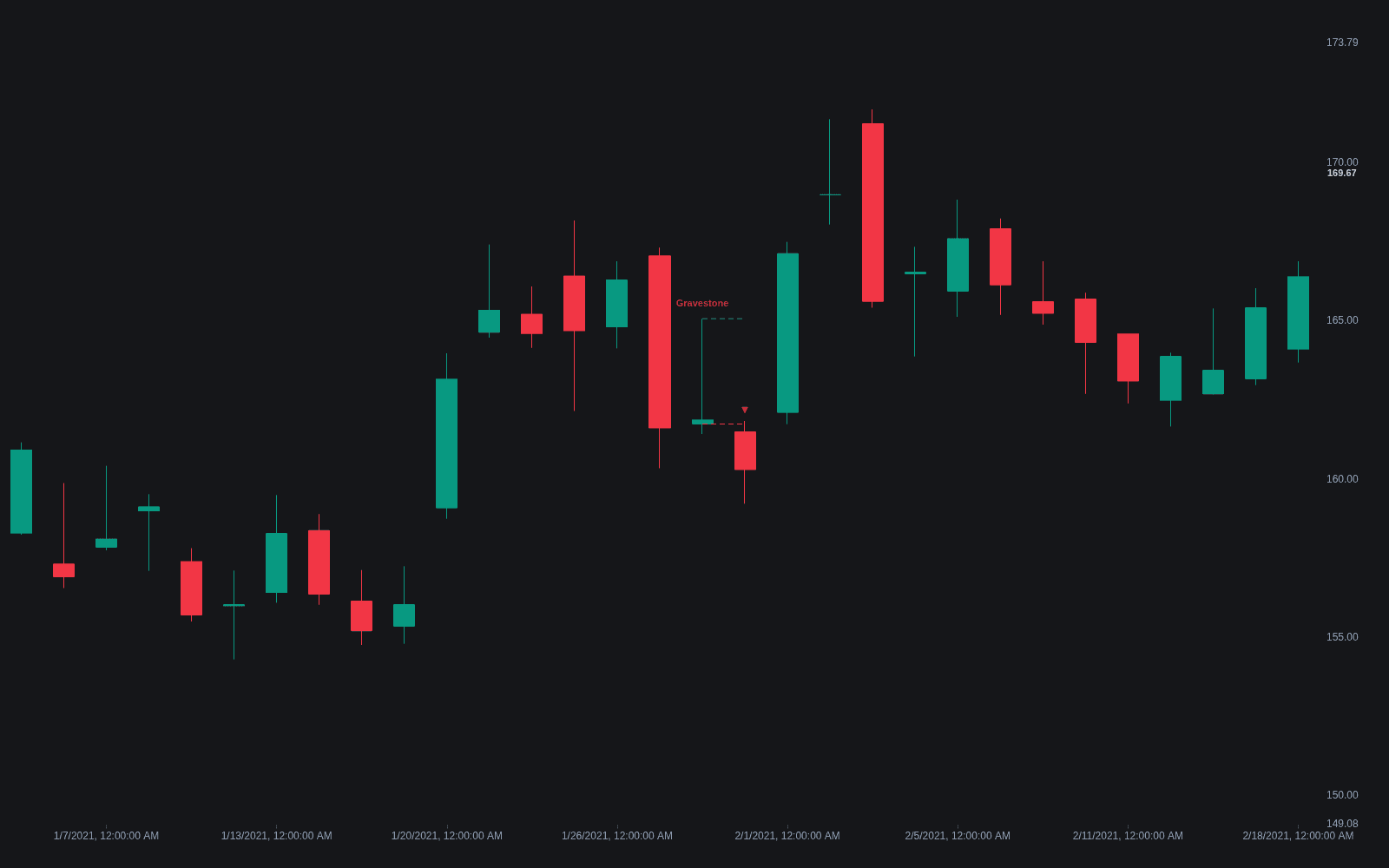
What is a gravestone doji?
The gravestone doji is a single candle shaped like an inverted T: open, close, and low all sit at or very near the same price at the bottom of the range, with a long upper shadow above. It is the doji variant in which the session's entire excursion happened above the open and was fully given back by the close, so the candle records a failed push to higher prices.
The name is the Japanese tradition's grim image of buyers who advanced during the session and did not survive it. After an uptrend, the long upper shadow shows that higher prices were available and were refused: buyers carried the market up, supply met them, and the close returned to the open. That is why the gravestone is primarily watched as a topping alert at highs, at resistance, or after an extended advance. A gravestone after a decline is occasionally read as a probing, indecisive attempt at recovery, but the bearish-reversal reading at highs is the standard one.
As with every single-candle formation in the candlestick catalog, the gravestone documents the failure of one side rather than the commitment of the other. Sellers erased the rally; whether they can press the market lower is a separate question the next sessions answer, which is why confirmation is standard practice.
How to identify a gravestone doji on a chart
The inverted-T shape is easy to spot; the qualifying checks separate signal from noise.
- 1Require open and close to be equal or nearly equal, placed at or very near the low of the bar, leaving no meaningful body and little or no lower shadow.
- 2Require a long upper shadow, commonly at least two to three times any body height and long relative to recent bars.
- 3Weigh context: the candle matters after an advance or at resistance, where the failed excursion has something to reject; mid-range prints are mostly noise.
- 4Prefer elevated volume on the session, which supports the supply-response reading of the upper shadow.
- 5Wait for confirmation, typically a following close below the gravestone's body, before treating the top as in place.
How traders use it
- As a topping alert: a gravestone at resistance or after a steep advance flags active supply overhead, prompting longs to tighten stops or scale out and prompting reversal traders to watch for a confirming down-close.
- For risk definition: the high of the shadow is the natural invalidation level, since acceptance above it means the rejected prices were not rejected for long.
- As one input in confluence: gravestones that print at measured targets, prior highs, or other independent levels are graded well above isolated ones, consistent with general candlestick practice.
- With honest limits: in strong uptrends single upper-shadow candles frequently mark only a pause, and buying pressure resumes. The pattern locates a possible turn and a stop level; it does not predict the turn.
Gravestone doji vs neighboring candles
Shooting star: The shooting star has a small real body at the bottom of its range, while the gravestone's open and close coincide. Both encode the same failed excursion higher, and the practical difference is minor.
Inverted hammer: The inverted hammer is the same shape appearing after a decline, where it is read as a tentative bullish probe. Shape alone does not decide the meaning; the preceding trend does.
Dragonfly doji: The dragonfly is the mirror image: open and close at the high with a long lower shadow, recording a rejected excursion lower rather than higher.
Concept family
Chart & Candlestick Patterns
84 concepts mapped · 84 in the Library
Gravestone Doji FAQ
Turn Gravestone Doji into a trading strategy.
Take the implementation from this page into Quant, then build on it, backtest it on real data, and keep refining it in conversation.