Concept
Exhaustion Bar
Exhaustion Bar is a Chart & Candlestick Patterns concept. The Library holds 1 implementation, a working definition you can pull into Quant.
Top Exhaustion Bar indicator
The top custom implementation, built on the original standard Exhaustion Bar formula.
1 total
The Exhaustion Bar implementation below can become a backtested trading strategy — describe your rules and Quant writes the code.
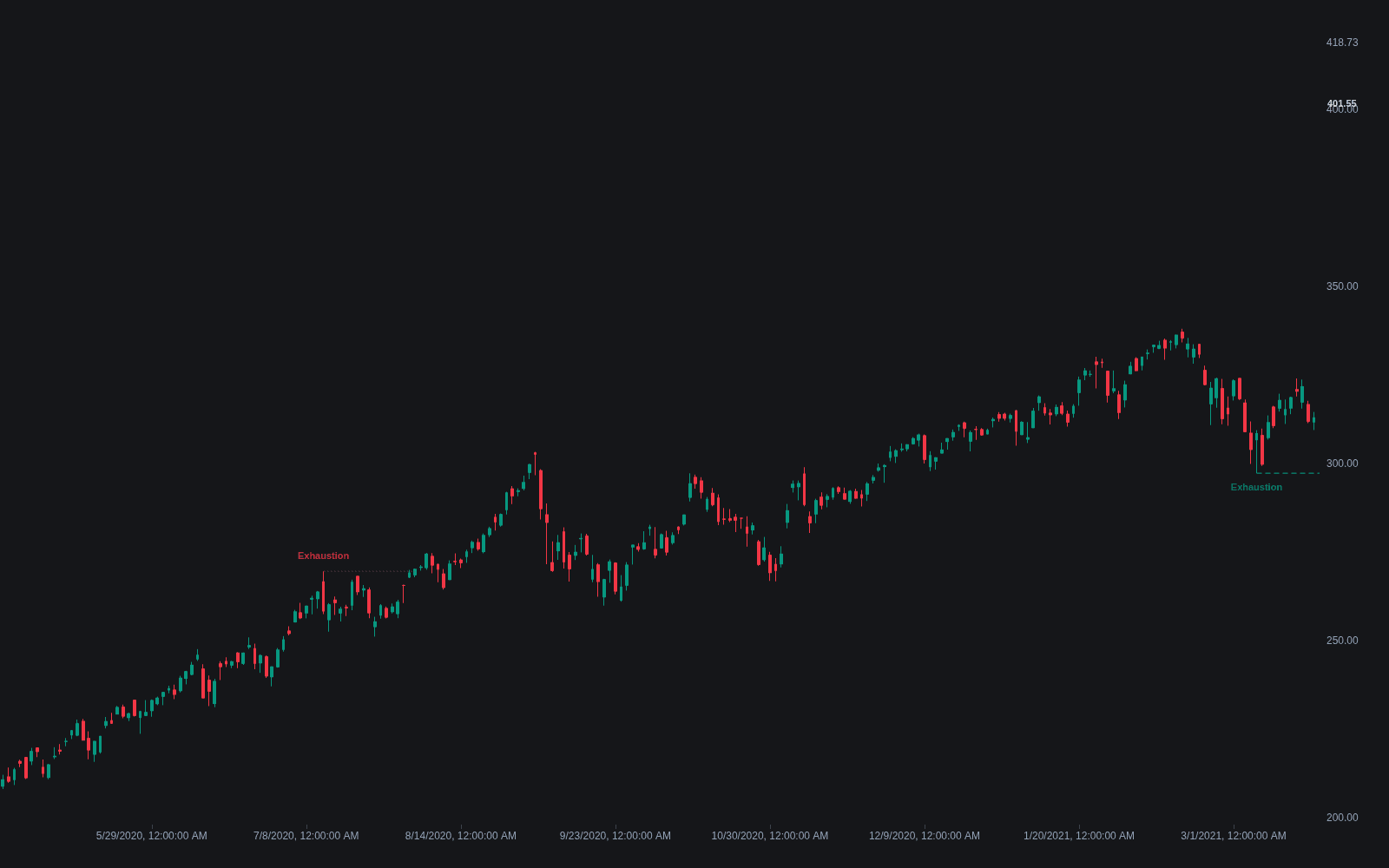
What is an Exhaustion Bar?
An exhaustion bar is a single bar that marks the apparent end of a directional move: it extends the trend forcefully, often with unusually wide range, a gap, or a volume spike, yet closes poorly for the trend's direction, back inside its range or near the opposite extreme. In an uptrend the classic form drives to a new high on heavy volume but closes near its low; in a downtrend it plunges to a new low and closes near its high.
The bar matters because of what the combination implies. Wide range and heavy volume show maximum effort; a close that gives most of it back shows minimal result. In volume-analysis terms the trend's final buyers (or sellers) have been drawn in and absorbed by the other side, an idea closely related to climactic action and stopping volume in the Wyckoff-influenced literature. The move has spent its fuel on a single bar.
Definitions vary by author, and that is worth being honest about. Some require a gap in the trend direction that the bar then fails to hold; others emphasize range and close location relative to recent bars; volume-focused readings insist on a participation extreme. The shared core is a trend-direction extreme, an effort signature, and a weak close against the trend, appearing after an extended move rather than mid-range.
How to identify an exhaustion bar
Context does most of the work: the same bar in the middle of a range means nothing.
- 1Require an extended, ideally accelerating prior trend; exhaustion needs something to exhaust.
- 2Look for a bar that makes a new extreme for the move, often after a gap in the trend direction.
- 3Check the effort signature: range noticeably wider than recent bars, and volume well above recent averages where volume is meaningful.
- 4Check the result: the close should be in the opposite half of the bar's range, ideally in the opposite quarter, giving back most of the bar's excursion.
- 5Prefer bars that leave a long wick beyond all nearby price action, showing the probe was rejected rather than accepted.
- 6Wait for confirmation if desired: a following bar closing beyond the exhaustion bar's midpoint or opposite extreme, as in a two-bar reversal, substantially cleans up the signal.
How traders use it
- Countertrend entry with a bar-defined stop: enter against the trend on the close of the bar or on the next bar's confirmation, with the stop beyond the exhaustion extreme; the bar supplies both trigger and invalidation, which is its main practical appeal.
- Profit-taking signal: trend followers use exhaustion bars not to reverse but to exit or reduce, since even when the trend later resumes, an exhaustion bar frequently precedes a multi-bar retracement.
- Marking a reference extreme: the bar's wick tip often behaves as a durable level, and traders watch subsequent tests of it, since acceptance beyond it argues the move was continuation, not exhaustion.
- Building block for larger reversals: exhaustion bars commonly form the tip of a V-reversal or the climax within a bottoming process, so many traders treat the bar as the alert and the following structure as the trade.
- Honest limitation: strong trends print false exhaustion bars repeatedly, and fading every one is a losing habit; the signal performs best at extended extremes, into higher-timeframe levels, and worst against fresh momentum.
Exhaustion bar vs. related single-bar signals
Pin bar: The pin bar is defined purely by its shape, a long tail and small body, at any location; the exhaustion bar adds requirements of trend context, extreme extension, and usually an effort signature in range or volume.
Key reversal: The key reversal specifies open and close mechanics, a new extreme with a close beyond the prior bar's close; exhaustion bar is the looser, effort-and-result reading of the same event.
Exhaustion gap: The exhaustion gap is the gap version of the same idea, a final enthusiasm gap that fails; an exhaustion bar often begins life as an exhaustion gap that closes weak.
Concept family
Chart & Candlestick Patterns
84 concepts mapped · 84 in the Library
Exhaustion Bar FAQ
Turn Exhaustion Bar into a trading strategy.
Take the implementation from this page into Quant, then build on it, backtest it on real data, and keep refining it in conversation.