Concept
Tri-star
Tri-star is a Chart & Candlestick Patterns concept. The Library holds 1 implementation, a working definition you can pull into Quant.
Top Tri-star indicator
The top custom implementation, built on the original standard Tri-star formula.
1 total
The Tri-star implementation below can become a backtested trading strategy — describe your rules and Quant writes the code.
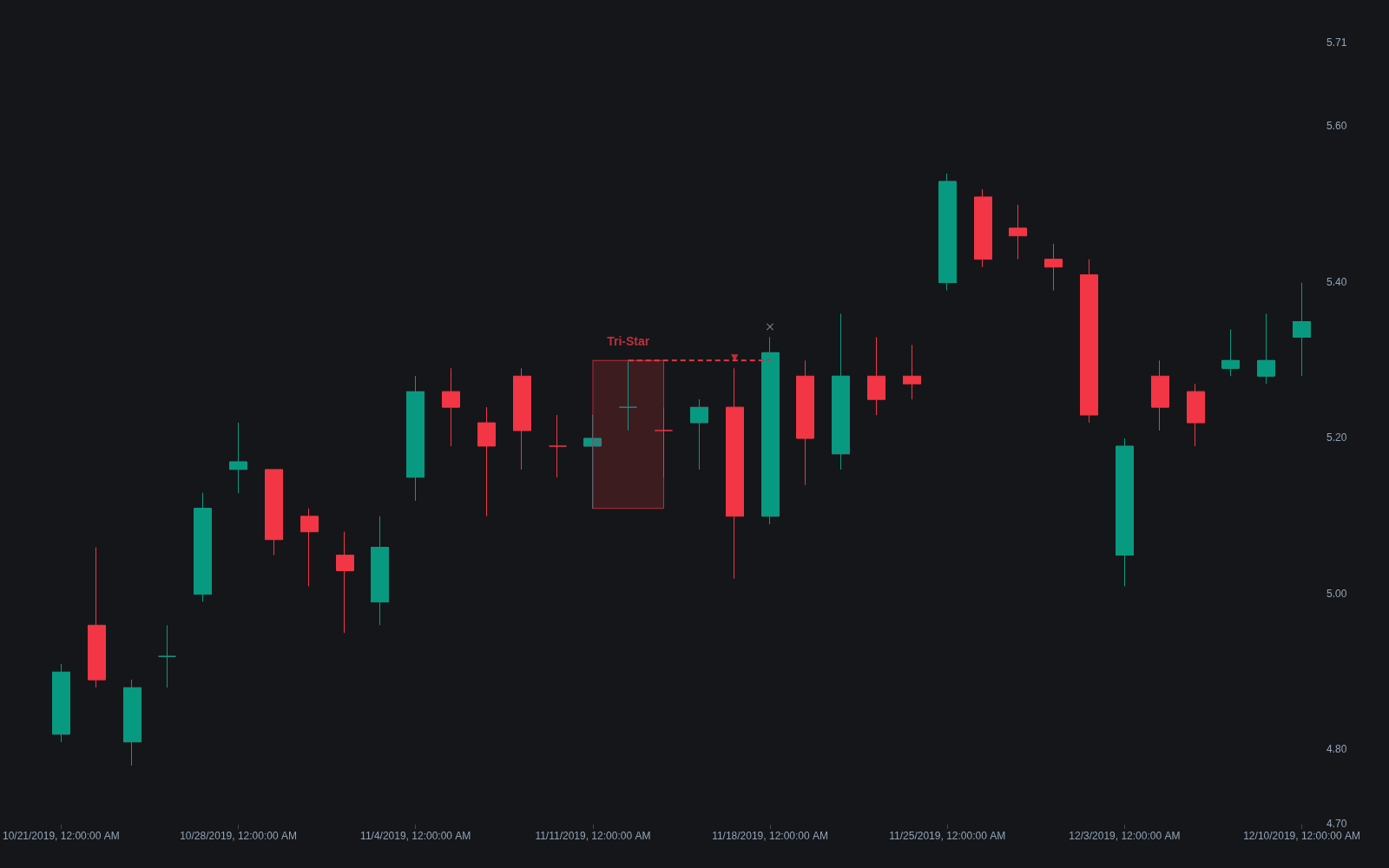
What is a Tri-Star?
The tri-star is a rare three-candle reversal pattern from the Japanese candlestick tradition: three consecutive doji in which the middle doji gaps away from its neighbors. A bearish tri-star forms after an advance, with the middle doji gapping above the other two; the bullish version forms after a decline, with the middle doji gapping below. Three straight sessions in which open and close finish essentially equal signal that directional conviction has drained out of the trend entirely.
The logic is exhaustion stacked on exhaustion. A single doji after a trend is a pause; three in a row, with the middle one stranded at a gap extreme, records a market that pushed to a new price zone and found no acceptance there on either side. That stranded middle doji resembles the island of an island reversal compressed into a single indecisive bar.
Traders care about it mostly because of its rarity and its context. Strict tri-stars are genuinely uncommon on liquid daily charts, since three consecutive doji with clean gaps require a very specific fade in participation. When one does appear at the end of an extended move, candlestick literature treats it as a strong reversal warning, though sample sizes are small enough that its statistics are less settled than those of common patterns, and confirmation from the next candle is conventionally required.
How to identify a tri-star on a chart
Strictness matters here; loosening the doji or gap requirements turns a rare pattern into ordinary chop.
- 1Establish a clear preceding trend, since three doji inside a sideways range signal nothing.
- 2Require three consecutive doji: each candle's open and close should be essentially equal, with real bodies far smaller than recent bars.
- 3Check the middle doji: it should gap above the first and third doji at a top, or below them at a bottom, even if only by a small margin.
- 4Distinguish doji from spinning tops; small but visible bodies weaken the pattern.
- 5Wait for confirmation: a decisive candle in the reversal direction closing beyond the third doji.
- 6In 24-hour markets where true gaps are rare, accept that strict tri-stars will almost never print, rather than relaxing the definition.
How traders use it
- As a reversal alert rather than a standalone entry: most practitioners wait for a confirming close against the prior trend before acting, because doji signal indecision, not direction.
- Stop placement is naturally defined by the extreme of the middle doji; acceptance beyond it reinstates the prior trend and invalidates the read.
- Some traders treat a loose tri-star, three near-doji without perfect gaps, as a milder exhaustion note and combine it with support, resistance, or momentum divergence rather than trading it alone.
- Rarity is a real limitation: the pattern appears too infrequently to anchor a systematic strategy, so it functions best as one input among broader candlestick patterns analysis.
Tri-star vs. related exhaustion patterns
Abandoned Baby: The abandoned baby isolates a single gapped doji between two directional candles; the tri-star replaces those directional candles with doji as well, showing indecision across all three sessions.
Evening Star: An evening star's first and third candles have real bodies that show the handoff from buyers to sellers; a tri-star never shows that handoff, only a total stall, which is why it leans harder on confirmation.
Doji: A lone doji is a common pause that resolves either way; the tri-star is three of them with a gapped middle, a far rarer and conventionally stronger exhaustion signal.
Concept family
Chart & Candlestick Patterns
84 concepts mapped · 84 in the Library
Tri-star FAQ
Turn Tri-star into a trading strategy.
Take the implementation from this page into Quant, then build on it, backtest it on real data, and keep refining it in conversation.