Concept
Three Inside Up/down
Three Inside Up/down is a Chart & Candlestick Patterns concept. The Library holds 1 implementation, a working definition you can pull into Quant.
Top Three Inside Up/down indicator
The top custom implementation, built on the original standard Three Inside Up/down formula.
1 total
Want to trade Three Inside Up/down? The implementation below is one prompt away from a backtested strategy in Quant.
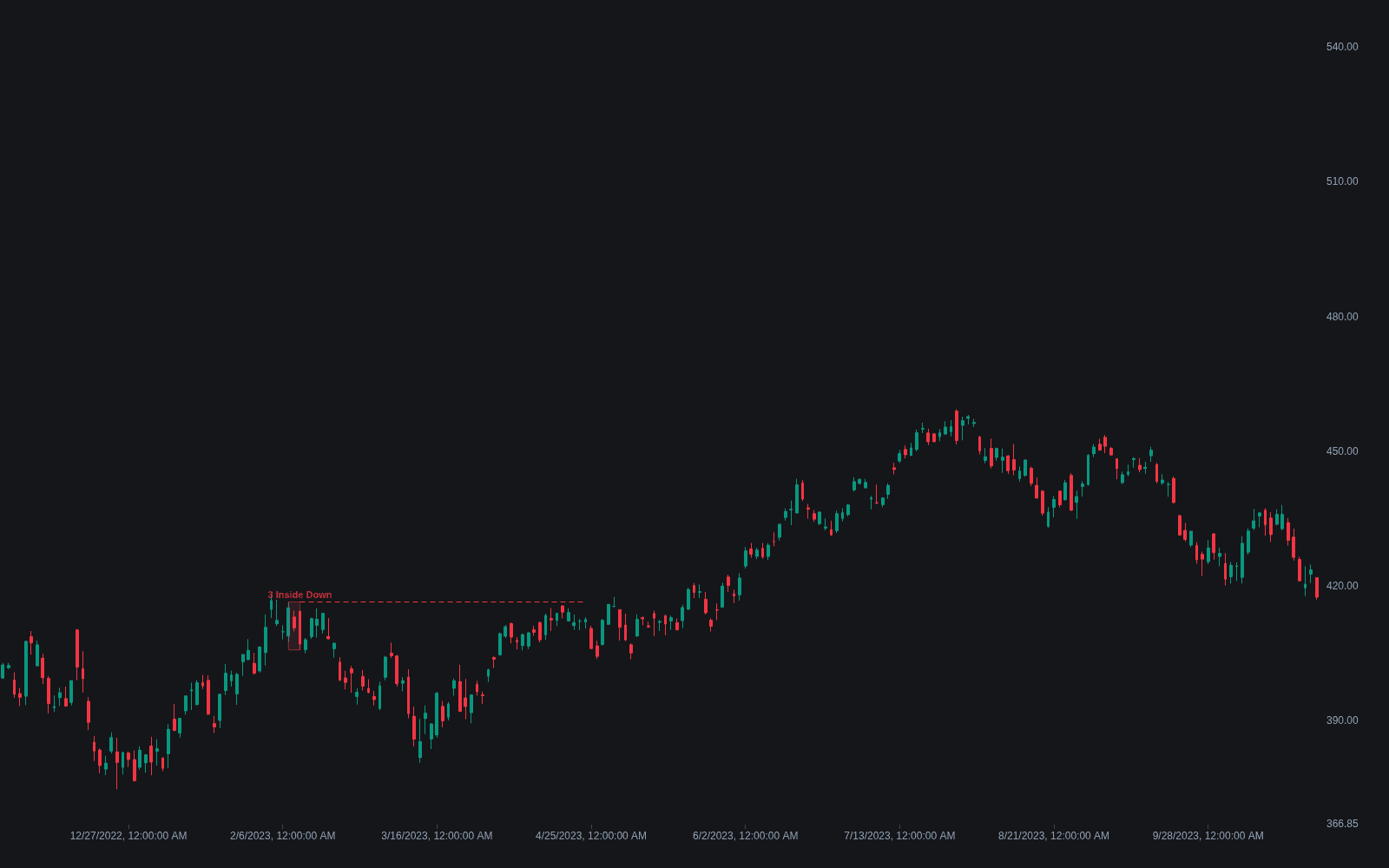
What is a Three Inside Up or Three Inside Down?
Three inside up and three inside down are three-candle reversal patterns built directly on the harami. The three inside up starts with a long dark candle in a decline, followed by a smaller white candle contained within the first candle's real body (the bullish harami), and completes with a third candle closing above the first candle's high or, in looser definitions, above the second candle's close. The three inside down is the mirror at the top of an advance: long white candle, contained dark candle, then a close below the first candle's low.
The pattern exists to solve the harami's central weakness. A harami on its own only records a pause: a big move followed by a session trapped inside it, which can precede reversal or nothing at all. The third candle converts that ambiguity into evidence by requiring price to actually leave the pattern in the reversal direction. In effect, the three inside patterns are the harami plus the confirmation candle most practitioners would have waited for anyway, formalized into a named pattern; that formalization is generally associated with Gregory Morris's work on candlestick pattern testing.
Traders care because confirmation-inclusive patterns are easier to act on and to code: the completion candle defines the entry, and the pattern's extremes define invalidation. The cost is the familiar one for all confirmed reversals, later entry. By the time the third candle closes beyond the first candle's range, a portion of the initial reversal move has already happened.
How to identify three inside up/down
Verify the harami first; the third candle only means something if the containment was real.
- 1Confirm trend context: a decline before a three inside up, an advance before a three inside down.
- 2Require a long first body in the trend direction, then a second candle whose real body is contained within the first candle's real body and colored against the trend.
- 3Check the third candle: it should close beyond the first candle's extreme in the reversal direction (above its high for up, below its low for down); looser variants accept a close beyond the second candle's close.
- 4Prefer a decisive third body rather than a marginal poke; a doji-like third candle leaves the reversal claim unconfirmed in spirit.
- 5Set invalidation at the pattern's far extreme: a return through it negates the confirmed reversal.
How traders use it
- As a self-confirming reversal entry: traders enter on the third candle's close, with the stop beyond the opposite end of the pattern, avoiding the separate wait-for-confirmation step a bare harami requires.
- As a screener signal: the three-candle structure is fully objective, which makes it common in scanners; the choice between the strict completion rule (beyond the first candle's extreme) and the loose one materially changes signal frequency.
- As a location-dependent setup: like most candlestick reversals, its practical value concentrates at meaningful spots, a support level, a prior swing, or an extended trend, rather than mid-range.
- As a trade-off decision: the built-in confirmation lowers the false-signal rate relative to an unconfirmed harami in most tests, but the later entry worsens the achievable reward-to-risk, so neither version dominates the other.
Three inside vs neighboring patterns
Harami: The three inside pattern is a harami plus a confirming third candle. The harami alone flags a pause; the third close is what asserts a direction.
Three outside up/down: The outside version is built on an engulfing candle instead of a contained one: the second candle wraps the first rather than fitting inside it. Both add the same style of confirmation candle.
Morning star: The morning star also uses a small middle candle and a confirming third, but its middle candle gaps or drops away from the first body rather than sitting inside it, marking a deeper stall before the turn.
Concept family
Chart & Candlestick Patterns
84 concepts mapped · 84 in the Library
Three Inside Up/down FAQ
Turn Three Inside Up/down into a trading strategy.
Take the implementation from this page into Quant, then build on it, backtest it on real data, and keep refining it in conversation.