Concept
Marubozu
Marubozu is a Chart & Candlestick Patterns concept. The Library holds 1 implementation, a working definition you can pull into Quant.
full/opening/closing
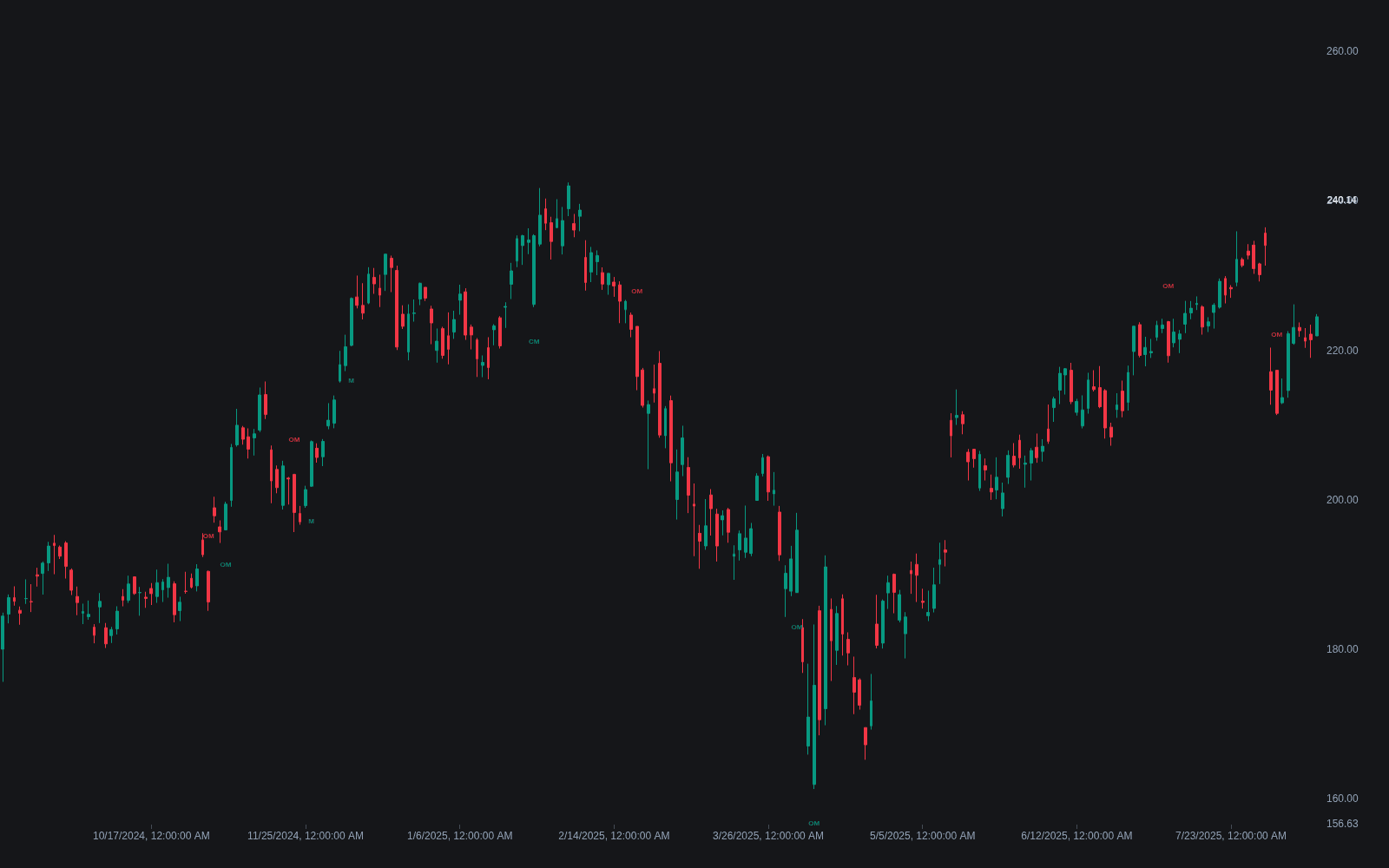
Top Marubozu indicator
The top custom implementation, built on the original standard Marubozu formula.
1 total
From studying Marubozu to trading it: take the implementation below into Quant and backtest it instantly.
What is a Marubozu?
A marubozu is a candlestick that is all body: open and close sit at (or nearly at) the bar's extremes, leaving no meaningful shadow on either end. The Japanese name means 'bald' or 'shaved'. A bullish marubozu opens at its low and closes at its high; a bearish one opens at its high and closes at its low. One side held control from the first trade to the last, which makes it the conviction candle, the opposite end of the spectrum from a doji.
Candlestick references split the pattern three ways: a full marubozu has no shadow at either end, an opening marubozu has none at the open end, and a closing marubozu has none at the close end. The closing variant is conventionally read as the stronger of the partial forms, since the drive persisted into the close. As with any wide-range bar, location decides the meaning: initiative early in a move, potentially climactic after an extended one.
The image is of a close-cropped or shaven head, a candle with no hair at either end; the partial forms are likewise called shaven head and shaven bottom. The pattern entered Western charting mainly through Steve Nison's Japanese Candlestick Charting Techniques (1991), which imported the Japanese rice-trading lexicon. In strict form it is rare on liquid markets, since some sliver of wick usually prints, so coded detectors typically allow shadows up to a few percent of the bar's range and require the body to be large relative to recent bars.
Read as an auction, a marubozu is an open drive: one side was in control at the first print and never surrendered it, with no counter-auction strong enough to leave a tail. That is why it carries more information than an ordinary large candle among candlestick patterns. Context still rules: on a one-minute chart a shadowless bar is routine, on a daily or weekly chart it summarizes a fully one-sided session, and around scheduled news it may reflect a single order burst rather than durable conviction.
How to identify a marubozu on a chart
The pattern is a single candle, so identification is a short checklist applied to the bar and its surroundings.
- 1Find candles that are essentially all body: open and close at, or within a small tolerance of, the extremes, commonly a few percent of the total range.
- 2Require meaningful size: the body should exceed the typical range of recent bars, since a shadowless but tiny candle says little.
- 3Classify the form: no shadows at all is a full marubozu, none at the open end is an opening marubozu, none at the close end is a closing marubozu.
- 4Read the location: out of a base or through a level it is initiative; after an extended run it may be climactic. Check volume where available.
- 5Note what it builds: one that clears the prior bar's range can complete a bullish or bearish engulfing pattern, and one following a quiet inside bar coil often marks expansion from contraction.
How traders use it
- As a breakout-quality read: a marubozu closing through a level suggests one-sided participation through the break, versus a long-wicked candle that traded through and was pushed back.
- As a component of larger patterns: engulfing sequences, three-soldiers-style advances, momentum ignition candles, and the recovery candle of a morning star all read stronger when the individual bars are marubozu-like.
- As an exhaustion caution: an unusually large marubozu after a long run can be the climax rather than the beginning, so many traders check volume and how price treats the candle's midpoint before chasing it.
- As a reference frame for risk: the candle's extremes and midpoint act as short-term levels. Price holding above the midpoint keeps the drive credible, while a full retrace that swallows the bar sets up a two-bar reversal read.
- As a scan filter: requiring marubozu-quality bodies in pattern scanners cuts noise, since a close near the extreme with little rejection is what most momentum entries want anyway.
Marubozu vs other single-candle reads
Wide-range Bar: A wide-range bar is defined by size alone and may carry long shadows; a marubozu is defined by absent shadows and can be modest in size. The strongest conviction candle is both: unusually large and shadowless.
Doji: The doji is the exact opposite: all shadow and virtually no body, a bar that ended where it began. A marubozu shows total one-sided control, a doji a stand-off; the spectrum of candle bodies lies between them.
Pin Bar: A pin bar's information lives in its single long tail, a rejected probe. A marubozu has no tail at all, showing acceptance and drive; one argues for reversal of the probed move, the other for continuation.
Engulfing Bar: An engulfing bar is defined relative to the prior candle's range, a two-bar comparison, while a marubozu is judged on its own anatomy. The two stack: an engulfing candle that is also a marubozu is that reversal's strongest textbook form.
Concept family
Chart & Candlestick Patterns
84 concepts mapped · 84 in the Library
Marubozu FAQ
Turn Marubozu into a trading strategy.
Take the implementation from this page into Quant, then build on it, backtest it on real data, and keep refining it in conversation.