Concept
Spinning Top
Spinning Top is a Chart & Candlestick Patterns concept. The Library holds 1 implementation, a working definition you can pull into Quant.
Top Spinning Top indicator
The top custom implementation, built on the original standard Spinning Top formula.
1 total
Want to trade Spinning Top? The implementation below is one prompt away from a backtested strategy in Quant.
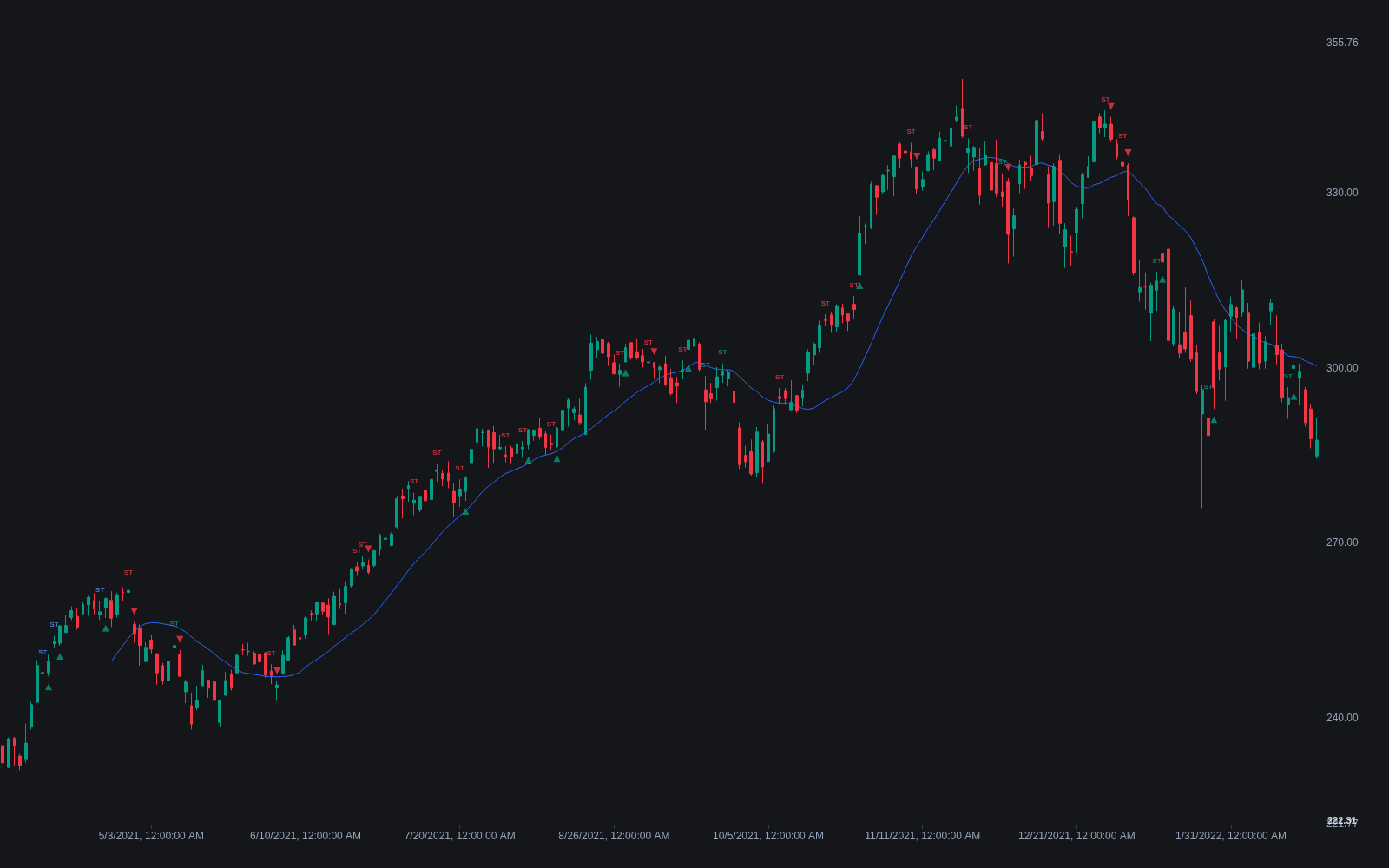
What is a Spinning Top?
A spinning top is a single candle with a small real body near the middle of its range and upper and lower shadows that are each longer than the body. The shape records a session where both sides pushed and neither held: price traveled well above and below the open, then settled close to where it started. Body color matters little, since the open-to-close distance is small by definition. It is the standard candlestick shorthand for indecision, one step short of a doji, whose body is virtually zero, and the polar opposite of a marubozu, which is all body and no shadow.
Context supplies all of the meaning. After a strong directional run, a spinning top says momentum stalled and the next candle gets to resolve the standoff; inside an established range it is ordinary noise. It is also the archetypal middle candle of star reversals such as the morning star.
The Japanese tradition named it koma, after the child's toy it resembles, and the taxonomy around it grades indecision by degree: the doji at the extreme where the body vanishes, the spinning top with its small but visible body, and the high-wave candle, the wilder cousin whose shadows stretch to multiples of the body, indecision with violence. Measurement conventions are honest approximations, scanners typically demanding a body under some fraction of the range, a third being common, with both shadows exceeding the body, and the thresholds between the species are arbitrary enough that different tools tag different bars.
Frequency is the reading's discipline: spinning tops print constantly, so nearly all of them mean nothing, and the ones that matter are located, after extended runs, at mapped levels, in the star position of multi-candle reversals. Volume adds the second dimension: an indecisive candle on unremarkable volume is a rest, while the same shape on heavy volume at an extreme records a genuine fight where size changed hands without progress, churn worth respecting. Scanner builds that tag momentum versus indecisive candles automate the sorting, leaving the trader the location judgment.
How to identify a spinning top
Small body, centered, both shadows longer: then location does the rest.
- 1Require a small real body: open-to-close distance well under the bar's range, a third or less in common scanner rules.
- 2Require centrality: the body sitting near the middle of the range rather than pinned at either end.
- 3Require both shadows to exceed the body, the two-sided excursion that separates indecision from one-sided rejection.
- 4Locate it: after an extended run or at a mapped level the bar is information, inside a drifting range it is noise.
- 5Wait for resolution: the following candle's direction converts the standoff into a read, and most playbooks act on that candle, not the top itself.
How traders use it
- As a pause marker after an extended move: traders wait for the following candle to resolve direction before reading it as reversal or continuation.
- As the indecision component inside multi-candle patterns, most visibly the star position of morning and evening stars.
- As a filter: entries that would trigger on a spinning top are often skipped or downsized because the bar carries no directional information on its own.
- With volume context: a spinning top on heavy volume at an extreme reads as churn, size fighting without progress, and earns attention that the common quiet variety never deserves.
- In automated tagging: indecisive-candle finders classify bars mechanically, so systems can suppress signals on indecision bars and journals can measure how often the standoffs resolved each way.
Spinning top vs related single candles
Doji: The same indecision one degree further: the doji's open and close nearly coincide, its body a line. The boundary between the two is an arbitrary body threshold that varies by scanner, and their readings are identical in kind, the doji simply the stronger statement.
Pin Bar: Both carry long shadows; the difference is symmetry. The pin bar's single dominant wick records one-sided rejection, a directional statement; the spinning top's balanced wicks record a stalemate. One says a side failed, the other says neither side won.
Marubozu: The polar opposite: all body, no shadow, one side in complete control from open to close. Between the marubozu's conviction and the spinning top's balance runs the whole single-candle spectrum, and reading bars is largely locating them on it.
Concept family
Chart & Candlestick Patterns
84 concepts mapped · 84 in the Library
Spinning Top FAQ
Turn Spinning Top into a trading strategy.
Take the implementation from this page into Quant, then build on it, backtest it on real data, and keep refining it in conversation.