Concept
Runaway Gap
Runaway Gap, also known as measuring gap, is a Chart & Candlestick Patterns concept. The Library holds 1 implementation, a working definition you can pull into Quant.
Top Runaway Gap indicator
The top custom implementation, built on the original standard Runaway Gap formula.
1 total
Want to trade Runaway Gap? The implementation below is one prompt away from a backtested strategy in Quant.
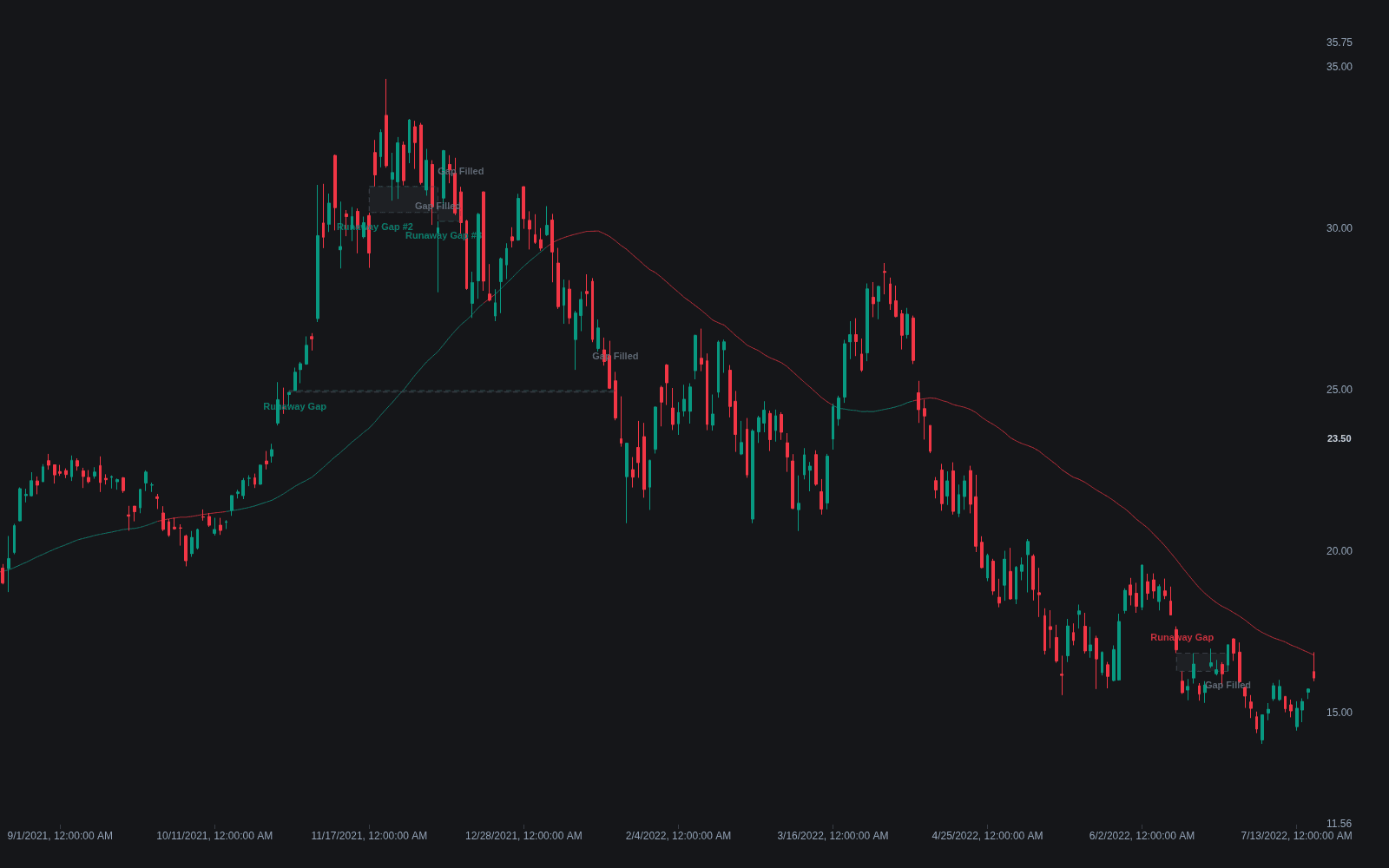
What is a Runaway Gap?
A runaway gap, also called a measuring gap or continuation gap, is a price gap that appears in the middle of an established trend rather than at its beginning or end. Price is already moving, conviction strengthens, and one session simply opens beyond the prior session's range and keeps going. Unlike a gap that starts a move or one that ends it, the runaway gap records a trend healthy enough to skip prices entirely.
It is the middle member of the classical gap taxonomy associated with Edwards and Magee: the breakaway gap begins a trend out of a base, the runaway gap extends it, and the exhaustion gap finishes it. The alias measuring gap comes from the classical guideline that this gap tends to appear near the midpoint of the overall move, so the distance from the trend's origin to the gap can be projected beyond it to estimate a target, a gap-based cousin of the measured move.
Traders care for two reasons. First, a runaway gap is a continuation signal: it implies the trend has enough fuel that pullbacks may stay shallow. Second, it tends not to fill while the trend remains intact, so the gap zone itself becomes a reference. A close back through a supposed runaway gap is a meaningful warning that the trend is weaker than it looked, or that the gap was really exhaustion in disguise.
How to identify a runaway gap on a chart
The defining evidence is trend position plus persistence: a mid-trend gap that holds.
- 1Confirm an established trend is already underway, typically after an earlier breakout or breakaway gap from a base.
- 2Find a gap that prints with the trend, roughly mid-move, not at the launch point and not after a long climactic stretch.
- 3Check volume: conventionally solid but less extreme than the frenzy that accompanies exhaustion; the market is confident, not panicking.
- 4Watch whether the gap holds; a runaway gap tends to resist gap fill while the trend persists, and price often uses the gap zone as support or resistance on pullbacks.
- 5Apply the measuring guideline loosely: project the distance from the trend origin to the gap forward from the gap for a rough objective, treating it as an estimate rather than a rule.
- 6Reclassify honestly if evidence changes: a quick fill and stalled progress suggest the gap was exhaustion, not continuation.
How traders use it
- Trend confirmation: a runaway gap tells trend followers the move has institutional participation behind it, supporting decisions to hold winners or add on shallow pullbacks rather than take profits early.
- Target estimation: the measuring-gap projection gives a rough objective for the remainder of the move; large pattern studies treat it as a coarse tendency, so it is better used for expectation setting than for precise exits.
- Gap zone as a level: because the gap tends to stay open, its edges serve as support in uptrends and resistance in downtrends, and stops are often parked beyond the far side of the gap.
- Failure as information: a decisive close back through the gap undermines the continuation thesis, so many traders treat a filled runaway gap as a signal to reduce exposure or reassess the trend.
- With realistic limits: the runaway label is only provisional in real time, and a trend can print more than one such gap, which makes the midpoint projection ambiguous when several candidates exist.
Runaway gaps vs. adjacent gap types
Breakaway Gap: A breakaway gap launches the trend out of a consolidation; a runaway gap occurs later, once the trend is already established and running.
Exhaustion Gap: Exhaustion prints late, on climactic volume, and fills quickly; a runaway gap prints mid-trend and tends to hold. The distinction is usually settled only by the follow-through.
Common Gap: A common gap occurs inside a trading range, carries little directional information, and fills routinely; a runaway gap requires a trend to continue.
Concept family
Chart & Candlestick Patterns
84 concepts mapped · 84 in the Library
Runaway Gap FAQ
Turn Runaway Gap into a trading strategy.
Take the implementation from this page into Quant, then build on it, backtest it on real data, and keep refining it in conversation.