Concept
Outside Bar
Outside Bar is a Chart & Candlestick Patterns concept. The Library holds 1 implementation, a working definition you can pull into Quant.
Top Outside Bar indicator
The top custom implementation, built on the original standard Outside Bar formula.
1 total
From studying Outside Bar to trading it: take the implementation below into Quant and backtest it instantly.
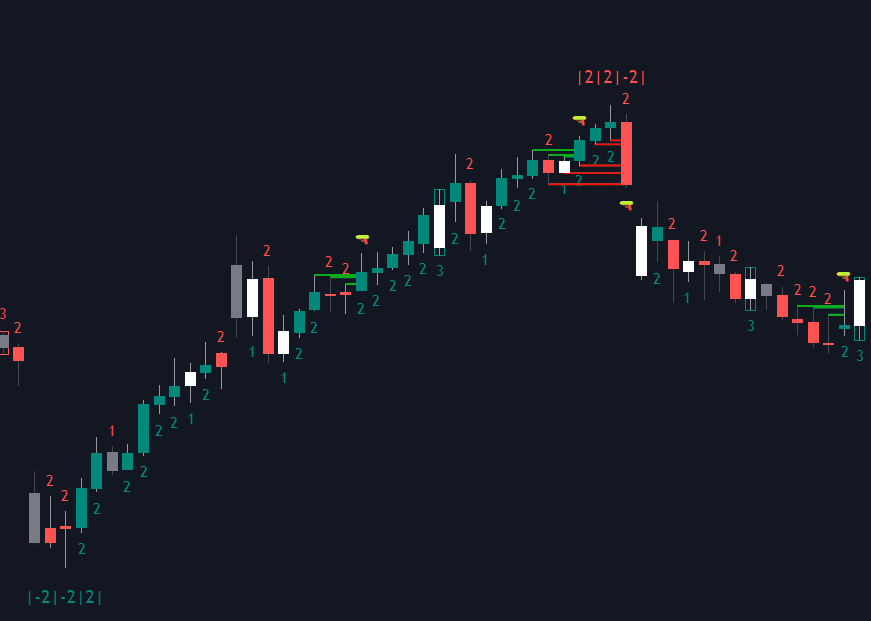
What is an Outside Bar?
An outside bar posts both a higher high and a lower low than the bar before it: its range fully engulfs the prior bar's range. Where the inside bar records contraction, the outside bar records expansion, an auction that traveled beyond both of the prior bar's extremes within a single period and ran any stops resting on each side. The bar is two-sided by construction, so the close carries the directional information: a close near the low after taking out the prior high reads as a bearish outside reversal, and the mirror reads bullish.
Location decides the reading. At the end of a swing, an outside bar that sweeps the prior swing high or low and closes hard the other way is a classic reversal candidate; in the middle of a trend or range it is often just volatility, both sides probed and neither resolved. The pattern also anchors a modern vocabulary: in Rob Smith's 'Strat' framework the outside bar is the '3', broadening action, alongside '1' for inside bars and '2' for directional bars. However it is labeled, an outside bar with a mid-range close is ambiguous by nature, and most methods require the close, the level, or the next bar to commit before acting.
How to identify an Outside Bar
The definition is mechanical; the meaning depends on the close and the location.
- 1Verify engulfment of range: the bar's high must exceed the prior high and its low must undercut the prior low. Bodies are irrelevant at this step; the comparison is wick to wick.
- 2Read the close: a close in the upper or lower portion of the bar gives a directional lean, while a mid-range close leaves the bar unresolved and better treated as expansion only.
- 3Check the sequence on a lower timeframe if your model cares: which extreme broke first separates 'swept the lows then reversed' from 'broke out then failed', the same information a two-bar reversal spreads across two bars.
- 4Grade the location: outside bars at swing extremes, session extremes, or major levels are decision candles; mid-range ones are usually noise with a wide range.
How traders use it
- As a reversal signal at extremes: an outside bar that takes out a prior low and closes near its high is traded as a bullish outside reversal, with entries on the close or a break of the bar's high and the stop beyond the opposite end.
- As an order-flow read: the two-sided range means any resting stops on both sides were run, so when the close commits to one direction, sweep-based traders treat the bar as a completed liquidity sweep plus displacement in one candle.
- As a scenario label: Strat-style methods tag the bar a 3 and trade the sequences it starts (3-1-2 combinations, for example), using the outside bar's extremes as the governing range.
- As a volatility flag: an outside bar is by construction a wide-range bar relative to its neighbor, so systems treat it as range expansion and adjust stops and targets accordingly.
Outside Bar vs similar patterns
Bullish/bearish Engulfing: Candlestick engulfing compares real bodies: the second body must contain the first, usually with opposite colors. The outside bar compares full ranges and ignores body color. Many bars qualify as both, but a small-bodied outside bar with long wicks may engulf nothing body-wise.
Key Reversal: A key reversal (definitions vary by author) typically requires a new extreme in the trend's direction plus a close back beyond the prior bar's close, without necessarily engulfing both extremes. An outside reversal is the stricter cousin: both extremes taken, then a committed close.
Two-bar Reversal: The two-bar reversal spreads the story across two candles: one directional bar, then a second that closes back through it. An outside reversal compresses probe and rejection into a single bar; drop to a lower timeframe and it usually resolves into that two-bar sequence.
Concept family
Chart & Candlestick Patterns
84 concepts mapped · 84 in the Library
Outside Bar FAQ
Turn Outside Bar into a trading strategy.
Take the implementation from this page into Quant, then build on it, backtest it on real data, and keep refining it in conversation.