Concept
One-timeframing
One-timeframing is a Volume & Order Flow concept. The Library holds 1 implementation, a working definition you can pull into Quant.
Top One-timeframing indicator
The top custom implementation, built on the original standard One-timeframing formula.
1 total
Want to trade One-timeframing? The implementation below is one prompt away from a backtested strategy in Quant.
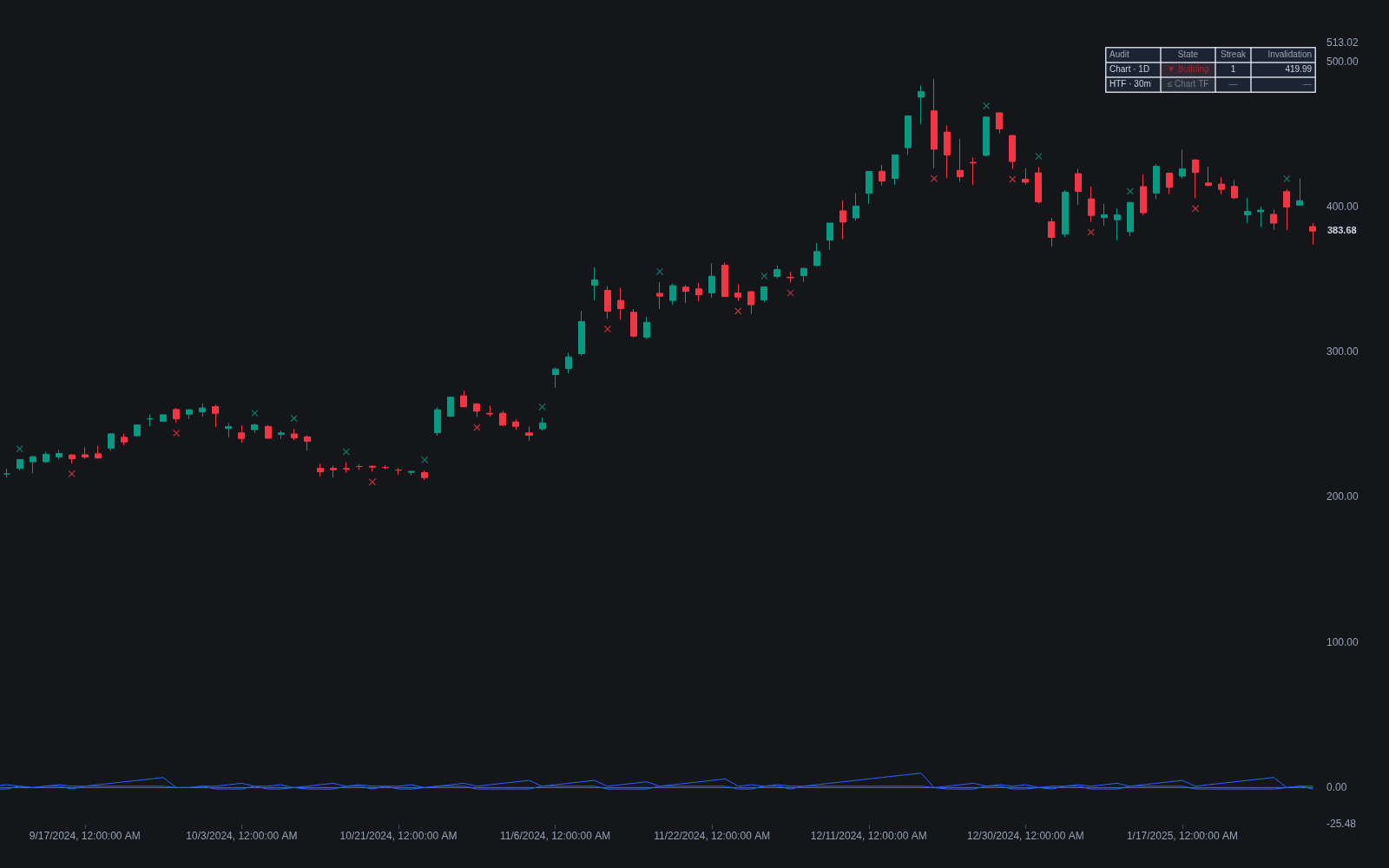
What is One-timeframing?
One-timeframing is auction-theory shorthand, spread through the Market Profile work of Dalton and others, for a market that keeps attacking one side without ever violating the other. One-timeframing up means each successive period holds at or above the prior period's low while extending higher; one-timeframing down means each period holds at or below the prior period's high. The period is whatever bracket you audit: the 30-minute periods of a TPO profile within a day, days within a week, weeks within a month.
The vocabulary comes out of the Market Profile lineage. J. Peter Steidlmayer's work at the Chicago Board of Trade in the 1980s organized each session into half-hour brackets, and James Dalton's books, Mind Over Markets in particular, turned bracket-by-bracket auditing into a routine for tracking who controls the auction. One-timeframing is the piece of that routine that escaped into general use: a compact control test any trader can run on plain candles.
The read is control. While the sequence is intact, one side of the auction is running the market and conditions are directional rather than balanced; the first trade through the prior period's opposite extreme is the earliest mechanical hint that control is being contested.
Because the test uses only highs and lows, it pairs naturally with volume evidence. A sequence backed by elevated relative volume and one-sided volume delta carries more weight than one grinding forward on thin participation, and a point of control migrating in the sequence's direction confirms that value is following price rather than lagging it. Many profile traders run the check alongside session VWAP: a market one-timeframing higher while holding a rising VWAP is about the cleanest picture of a trend day intraday trading offers.
How to identify one-timeframing on a chart
The audit is mechanical enough to run by eye once the bracket is chosen.
- 1Pick the bracket: 30-minute periods for an intraday audit (the native Market Profile convention), daily bars for a weekly audit, weekly bars for a monthly one.
- 2For an up sequence, check each completed period against the one before: it must hold at or above the prior period's low, ideally while extending to a higher high.
- 3For a down sequence, mirror the test: each period holds at or below the prior period's high while probing lower.
- 4Mark the prior period's opposite extreme as the running invalidation line and roll it forward as each new period completes.
- 5When that level trades, note how: a tick through it ends the pattern by definition, while acceptance beyond it (time spent, value building) upgrades the break into a real change of tone.
How traders use it
- As a trend-day filter: while a session one-timeframes, profile traders lean with it and treat fades as low-quality until the sequence breaks.
- As a mechanical reference for risk: the prior period's extreme is the line in the sand, so stops and alerts sit just beyond it and a violation ends the pattern.
- As higher-timeframe context: daily or weekly one-timeframing frames which side is in control for swing decisions before drilling into intraday structure.
- As a trailing framework: in a running sequence, stops are walked forward period by period behind the prior extreme, letting a trend day pay while defining precisely where it stops being one.
- As a weight-of-evidence input: the sequence is read against volume profile development, since a one-timeframing move that keeps building volume at new prices reflects acceptance, while one that thins out warns the advance lacks real participation.
One-timeframing vs related concepts
TPO Profile: The TPO profile is the session's full distribution built from 30-minute brackets; one-timeframing is a single yes/no question asked of those same brackets. You can run the audit on plain candles without ever drawing the profile, which is why the shorthand outgrew its source.
Session VWAP: Session VWAP reads control from the average price of the day's business; one-timeframing reads it from period extremes. VWAP answers who is in profit on the day, the sequence answers who keeps failing to break the other side, and trend days tend to show the two agreeing.
Value Area: Value area describes where a market found acceptance and balance; one-timeframing describes its refusal to balance at all. A session usually resolves toward one mode or the other, so the two reads work as opposite ends of the same auction spectrum.
Concept family
Volume & Order Flow
88 concepts mapped · 88 in the Library
One-timeframing FAQ
Turn One-timeframing into a trading strategy.
Take the implementation from this page into Quant, then build on it, backtest it on real data, and keep refining it in conversation.