Concept
Continuation
Continuation is a Trend concept. The Library holds 1 implementation, a working definition you can pull into Quant.
Top Continuation indicator
The top custom implementation, built on the original standard Continuation formula.
1 total
From studying Continuation to trading it: take the implementation below into Quant and backtest it instantly.
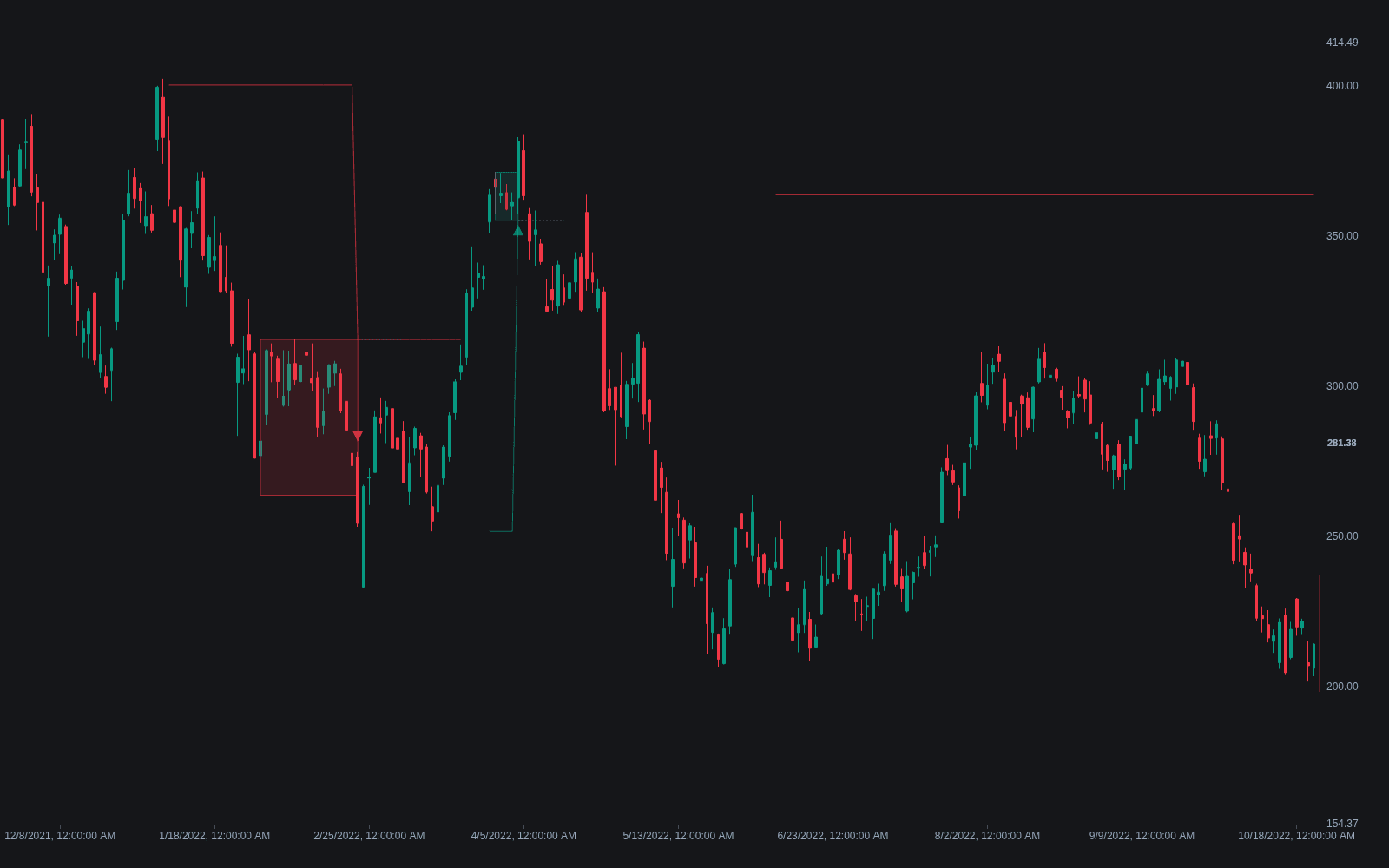
What is Continuation?
Continuation is the resolution of a pause in the direction of the prevailing trend: an impulse leg runs, price digests through a pullback, flag, or range, and the next leg then breaks out the same way the last one pointed. The term covers both the event (the resumption itself) and the family of patterns that tend to precede it, such as flags, pennants, and triangles, where contracting range and thinning volume mark a rest rather than a fight.
The working assumption behind continuation trading is that trends persist more often than they reverse at any given pause, so the burden of proof sits on reversal. That assumption fails regularly in practice: pauses do become tops and bottoms, which is why continuation setups are judged by whether trend structure survives the pause (shallow retracement, prior swing intact) rather than by the pattern's shape alone.
Grading a pause is mostly three measurements. Depth: retracements holding in the shallow third-to-half of the prior leg keep the trend's sponsorship story intact, while deeper give-backs erode it. Structure: the prior swing point surviving is the line between digestion and damage. Participation: volume draining through the pause and expanding on the trendward break is the classic signature, and its inverse, heavy churn inside the pause, hints the rest is actually a fight. Time belongs on the list too: healthy pauses are brief relative to the legs around them, and a consolidation that drags on longer than the impulse that created it is spending the trend's energy rather than storing it.
Formal treatments of the idea exist at every level of rigor: classical pattern work grades the shapes, short-term studies in the TASC tradition define continuation and reversal events mechanically so they can be tested, and Library tools from AlgoAlpha's continuation-signal engine to pattern classifiers automate the detection. The playbook framing is the useful one: continuation is stage three of the breakout, pullback, continuation sequence, which makes it less a pattern to hunt than a decision point every trend repeatedly serves up, where the trader's job is to grade the pause and act only when the resolution confirms.
How to identify a continuation setup
The sequence is trend, pause, grade, resolve; each stage has a check.
- 1Establish the trend first, by structure or by a regime read: without a prevailing direction there is nothing to continue.
- 2Locate the pause: a pullback, flag, triangle or tight range following an impulse leg.
- 3Grade its depth against the prior leg: retracements in the shallow third-to-half favor continuation, and the prior swing point must survive.
- 4Check participation: volume contracting through the pause fits digestion; expansion against the trend inside the pause is a warning.
- 5Act on the resolution: entry as the pause breaks trendward, per the breakout grammar, with the stop beyond the pause's far extreme, and stand down if the break arrives counter-trend instead.
How traders use it
- As the third stage of the breakout, pullback, continuation sequence: entries are taken as the pause resolves trendward, with stops beyond the pause's extreme.
- As a bias check: while a pullback holds above the prior swing and volume contracts, traders keep working the trend side and treat counter-trend signals as suspect.
- As an add-on point for existing winners, committing more size only after the trend proves it is resuming.
- With dynamic references: pauses that terminate at a rising EMA or other moving baseline convert the continuation entry into a repeatable pullback-to-average play, the same grade applied at a moving level.
- Regime-gated: systematic versions only enable continuation logic while a trend classifier agrees, since the setup's core premise, that pauses resolve trendward, is precisely what stops being true in ranges.
Continuation vs related resolutions
Reversal: The competing resolution of every pause. Continuation keeps the prior swing intact and resolves trendward; reversal breaks structure and resolves against it. The disciplined framing puts the burden of proof on reversal while conceding that pauses become tops and bottoms regularly.
Breakout: Continuation resolves through a breakout, but not every breakout is continuation: breaks from multi-month bases start trends rather than extend them. The distinction matters for expectations, since continuation breaks inherit an existing trend's sponsorship while fresh breaks must recruit theirs.
Bull/Bear Flag: The flag is the most literal continuation pattern: a brief countertrend drift between parallel boundaries after a sharp leg. Continuation is the broader event the flag serves; flags, pennants, triangles and simple pullbacks are alternative shapes for the same pause-and-resume mechanics.
Concept family
Trend
100 concepts mapped · 100 in the Library
Continuation FAQ
Turn Continuation into a trading strategy.
Take the implementation from this page into Quant, then build on it, backtest it on real data, and keep refining it in conversation.