Final Flag
Final Flag, also known as final bull flag, final bear flag, final flag reversal, is a Chart & Candlestick Patterns concept. The Library holds 1 implementation, a working definition you can pull into Quant.
Top Final Flag indicator
The top custom implementation, built on the original standard Final Flag formula.
1 total
From studying Final Flag to trading it: take the implementation below into Quant and backtest it instantly.
What is a Final Flag?
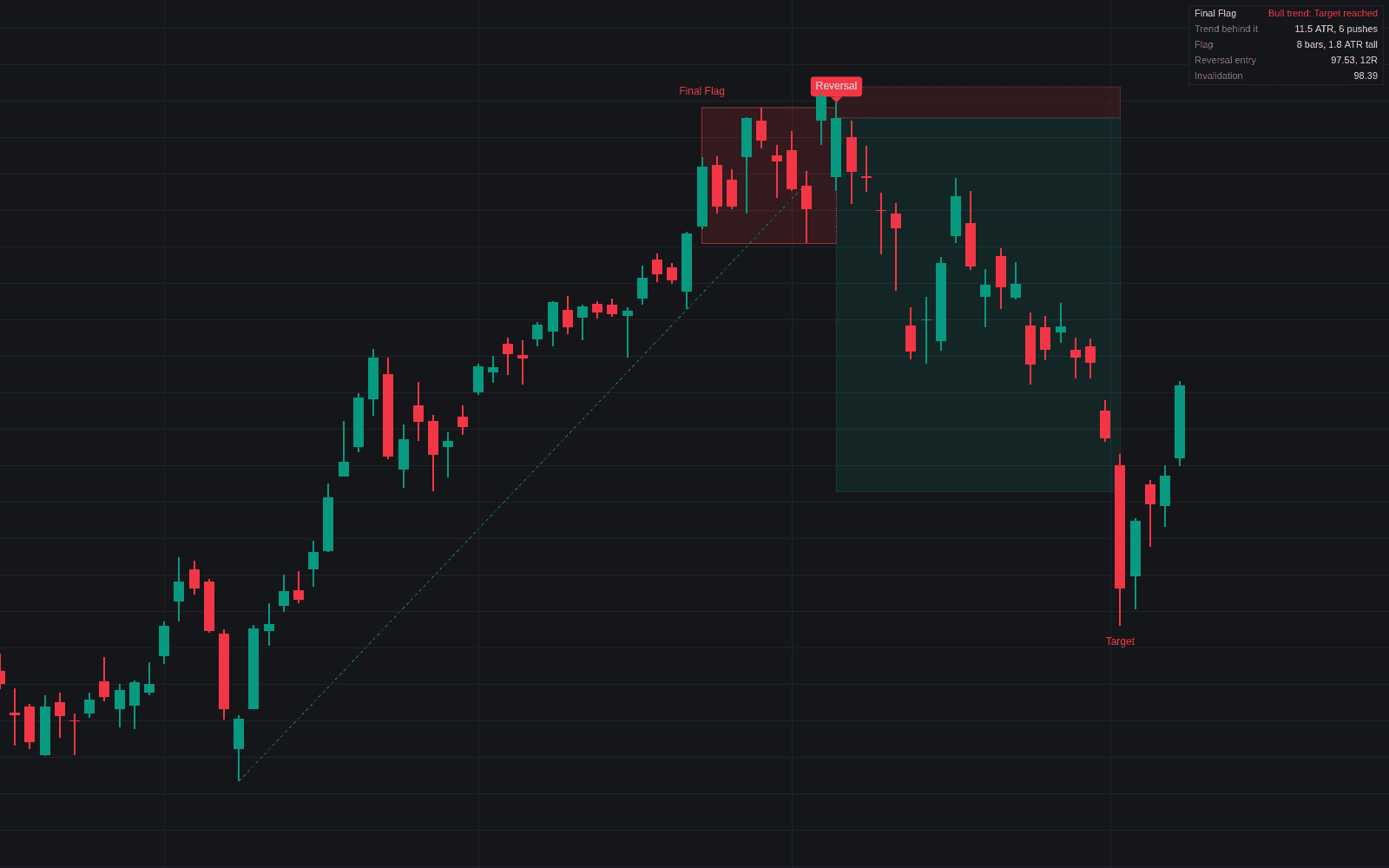
A final flag is Al Brooks' term for the last pause in a trend: a late flag whose breakout in the trend direction fails within a few bars and reverses. His list of abbreviations describes it as usually a horizontal pattern after a trend whose breakout often fails and reverses, and a final bull flag as a trading range or triangle late in a bull trend. It can be as small as two consecutive inside bars.
In Reading Price Charts Bar by Bar, Brooks describes the sequence: a protracted trend forms a horizontal flag that extends sideways for several bars, breaks a trendline, then breaks out to a new extreme but quickly reverses within the next few bars. That failed breakout often marks the end of the trend, and the countertrend move that follows usually has at least two legs. The logic is a trap: the sideways flag shows two-sided trading, the breakout draws in late with-trend traders, and their exits fuel the reversal.
The label is earned only in hindsight. Any late flag could be the final one and most flags in a strong trend are not, so Brooks treats it as a setup to act on after the breakout fails, never as a reason to fade a trend in advance. In a spike and channel trend, the final flag typically forms late in the channel as it flattens.
How to identify a final flag
The trend's maturity matters as much as the flag itself.
- 1Start with an extended trend, ideally one that has printed climactic bars or broken a trendline.
- 2Find a late, mostly horizontal flag: a tight trading range, a small triangle, or two inside bars in a row.
- 3Watch the breakout to a new trend extreme and judge its follow-through bar by bar.
- 4Trigger on the failure: a reversal back into the flag within a few bars of the breakout, with the breakout extreme as invalidation.
How traders use it
- Reversal entry: trade the failed breakout as price reverses back into the flag, stop beyond the breakout extreme, planning for a two-legged correction rather than an instant new trend.
- Exit signal: trend traders treat a late horizontal flag with a weak breakout as a cue to tighten stops.
- Failed failure: when the reversal itself fails within a bar or so and the breakout resumes, Brooks calls it a failed failure of the final flag, which turns the setup back into a with-trend signal.
Final flag vs related patterns
Bull/bear Flag: An ordinary flag is a continuation pause; the final flag is the one whose breakout fails. The two look identical until the breakout, so position in the trend is the main clue.
False Breakout: A false breakout is any failed break of a level; the final flag is the late-trend case, where the failed with-trend breakout ends the trend's current leg.
Concept family
Chart & Candlestick Patterns
88 concepts mapped · 88 in the Library
Final Flag FAQ
Turn Final Flag into a trading strategy.
Take the implementation from this page into Quant, then build on it, backtest it on real data, and keep refining it in conversation.