Spike and Channel
Spike and Channel, also known as spike and channel trend, spike and channel bull trend, spike and channel bear trend, is a Chart & Candlestick Patterns concept. The Library holds 1 implementation, a working definition you can pull into Quant.
Top Spike and Channel indicator
The top custom implementation, built on the original standard Spike and Channel formula.
1 total
Want to trade Spike and Channel? The implementation below is one prompt away from a backtested strategy in Quant.
What is a Spike and Channel Trend?
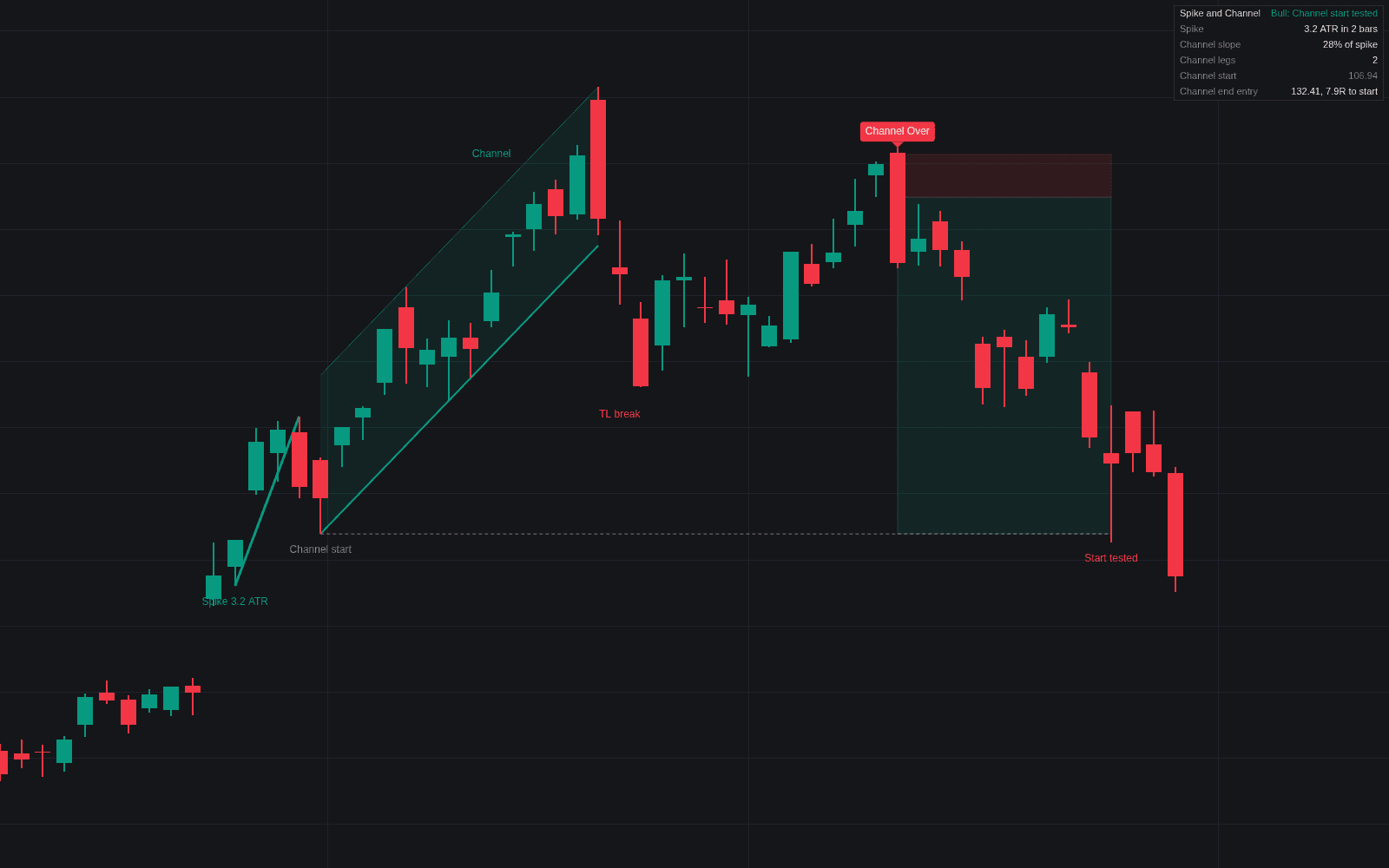
A spike and channel is Al Brooks' name for one of the most common shapes a trend takes: a spike, a breakout made of strong consecutive trend bars with little overlap, then a pullback, then a channel that continues in the same direction at a shallower slope. Brooks' glossary defines it as a breakout into a trend whose follow-through takes the form of a channel with less momentum, and his list of abbreviations spells out the minimum: a breakout, a pullback, then at least two more legs in a channel.
The two phases describe two different markets. The spike is urgency: one side overwhelms the other and price reaches a new level fast. The channel is the same trend once the other side participates, with overlapping bars, tails, pullbacks and what Brooks calls evidence of two-sided trading. He treats a channel as a sloping trading range in the making and teaches that spike and channel trends usually evolve into a trading range. When the channel ends, the correction often reaches back toward the start of the channel, the extreme of the pullback that followed the spike; in a bull trend, that is where buyers commonly try to build a double bottom bull flag.
The vocabulary comes from Brooks' books, Reading Price Charts Bar by Bar and the three-volume Trading Price Action series. The shape is fractal: Brooks notes that a tight, steep channel with only small, brief pullbacks is a spike on a higher-timeframe chart, so one move can be a spike on one chart and a channel on another.
How to identify a spike and channel
The spike qualifies the pattern; the channel is judged by how much weaker it is than the spike.
- 1Find the spike: one or more strong trend bars closing near their extremes, with little overlap and no meaningful pullback, often a breakout from a range or a gap.
- 2Mark the first pullback after the spike. Its extreme, the low in a bull trend, is the start of the channel.
- 3Confirm the channel: the trend resumes at a shallower angle with overlapping bars, tails and pullbacks, contained by a trendline and a parallel trend channel line.
- 4Count the legs: Brooks wants at least two legs in the channel, and three pushes in a wedge-like shape is a common ending.
- 5Watch for the end: a trendline break followed by a failed test of the trend extreme says the channel phase is over.
How traders use it
- Trading with the spike: a strong spike is a reason not to fade. Brooks-style traders buy the first pullbacks after a bull spike, or sell them after a bear spike, often counted as High 1 and High 2 entries.
- Trading inside the channel: with-trend entries still work but lose probability as bars overlap, so traders enter near the trendline and take profits near the trend channel line. Once a channel is broad and two-sided, some fade its extremes.
- Planning the correction: after the trendline breaks and the trend extreme fails to extend, the start of the channel becomes the first target for countertrend trades and the area where with-trend traders look for a double bottom flag.
- Honest limitation: channels often run further and longer than the countertrend side expects, and the test of the channel start is a tendency, not a schedule. Fading a channel before its trendline breaks is where the pattern costs traders most.
Spike and channel vs related structures
Bull/bear Flag: A flag is one brief pause after a pole that resolves in the pole's direction. After a spike, the trend instead continues as a slower channel of several legs.
Channel Continuation: A continuation channel slopes against the prior trend and is traded for its break back in the trend's direction. The channel in a spike and channel slopes with the trend and is itself the continuation, until it breaks.
Climactic Moves: A climax accelerates into the end of a trend; a spike and channel decelerates, with the channel weaker than the spike. Brooks lists spike and climax as a variant of the pattern, for when the follow-through after the spike is itself climactic.
Concept family
Chart & Candlestick Patterns
88 concepts mapped · 88 in the Library
Spike and Channel FAQ
Turn Spike and Channel into a trading strategy.
Take the implementation from this page into Quant, then build on it, backtest it on real data, and keep refining it in conversation.