Concept
Ehlers Instantaneous Trendline
Ehlers Instantaneous Trendline is a Trend concept. The Library holds 1 implementation, a working definition you can pull into Quant.
Top Ehlers Instantaneous Trendline indicator
The top custom implementation, built on the original standard Ehlers Instantaneous Trendline formula.
1 total
Want to trade Ehlers Instantaneous Trendline? The implementation below is one prompt away from a backtested strategy in Quant.
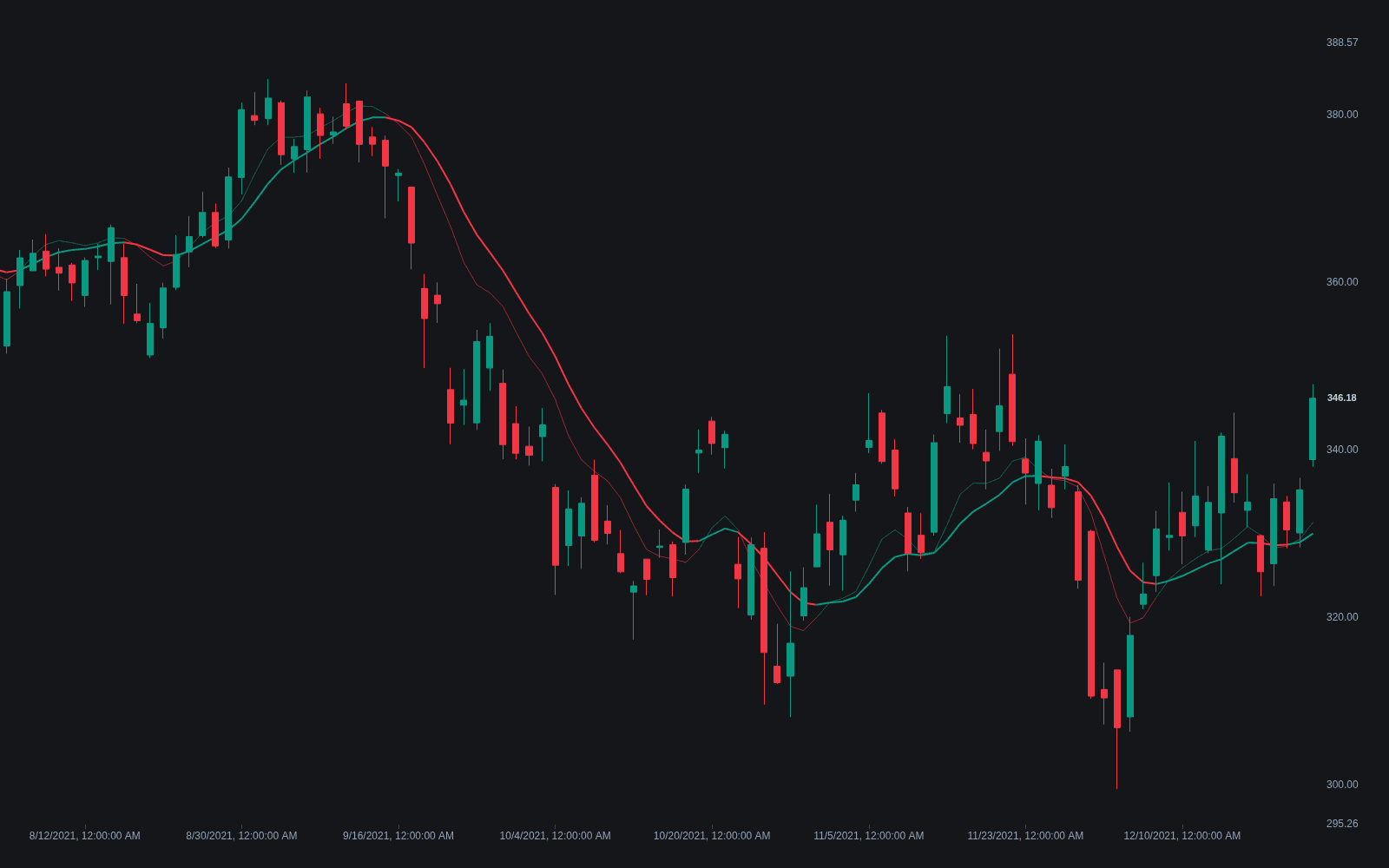
What is the Ehlers Instantaneous Trendline?
The Ehlers Instantaneous Trendline is a low-lag smoother introduced by John Ehlers, built on the idea that price can be modeled as trend plus cycle. If the dominant cycle is measured, averaging price over exactly one full cycle period makes the cyclical ups and downs cancel, and what remains is the trend. The original construction therefore measures the dominant cycle with Hilbert Transform techniques and continuously adapts its averaging window to the measured period; the 'instantaneous' name reflects the aim of near-zero lag, the window tracking the current cycle length rather than a fixed lookback.
Ehlers later published a simplified version that approximates the same behavior with a compact recursive filter governed by a single alpha coefficient, typically plotted with a faster trigger line (a lag-reduced copy of the trendline) whose crossings mark trend changes. Read it like a moving average: slope, and which side of it price holds. The honest caveats: in cyclic, sideways conditions the line flattens through the middle of the range by design, and the adaptivity is only as good as the dominant cycle measurement feeding it, which on noisy data is an estimate, not a fact.
The two versions have distinct pedigrees. The full construction appeared in Ehlers' Rocket Science for Traders, where the Hilbert machinery measures the period bar by bar and the average resizes itself accordingly; the simplified recursion, published in his later work, fixes alpha around 0.07 and trades the adaptive machinery for robustness and portability, which is why most platform ports, including the widely used LazyBear version, implement the simplified form. The trigger line in the common presentation is a two-bar forward projection of the trendline itself, twice the current value minus the value two bars back, a cheap lag-reduction trick that leads the parent line just enough to cross usefully.
In the Ehlers toolkit the line's identity is its premise: it treats sideways markets as cycles to be canceled rather than noise to be smoothed, which produces its distinctive flat behavior mid-range, a feature doubling as a range detector. Against a fixed EMA it promises comparable smoothness with less lag when the cycle estimate is right, and roughly EMA behavior when it is not. Trigger-crossing systems build directly on the pair, and its flattening makes it a natural input for a trend regime read, the line's own posture reporting whether trend tactics currently have anything to work with.
How to identify the Instantaneous Trendline
Most charts run the simplified version; its parts are quick to verify.
- 1Check the input: a single alpha coefficient, around 0.07 in the published default, rather than a bar-count length.
- 2Confirm the recursion: a compact filter blending the last few prices with prior outputs, approximating a one-cycle average of price.
- 3Find the trigger: a lag-reduced companion, commonly twice the trendline's current value minus its value two bars back.
- 4Read the pair: trendline slope and price's side for bias, trigger crossings for timing events.
- 5Use the flat state: the line going horizontal through the middle of a range is the design working, a message to stand trend tactics down rather than a malfunction.
How traders use it
- As a trend bias line: slope and price's side of the trendline define direction, with less lag than a fixed average of comparable smoothness when the cycle estimate is on target.
- As a signal pair: crossings between the trendline and its trigger line are the classic entry and exit events in Ehlers' own presentation of the tool.
- As a drop-in replacement for a conventional moving average in baseline or crossover roles where lag is the main complaint.
- As a range detector: the line's deliberate flattening in cyclic conditions is itself a read, gating trend systems off exactly where their setups degrade.
- In multi-timeframe stacks: a higher-timeframe instantaneous trendline supplies the governing bias while the trading timeframe uses the trigger pair for execution, the standard division between regime and timing.
Instantaneous Trendline vs related smoothers
EMA: The EMA smooths over an arbitrary fixed memory; the Instantaneous Trendline aims its averaging at the measured cycle so the oscillation cancels out. When the cycle estimate is good the result is comparable smoothness with visibly less lag; when it is poor, the two lines behave much alike.
Ehlers SuperSmoother: Same author, different philosophy: the SuperSmoother is a fixed-cutoff filter that rejects everything faster than a chosen period, while the Instantaneous Trendline adapts to cancel the current dominant cycle specifically. One is a designed filter, the other a model-based average.
Adaptive-lookback MA: The generic adaptive family varies its window by volatility or efficiency; the Instantaneous Trendline varies its effective window by measured cycle period, a narrower and more specific adaptation. Cycle-aware markets reward the specificity; trending, cycle-free ones erase the difference.
Concept family
Trend
100 concepts mapped · 100 in the Library
Ehlers Instantaneous Trendline FAQ
Turn Ehlers Instantaneous Trendline into a trading strategy.
Take the implementation from this page into Quant, then build on it, backtest it on real data, and keep refining it in conversation.