Concept
ATR Trailing Regime
ATR Trailing Regime is a Trend concept. The Library holds 1 implementation, a working definition you can pull into Quant.
Top ATR Trailing Regime indicator
The top custom implementation, built on the original standard ATR Trailing Regime formula.
1 total
The ATR Trailing Regime implementation below can become a backtested trading strategy — describe your rules and Quant writes the code.
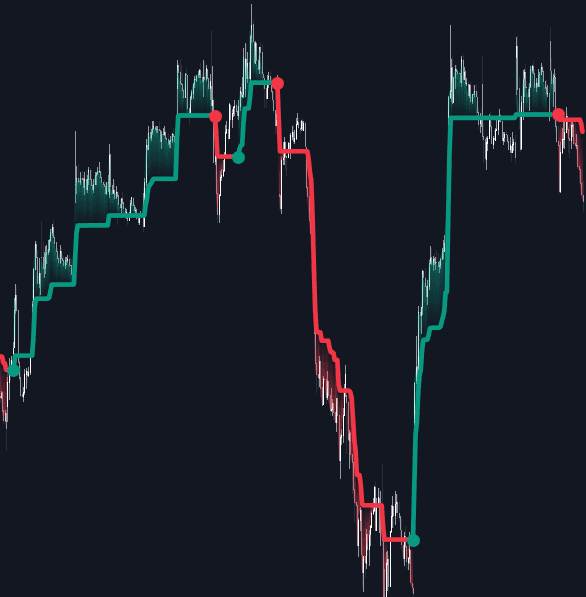
What is an ATR Trailing Regime?
An ATR Trailing Regime is a trend-following construct in which a stop line is offset from price by a multiple of the ATR and ratchets in the trend's favor. In an up regime the line sits below price at the anchor minus the offset and is only allowed to rise; when price crosses it, the regime flips to down and the line re-forms above price. The output is two things at once: a concrete trailing level and a binary long/short state.
It is a family rather than a single indicator. Variants differ in the anchor (Supertrend offsets from the bar midpoint, the Chandelier Stop from the highest high since the trend began, plain ATR trailing stops from the close) and in the flip rule, but all share two mechanics: a volatility-scaled distance, so the line breathes wider in volatile phases and tighter in quiet ones, and a one-way ratchet, so an established stop never loosens.
The construct matters because one line answers three questions: current bias, where the protective stop belongs, and where the regime flips. That makes it a common backbone for always-in systems and a standard gate in front of other signals. Its structural weakness is equally well defined: in ranges the flips cluster and each one costs, and the flip is always late by design, since the ATR distance is the price paid for confirmation.
How to calculate an ATR Trailing Regime
Every variant in the family reduces to the same four mechanical steps.
- 1Compute the ATR over a lookback (14 is a common default) and multiply it by a chosen factor, commonly between 2 and 3.5, to get the offset.
- 2In an up regime, subtract the offset from the anchor (close, bar midpoint, or highest point since the flip, depending on the variant) to get a candidate stop, then ratchet: the new stop is the higher of the candidate and the previous stop. A down regime mirrors this above price.
- 3Apply the flip rule: when a bar closes beyond the line (below it in an up regime), switch the regime and seed a new line on the opposite side of price.
- 4Read the state: line below price means long regime, line above means short, the gap between price and line is the current risk per unit, and rapidly alternating flips are themselves a signal that conditions are rangebound.
How it's calculated
A stop line held a multiple of ATR away from price that only ratchets with the trend and flips the long/short regime when price closes through it.
SuperTrend is the same construction anchored to the bar midpoint (H_t + L_t) / 2 instead of the close.
The chandelier exit anchors to the highest high (long) or lowest low (short) of the last n bars.
The max/min ratchet means the stop only tightens; it never loosens during a pullback.
How traders use it
- As an always-in regime filter: other entries are taken only in the direction of the current state, or the flips themselves are traded stop-and-reverse style, reversing at every flip and accepting whipsaw as the cost of never being flat when a trend finally arrives.
- As a trailing exit: after an entry from any setup, the line becomes the stop and the ratchet enforces the discipline of never widening it; this is the regime-shaped branch of the broader trailing method taxonomy.
- As a volatility-aware risk unit: because the stop distance is ATR-scaled, pairing the regime with volatility-targeted sizing keeps the currency risk per trade roughly constant across quiet and violent markets.
- As a gated system component: since flips degrade badly in congestion, the regime is often enabled only when a strength gauge such as the ADX / DMI System confirms trending conditions.
ATR Trailing Regime vs neighboring constructs
Supertrend: Supertrend is one specific implementation: bar-midpoint anchor, ATR offset, ratchet, and a colored flip line. The ATR Trailing Regime is the general construct that Supertrend, and many renamed variants, instantiate.
Parabolic SAR: Both are always-in flip systems. Parabolic SAR's distance is driven by an acceleration factor that tightens with time and new extremes, not by volatility, so it crawls toward price even when nothing happens; an ATR line tightens only when volatility contracts.
Chandelier Stop: The chandelier is one anchor choice within the family, the highest high since entry minus a multiple of ATR, and it is usually run as an exit-only tool rather than a self-flipping regime.
Volatility Stop: Volatility Stop is often used as a near-synonym, typically meaning the close-anchored version descending from Wilder's volatility system. This page covers the regime mechanics shared across all the anchor choices.
Concept family
Trend
100 concepts mapped · 100 in the Library
ATR Trailing Regime FAQ
Turn ATR Trailing Regime into a trading strategy.
Take the implementation from this page into Quant, then build on it, backtest it on real data, and keep refining it in conversation.