Concept
Chebyshev Filters
Chebyshev Filters are Trend concepts. The Library holds 1 implementation, a working definition you can pull into Quant.
type I/II
Top Chebyshev Filters indicator
The top custom implementation, built on the original standard Chebyshev Filters formula.
1 total
From studying Chebyshev Filters to trading it: take the implementation below into Quant and backtest it instantly.
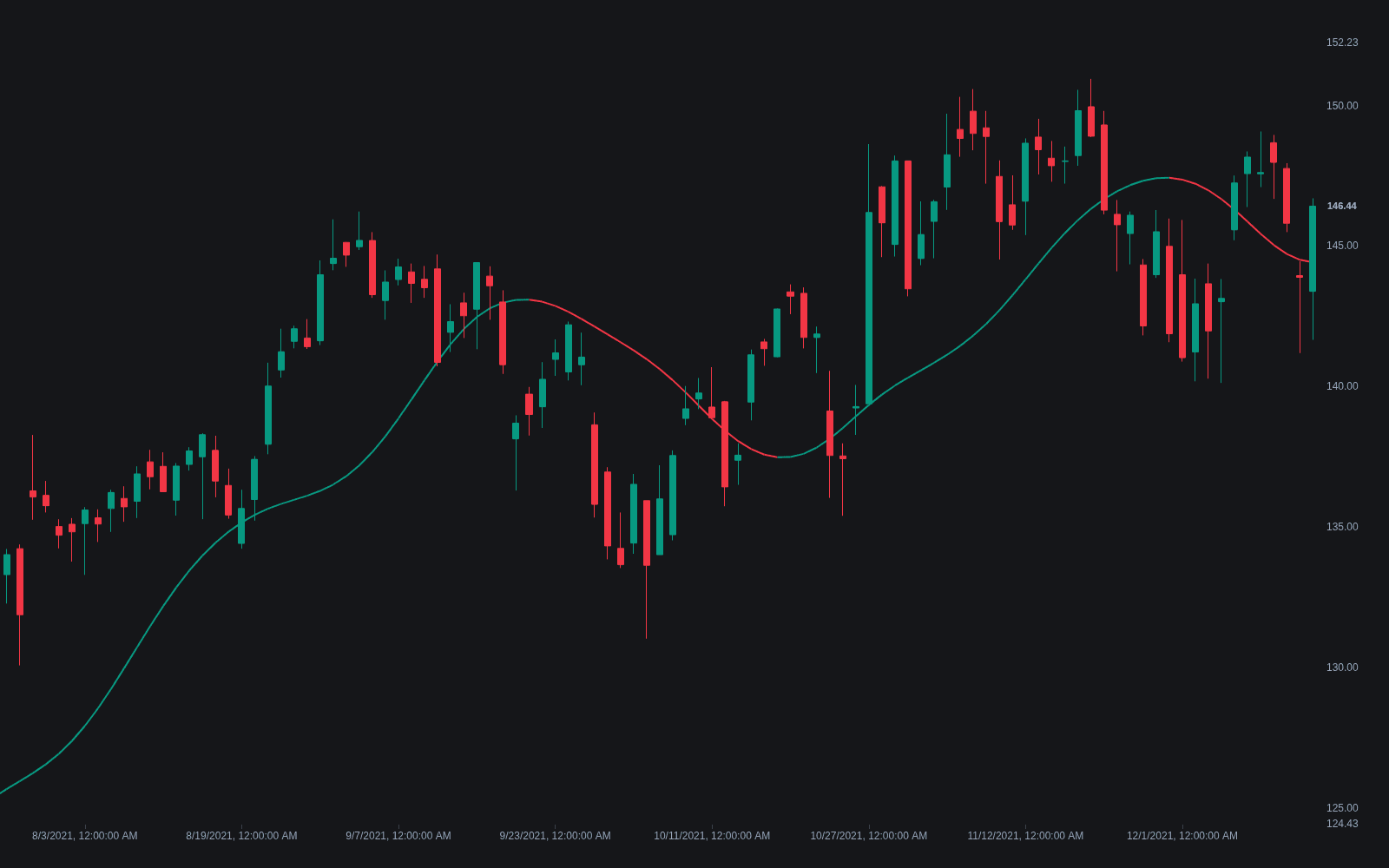
What are Chebyshev Filters?
Chebyshev filters are recursive low-pass filters borrowed from classical signal processing, named after mathematician Pafnuty Chebyshev, whose polynomials shape their frequency response. Applied to price, they do what every digital smoother does: pass the slow trend component and attenuate fast fluctuations. Their distinguishing property is the roll-off. For a given filter order, a Chebyshev design separates trend from noise more sharply than gentler designs such as the Gaussian Filter, at the cost of ripple, a small unevenness in how frequencies are passed or rejected.
The namesake was a nineteenth-century Russian mathematician whose approximation polynomials solve the underlying design problem: making the filter's response as close to ideal as possible for its complexity. The designs reached trading charts by way of the digital-signal-processing current in technical analysis, most visibly promoted by John Ehlers, which treats price as a noisy signal and imports engineering filters wholesale rather than reinventing smoothers indicator by indicator.
The two standard types split by where that ripple lives. Type I allows ripple in the passband (the trend frequencies it keeps) in exchange for the steepest roll-off available from an all-pole filter of its order; Type II, the inverse design, keeps the passband flat and pushes the ripple into the stopband it rejects. On a chart, the practical consequences are aggressive noise rejection for the lag incurred, plus a tendency to overshoot slightly around sharp turns. Traders comparing filters usually weigh it against smoother, gentler designs like the Ehlers SuperSmoother.
Parameterization is a three-way dial. The cutoff period decides what counts as trend versus noise; the order decides how sharply that boundary is enforced, with higher orders separating better but ringing and lagging more; the allowed ripple trades passband fidelity against roll-off steepness. That explicitness is the appeal for systematic traders: instead of choosing among named averages such as an SMA or EMA, the designer states the trade-off directly and lets the filter realize it.
How to read a Chebyshev filter on a chart
The filter plots as a smooth line on price, and its behavior is read the way any trend baseline is, with two design quirks to know about.
- 1Plot the filter with a cutoff period matched to the swings you trade; the line keeps cycles slower than the cutoff and suppresses faster ones.
- 2Read side and slope as the trend state: price above a rising line is the basic bullish configuration, exactly as with a moving average baseline.
- 3Compare it against a conventional average of similar lag to see the design difference: the Chebyshev line should track turns of comparable speed while carrying visibly less wiggle.
- 4Expect mild overshoot after violent reversals; the sharper the filter, the more it can swing past the turn before settling, so avoid reading the first bars after a V-turn too literally.
- 5If the implementation exposes order and ripple, raise them for cleaner separation and accept the added lag, or lower them for faster response with more noise bleeding through.
How it's calculated
A Chebyshev filter is a recursive price smoother from signal processing whose response trades controlled ripple for a steeper cutoff than an equal-order Butterworth.
The coefficients a_k and b_k come from standard filter design (Chebyshev pole placement plus a bilinear transform at the chosen cutoff), not from a closed-form price formula.
Type I is equiripple in the passband and monotone in the stopband; Type II (inverse Chebyshev) reverses this, with a flat passband and ripple in the stopband.
As δ approaches 0 the Type I response approaches a Butterworth; larger ripple gives a sharper cutoff but more distortion and lag near the cutoff period.
How traders use it
- As a trend baseline: plot the filter on price and read slope and side, exactly as a moving average is used, but with a sharper split between what is smoothed away and what is kept.
- As a preprocessing stage: smooth price or an oscillator's input before computing signals, so crossovers and divergence reads fire on cleaned data rather than raw noise.
- As one half of a two-filter crossover: a fast and a slow Chebyshev filter (or a Chebyshev against a conventional average) crossing to time trend changes.
- As dynamic support and resistance: a well-tuned filter line serves the same role as dynamic S/R via MA, with pullbacks to the line watched for defended tests in the trend's direction.
- As ribbon material: several cutoffs plotted together form an MA ribbon-style stack whose spreading and squeezing reads trend strength, with the Chebyshev versions keeping the strands smoother than raw averages.
Chebyshev Filters vs other smoothers
Ehlers SuperSmoother: The SuperSmoother is designed for maximum smoothness with minimal lag and no deliberate ripple, a gentle all-rounder. A Chebyshev design buys a steeper trend/noise boundary at the price of ripple and overshoot; which wins depends on whether whipsaw or distortion costs the strategy more.
EMA: An EMA is a first-order recursive filter: cheap, familiar, and slow to separate trend from noise, with attenuation that falls off gradually. A Chebyshev filter of higher order draws a much harder boundary at the cutoff, keeping slow structure while rejecting fast noise more decisively.
SMA: The SMA weights a finite window equally and has well-known side effects, including responding to old bars leaving the window. The Chebyshev filter is recursive with designed frequency behavior, so its smoothing character is stated up front rather than inherited from a window shape.
Concept family
Trend
100 concepts mapped · 100 in the Library
Chebyshev Filters FAQ
Turn Chebyshev Filters into a trading strategy.
Take the implementation from this page into Quant, then build on it, backtest it on real data, and keep refining it in conversation.