Concept
Vertical Horizontal Filter
Vertical Horizontal Filter is a Trend concept. The Library holds 1 implementation, a working definition you can pull into Quant.
VHF
Top Vertical Horizontal Filter indicator
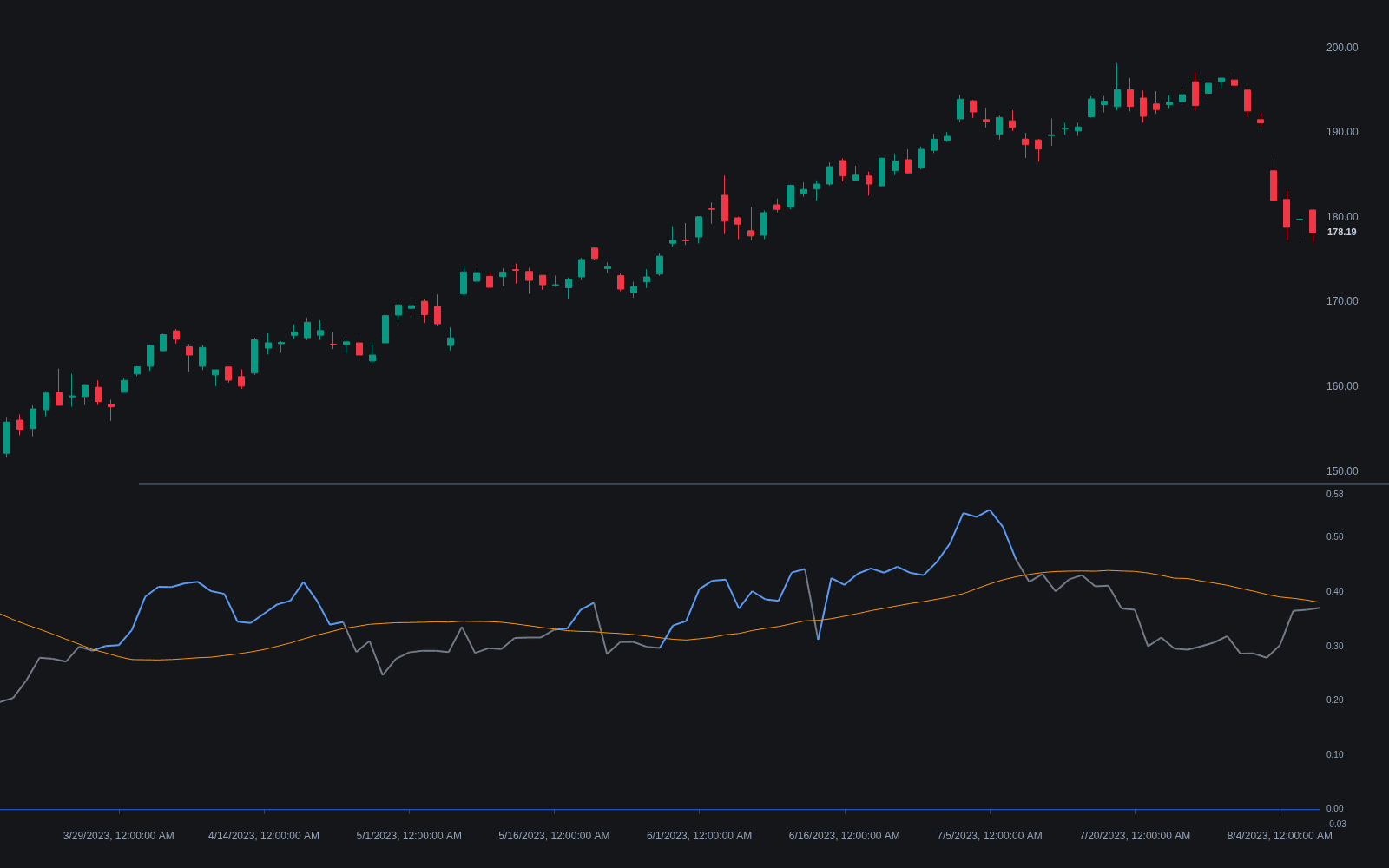
The top custom implementation, built on the original standard Vertical Horizontal Filter formula.
1 total
Want to trade Vertical Horizontal Filter? The implementation below is one prompt away from a backtested strategy in Quant.
What is the Vertical Horizontal Filter?
The Vertical Horizontal Filter (VHF) is a trend-versus-range gauge built on a simple geometric idea: in a trend, price movement is mostly vertical (net progress), while in a range it is mostly horizontal (back-and-forth travel with little progress). The VHF captures this as a ratio, dividing the distance between the highest and lowest close over a window by the total distance price actually traveled bar to bar. A market that walks in a straight line scores near 1; a market that churns scores near 0.
The indicator is attributed to Adam White, who presented it in the early 1990s as a way to decide which category of tool to trust: trend-following indicators when the VHF is high and rising, and oscillators when it is low or falling. That routing role, rather than signal generation, remains its main job.
The same efficiency intuition appears elsewhere in technical analysis, most directly in the Kaufman efficiency ratio, which uses net close-to-close change instead of the extreme-to-extreme range. Traders keep the VHF around because it is transparent, cheap to compute, and answers the single most consequential question in system design: is this market currently trending at all?
How it's calculated
Net range over the window is divided by the summed absolute bar-to-bar changes over the same window.
Some implementations use highest high and lowest low instead of closes in the numerator; the reading is slightly noisier but the interpretation is unchanged.
The VHF has no fixed trend threshold; it is usually read relative to its own recent history.
How traders use it
- As an indicator selector: a high or rising VHF argues for acting on moving average and breakout signals, while a low or falling VHF argues for fading extremes with oscillators. This routing decision is its designed purpose.
- As a filter inside a single system: trend entries are only taken when the VHF exceeds a level such as its own moving average or a percentile of recent readings, which tends to cut whipsaw trades at the cost of later entries.
- As a slope signal: because absolute levels vary by market, many practitioners watch the direction of the VHF rather than its value, treating a rising line as trend development regardless of where it starts.
- Its limitations are direction-blindness and lag: the VHF cannot distinguish an uptrend from a downtrend, and by the time a 28-bar ratio confirms trending conditions, a meaningful part of the move has often passed. Pairing it with a directional tool such as the ADX/DMI system or a moving average is standard practice.
VHF vs neighboring efficiency and strength measures
Kaufman efficiency ratio: The efficiency ratio uses the absolute net close-to-close change in its numerator, so a round trip that ends where it started scores near zero. The VHF uses the highest-minus-lowest close, so the same round trip can still score moderately high because the range was wide.
Choppiness Index: The Choppiness Index measures the same congestion idea but inverts and log-scales it, so high readings mean chop rather than trend. The VHF is the plain ratio: high means directional.
Random Walk Index: The RWI benchmarks displacement against a volatility-scaled random walk and produces separate up and down readings. The VHF makes no statistical claim and no directional distinction; it is the simpler, faster-to-read gauge.
Concept family
Trend
100 concepts mapped · 100 in the Library
Vertical Horizontal Filter FAQ
Turn Vertical Horizontal Filter into a trading strategy.
Take the implementation from this page into Quant, then build on it, backtest it on real data, and keep refining it in conversation.