Concept
Coral Trend
Coral Trend is a Trend concept. The Library holds 1 implementation, a working definition you can pull into Quant.
Top Coral Trend indicator
The top custom implementation, built on the original standard Coral Trend formula.
1 total
This Coral Trend implementation is strategy-ready: open it in Quant, set your rules, and it backtests automatically.
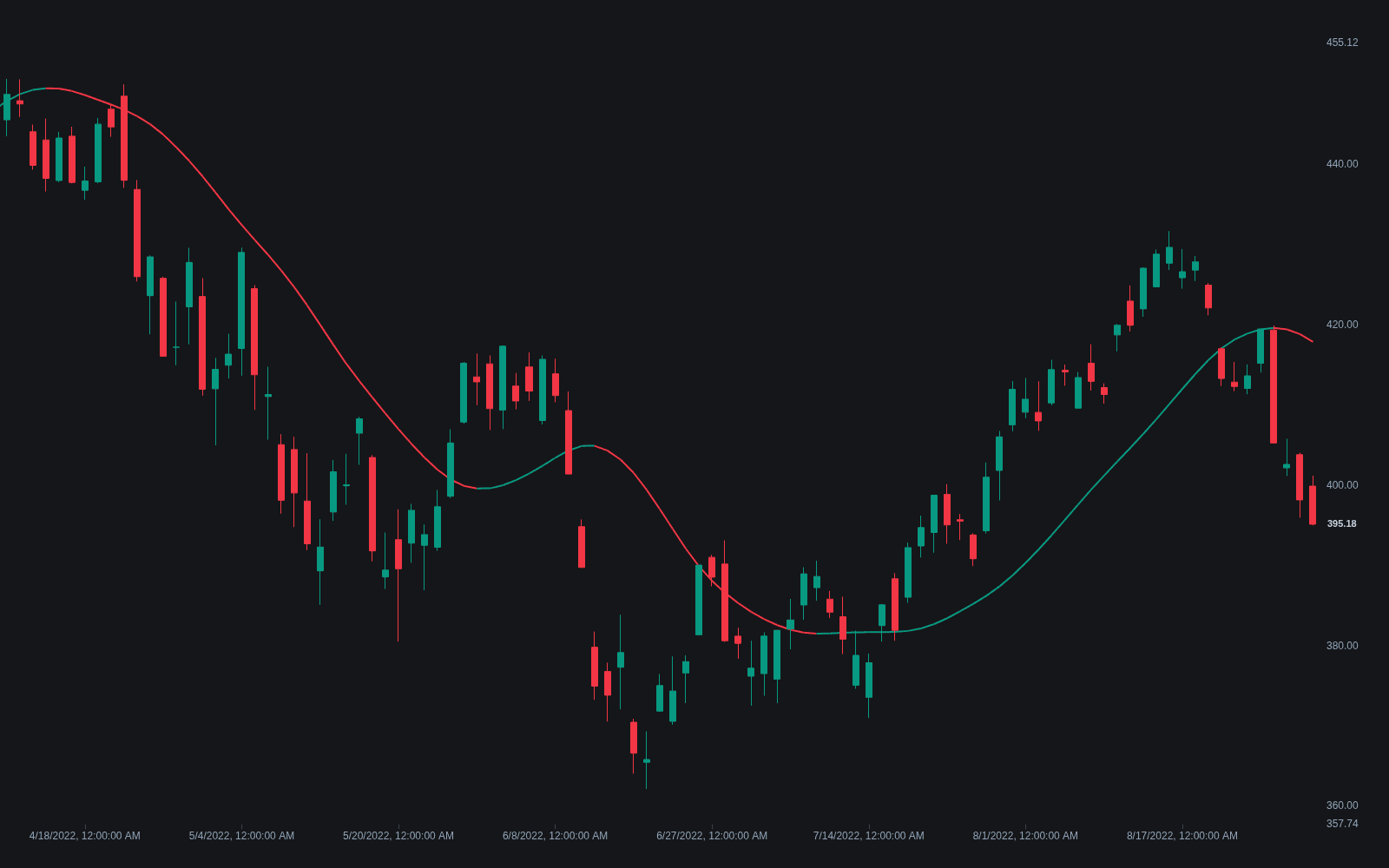
What is the Coral Trend?
The Coral Trend is a heavily smoothed trend line from the moving-average lineage, built by cascading several stages of exponential smoothing (common implementations chain six) and recombining the stages with weights derived from a single smoothing constant. The construction is closely related to T3: the repeated smoothing strips out most bar-to-bar noise, while the weighted recombination claws back part of the lag that stacking that many EMA passes would otherwise add. The result is a slow, rounded curve that turns cleanly rather than wiggling.
On charts it is almost always drawn as a color-coded line, one color while rising and another while falling, so the slope itself is the signal being presented. Two inputs govern behavior: a smoothing period that sets how slow the curve is, and the constant that controls how aggressively lag is compensated. Pushing that constant harder makes the line livelier but introduces overshoot around sharp turns, the standard trade-off in lag-compensated smoothers. Defaults vary by implementation, so treat any specific pair of settings as a starting point rather than a definition.
The indicator's lineage runs through the commercial futures-charting toolkits of an earlier era, where it circulated as the Coral filter before public ports, most prominently LazyBear's, made it a platform staple. Under the hood the recombination weights are polynomial functions of the single constant, the same design trick T3 uses: each smoothing stage adds noise rejection and lag, and the weighted sum of stages is chosen so the lag terms partially cancel. The cancellation is also where the overshoot comes from, since a filter tuned to anticipate its own delay will overshoot precisely when price does something its recent history did not predict.
In use the Coral Trend is less an entry engine than a regime dial painted onto price. The color flip is deliberately rare at sensible settings, so systems treat it as permission, longs while rising, shorts while falling, with faster tools handling timing inside that permission. Composite builds stack it with conventional moving averages for confluence, and multi-timeframe versions let a higher timeframe's color gate the trading timeframe's signals. Its honest limits are the family's: a very smooth line confirms turns late, and clusters of rapid color flips in a tight area are the tool's way of reporting a range it cannot help with.
How to identify the Coral Trend
A cascade, a recombination, and a color rule: the construction explains every behavior on the screen.
- 1Check the inputs: one smoothing period and one lag-compensation constant, the pair that fully parameterizes the line.
- 2Trace the cascade: several chained exponential smoothing stages, six in common builds, each feeding the next.
- 3Confirm the recombination: stage outputs blended with weights derived from the constant, canceling part of the accumulated lag.
- 4Read the coloring: one color while the line rises, another while it falls, making slope the presented signal.
- 5Interpret the failure mode: repeated color flips in a tight price area mark ranging conditions, the explicit stand-aside reading.
How traders use it
- As a trend filter: trade only in the direction of the line's color or slope, and stand aside, or expect ranging conditions, when the color flips repeatedly in a tight area.
- As a dynamic baseline: pullbacks to a still-rising line offer with-trend entries, the same way a moving average is used as dynamic support or resistance.
- As the slow leg of a crossover: price or a faster average crossing the Coral line to time entries, accepting that very smooth lines confirm late.
- As a permission layer: systematic builds let the color gate other signals, momentum triggers and breakout entries firing only while the Coral's direction agrees.
- Across timeframes: a higher-timeframe Coral supplies the governing color while the trading timeframe executes, so lower-timeframe chop cannot flip the bias that sizing and direction hang from.
Coral Trend vs related smoothers
T3: The closest relative: both cascade exponential stages and recombine them with polynomial weights to cancel lag. The differences are packaging and tuning, T3 exposing its volume factor, Coral its constant, and the Coral's slope-coloring convention, which turns the same mathematics into an at-a-glance regime dial.
EMA: A single exponential stage against a compensated cascade of six. The EMA is more responsive and noisier, its crossovers arriving earlier with more falses; the Coral trades that immediacy for a slope clean enough to color. They cooperate naturally as fast leg and slow leg.
Supertrend: Both render regime as color, by different machinery: Supertrend is a stateful ATR band that flips when price crosses it, holding level through noise; the Coral is a continuous smoothed line whose slope does the talking. The band ignores drift the line follows; the line grades strength the band cannot.
Concept family
Trend
100 concepts mapped · 100 in the Library
Coral Trend FAQ
Turn Coral Trend into a trading strategy.
Take the implementation from this page into Quant, then build on it, backtest it on real data, and keep refining it in conversation.