Concept
Bessel Filter
Bessel Filter is a Trend concept. The Library holds 1 implementation, a working definition you can pull into Quant.
Top Bessel Filter indicator
The top custom implementation, built on the original standard Bessel Filter formula.
1 total
From studying Bessel Filter to trading it: take the implementation below into Quant and backtest it instantly.
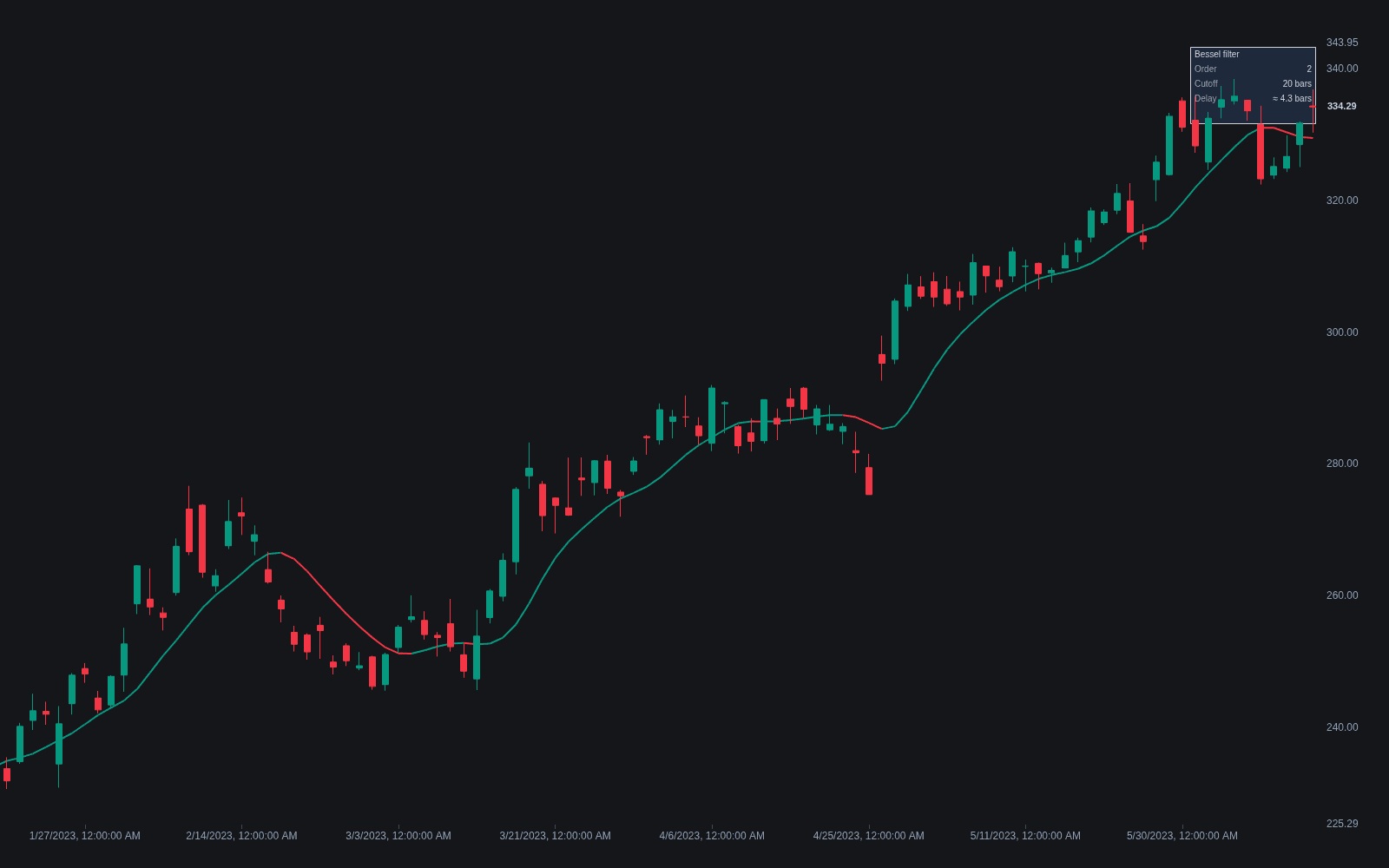
What is a Bessel filter?
A Bessel filter is a low-pass filter design whose defining property is maximally flat group delay: every frequency component that passes through it is delayed by very nearly the same number of bars. Applied to price, that matters more than it sounds. A smoother that delays slow swings by one amount and faster wiggles by another distorts the shape of the move it is drawing; a Bessel design shifts the whole waveform sideways almost intact. The design is named for the Bessel polynomials in its transfer function, and engineers often credit the practical filter to W. E. Thomson's 1949 work, which is why it is sometimes called a Bessel-Thomson filter.
Traders reach for it when shape preservation matters, for example when the smoothed line feeds a pattern detector, a swing-measuring routine, or a turning-point rule that would be confused by overshoot. Among the classical analog prototypes it has essentially no ringing and negligible overshoot on step inputs, so a sharp gap in price produces a clean, near-monotonic transition in the output rather than a decaying oscillation.
The cost is selectivity. For a given filter order the Bessel design has the gentlest rolloff of the classical designs, so it lets more high-frequency noise through than a Butterworth filter, Chebyshev design, or elliptic filter of the same order. Matching their noise suppression requires a higher order or a longer critical period, which raises the overall delay. One further honesty note: charts are sampled data, and converting the analog prototype to a bar-by-bar recursion (usually via the bilinear transform) degrades the constant-delay property somewhat, most visibly at short wavelengths.
How it's calculated
There is no single bar-domain formula; a Bessel filter is specified by its continuous prototype and then mapped to a recursive equation at a chosen cutoff. The two-pole low-pass prototype and the resulting digital form are:
Coefficients depend on the filter order and the cutoff period; they are produced by a design step (commonly the bilinear transform), not by a compact closed-form bar formula.
Higher-order Bessel filters are usually implemented as cascaded second-order sections.
The bilinear mapping preserves the flat-delay property only approximately, and least well at short periods.
How traders use it
- As a shape-preserving smoother feeding downstream logic: because all passed components are delayed roughly equally, swing highs and lows in the smoothed line keep their relative timing, which helps rules that measure swing amplitude or symmetry.
- As a gap-tolerant baseline: the near-absence of overshoot means a large opening gap does not produce the ring-and-settle artifact that sharper filters can print, so fewer false turning points tend to appear right after shocks.
- As the slow line in crossover logic where whipsaw from ringing is a known problem; traders accept the softer rolloff in exchange for a cleaner response to impulsive moves.
- Its limitation is bluntness: in noisy, rangebound conditions a Bessel smoother of modest order passes more chop than equal-order alternatives, so it is often paired with a separate trend-strength gate rather than trusted alone.
Bessel filter vs neighboring smoothers
Butterworth filter: Butterworth optimizes flat magnitude in the passband and rolls off faster; Bessel optimizes flat delay. Butterworth suppresses noise better at equal order but shows mild overshoot on sharp moves, while Bessel keeps waveform shape at the price of weaker attenuation.
Gaussian filter: The Gaussian smoother also has essentially no overshoot and behaves similarly in practice; the Bessel design approaches a Gaussian response as order increases. The Gaussian is defined by its bell-shaped impulse response, the Bessel by its flat group delay.
Ehlers SuperSmoother: The SuperSmoother is a two-pole Butterworth-derived recursion tuned for trading data, aimed at killing short wavelengths with little lag. It prioritizes attenuation near the two-bar limit, whereas Bessel prioritizes uniform delay across the passband.
Concept family
Trend
100 concepts mapped · 100 in the Library
Bessel Filter FAQ
Turn Bessel Filter into a trading strategy.
Take the implementation from this page into Quant, then build on it, backtest it on real data, and keep refining it in conversation.