Concept
SWMA
SWMA, also known as symmetric weighted MA, is a Trend concept. The Library holds 1 implementation, a working definition you can pull into Quant.
Top SWMA indicator
The top custom implementation, built on the original standard SWMA formula.
1 total
The SWMA implementation below can become a backtested trading strategy — describe your rules and Quant writes the code.
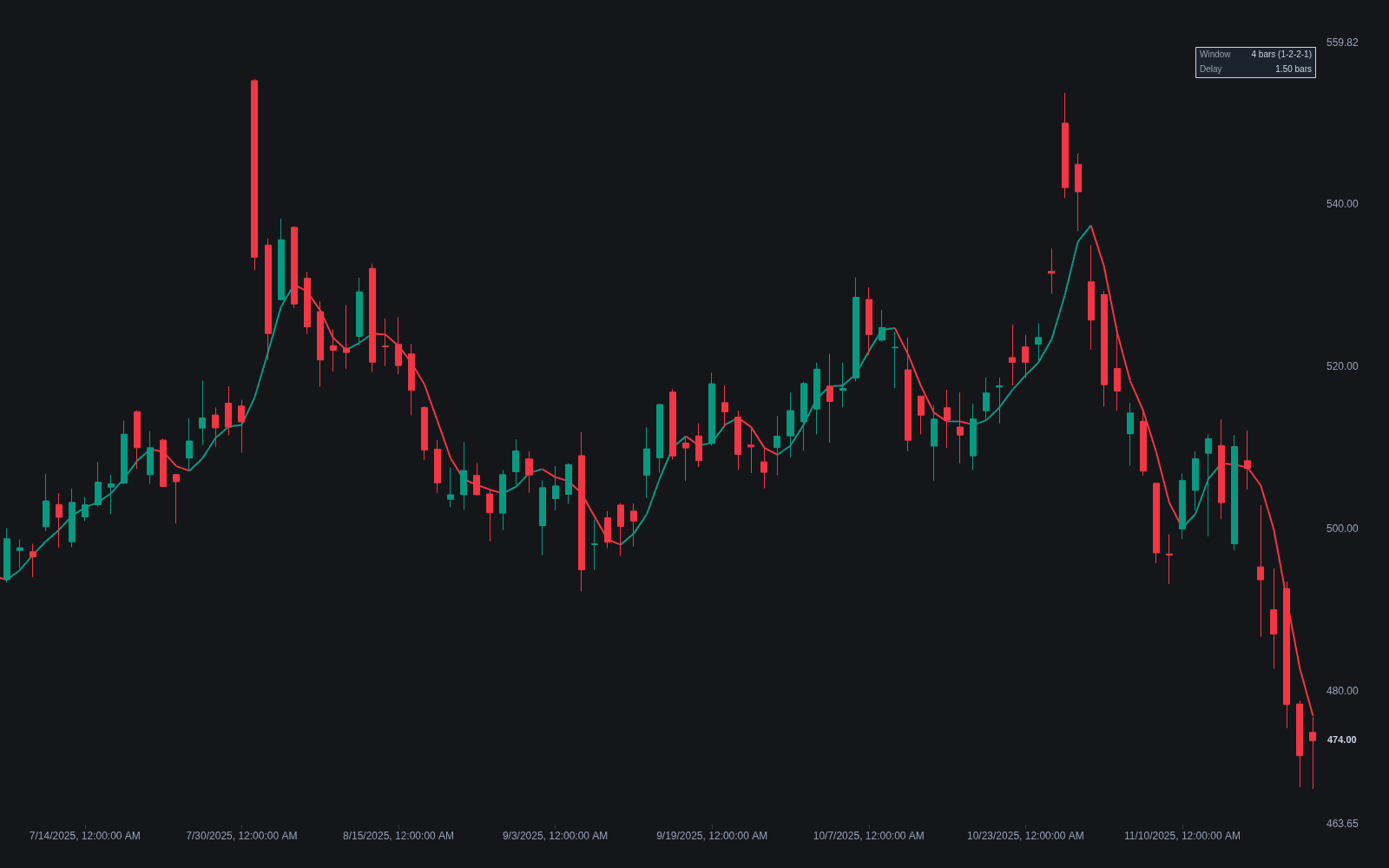
What is the SWMA?
The SWMA, or symmetric weighted moving average, is a moving average whose weights are mirrored around the center of its window. In the form most traders meet it (the built-in found in popular charting platforms), it is a fixed four-bar average with weights 1/6, 2/6, 2/6, 1/6: the two middle bars count double, the two outer bars count single, and the weights sum to one. More broadly, the term covers any finite moving average with center-symmetric weights, a family that also includes the triangular MA and the sine-weighted MA.
The symmetry is not cosmetic; it is the defining engineering property. A symmetric finite-impulse-response filter has exactly linear phase, meaning every frequency component it passes is delayed by the same fixed amount, (n - 1) / 2 bars for a window of n. The smoothed line is therefore an undistorted, uniformly shifted copy of the low-frequency content of price. Recursive averages like the EMA cannot make that claim: they delay slow swings and fast wiggles by different amounts, subtly warping the shape of moves.
Traders care about the four-bar SWMA mostly as a fast, cheap noise reducer. With a delay of exactly 1.5 bars it barely lags, and its double-weighted center suppresses single-bar spikes better than a plain four-bar SMA. It is common as a pre-smoothing stage inside composite indicators rather than as a standalone signal line, since four bars of smoothing is far too little to define a trend by itself.
How it's calculated
The standard fixed-length form uses four bars with symmetric weights summing to one:
This 1-2-2-1 weighting over four bars is the common charting-platform implementation and takes no length input.
Generalized symmetric versions use any mirrored weight profile over n bars; all share a constant delay of (n - 1) / 2 bars.
Because the window is symmetric, applying the weights forward or backward gives the identical result.
How traders use it
- As a pre-filter: smoothing the input of an oscillator or a longer average with the four-bar SWMA knocks out one-bar spikes at a cost of only 1.5 bars of delay, often cleaning signals more than it slows them.
- As a gentler price proxy in bar-by-bar logic: rules that compare consecutive closes can compare consecutive SWMA values instead, reducing sensitivity to single aberrant prints.
- Longer symmetric weightings are chosen when downstream logic measures swing shape or timing, because the uniform delay of symmetric filters preserves waveform geometry; see also windowed FIR smoothing for the general design approach.
- Its limitation is scope: four bars of smoothing does not filter regime noise, and the fixed length offers no tuning. It removes texture, not chop, and should not serve as a trend filter on its own.
SWMA vs neighboring weighted averages
WMA: The WMA weights bars linearly toward the most recent, deliberately asymmetric to cut lag. The SWMA's mirrored weights accept a fixed centered delay in exchange for distortion-free smoothing.
Triangular MA: The triangular MA is the length-adjustable member of the same symmetric family, with weights rising linearly to the window center. The common SWMA is essentially a compact fixed four-bar relative.
Sine-weighted MA: The sine-weighted MA shapes its symmetric weights with a half sine wave, giving a smoother rolloff of the window edges. Same linear-phase property, different weight profile and selectable length.
Concept family
Trend
100 concepts mapped · 100 in the Library
SWMA FAQ
Turn SWMA into a trading strategy.
Take the implementation from this page into Quant, then build on it, backtest it on real data, and keep refining it in conversation.