Concept
Trend-quality Composites
Trend-quality Composites, also known as RAVI, are Trend concepts. The Library holds 1 implementation, a working definition you can pull into Quant.
Top Trend-quality Composites indicator
The top custom implementation, built on the original standard Trend-quality Composites formula.
1 total
Want to trade Trend-quality Composites? The implementation below is one prompt away from a backtested strategy in Quant.
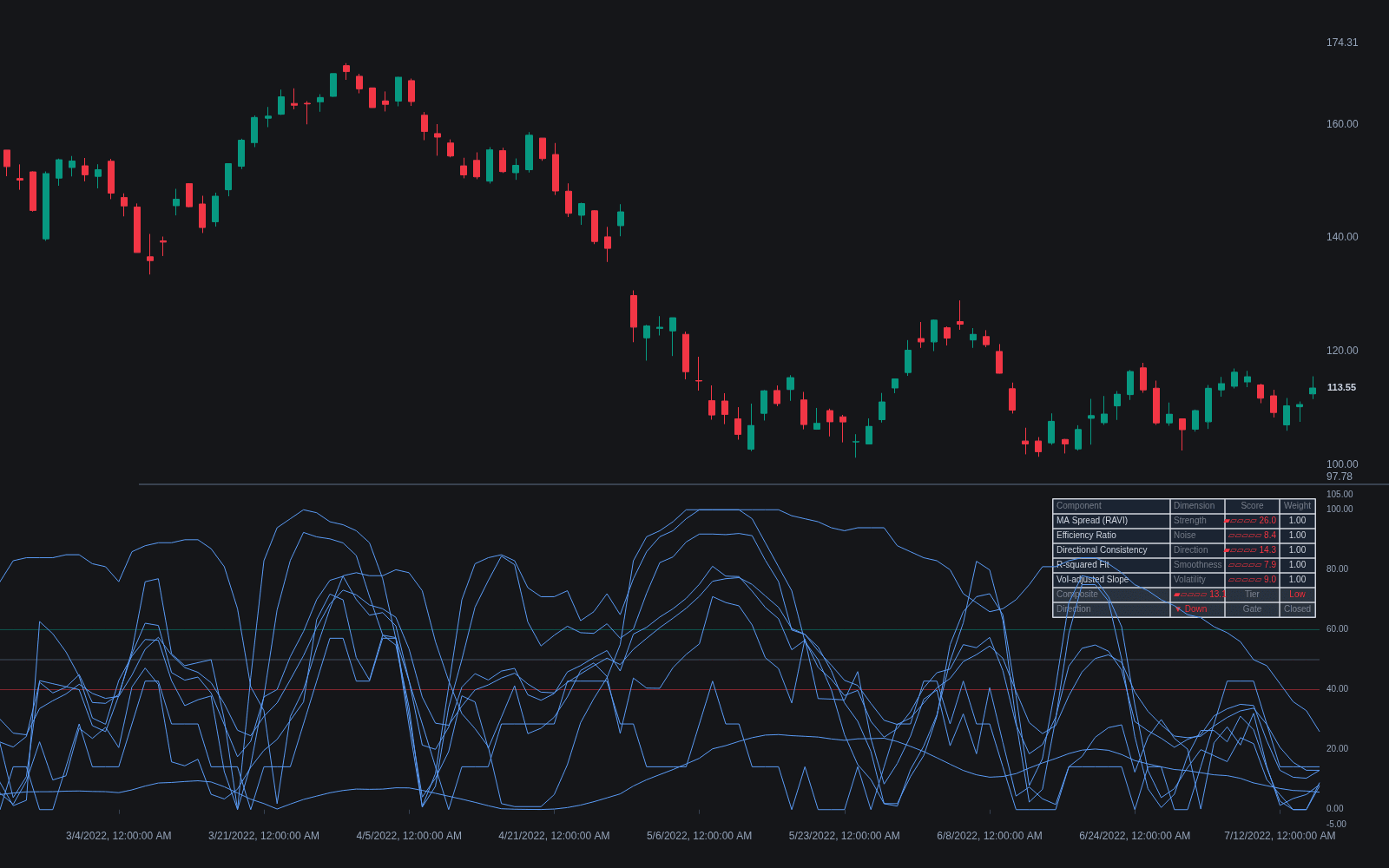
What are Trend-quality Composites?
Trend-quality composites are indicators that reduce several trend measurements (direction, strength, smoothness, volatility context) into a single score of how clean and tradeable the current trend is. Rather than asking only whether price is trending, they ask how efficiently it is trending: a market grinding steadily higher scores well, while one covering the same distance through violent whipsaw scores poorly. Common ingredients include moving-average spreads, noise measures like the Kaufman Efficiency Ratio, and volatility normalization.
A well-known member of the family is RAVI, Tushar Chande's Range Action Verification Index, which expresses the absolute gap between a short and a long simple moving average (7 and 65 periods are the usual pair) as a percentage of the long one; widening readings argue for trending conditions, narrow or shrinking readings for range trade. Other composites blend trend and volatility quality terms in their own ways, so exact formulas vary by implementation and should be read before use.
The volatility-quality branch works from bar anatomy instead of average spreads. The Volatility Quality Index, circulated from the MetaTrader community and ported by LazyBear, accumulates a signed fraction of each bar's range according to how much of it closed with the move, so directional bars build the line steadily while whipsaw bars cancel themselves; a smoothly rising or falling VQI is the signature of a quality trend, and loxx's zero-line variant recenters the same construction into an oscillator. chikaharu's Trend Volatility Index blends trend and volatility terms into a related score. Across the branch the formulas differ enough that reading the source is not optional.
Composite design has its own honesty rules. Every ingredient derives from the same price series, so double counting is the default risk: a moving-average spread and an efficiency ratio agree most of the time because they share an input, and stacking them inflates confidence without adding information. Ingredients therefore need normalizing before blending, thresholds need calibrating per instrument from the score's own history, and the graded score is usually worth more than any binary cut of it, sizing and confidence scaling by quality rather than gating on a magic number. A ribbon's alignment and spacing is the same idea done visually, which is a fine sanity check on what the number claims.
How to identify a trend-quality composite's construction
The family is defined by recipe rather than formula, so identification means reading the recipe.
- 1Inventory the ingredients: moving-average spreads, efficiency or noise ratios, volatility normalizers, and whatever else the score blends.
- 2Check normalization: each ingredient should be scaled to comparable units before weighting, or the largest-magnitude term silently runs the score.
- 3Establish the output scale and its threshold conventions: bounded or unbounded, centered or one-sided, and what reading is supposed to mean trending.
- 4Validate by eye against obvious history: a clean grinding trend should score high, a violent whipsaw covering the same distance should score low; a composite that cannot pass this test measures something else.
- 5Calibrate thresholds per instrument from the score's own distribution, and re-check them across regimes before letting them gate live signals.
How traders use it
- As a regime gate: trend-following entries are enabled only above a quality threshold, complementing binary trend/range classifiers with a graded score.
- As a strategy switch: high scores route signals to breakout and pullback logic, low scores to mean-reversion logic or to standing aside.
- As a weighting input: position size or signal confidence is scaled by trend quality instead of treating every trend as equal.
- For backtest segmentation: bucketing historical trades by the quality score at entry shows where a crossover or breakout system actually earns its returns, which is routinely a narrow high-quality slice of all signals.
- As alert hygiene: routing only above-threshold signals to notifications cuts the noise of range-generated triggers, so attention arrives when conditions actually resemble the ones the system was built for.
Trend-quality composites vs related measures
ADX/DMI System: ADX is one fixed construction, trend strength from directional movement, with decades of shared convention behind its thresholds. Composites are open recipes that can blend strength with smoothness and volatility context. ADX is the standard instrument; composites are custom rigs that must justify their extra parts.
Kaufman Efficiency Ratio: The efficiency ratio is a single elegant ingredient: net travel over total travel. Composites are recipes that may include it among several terms. The ratio's virtue is interpretability, the recipe's is coverage; blending buys breadth at the price of opacity and double-counting risk.
Trend/Range Classifiers: Classifiers emit a label, trend or range, usually by thresholding something; composites emit the graded score itself. The score preserves information the label discards, which matters most near the boundary, exactly where binary classifiers thrash and graded sizing degrades gracefully.
Concept family
Trend
100 concepts mapped · 100 in the Library
Trend-quality Composites FAQ
Turn Trend-quality Composites into a trading strategy.
Take the implementation from this page into Quant, then build on it, backtest it on real data, and keep refining it in conversation.