Concept
Trend Acceleration/inflection
Trend Acceleration/inflection, also known as slope inflection, acceleration phase, is a Trend concept. The Library holds 1 implementation, a working definition you can pull into Quant.
Top Trend Acceleration/inflection indicator
The top custom implementation, built on the original standard Trend Acceleration/inflection formula.
1 total
Want to trade Trend Acceleration/inflection? The implementation below is one prompt away from a backtested strategy in Quant.
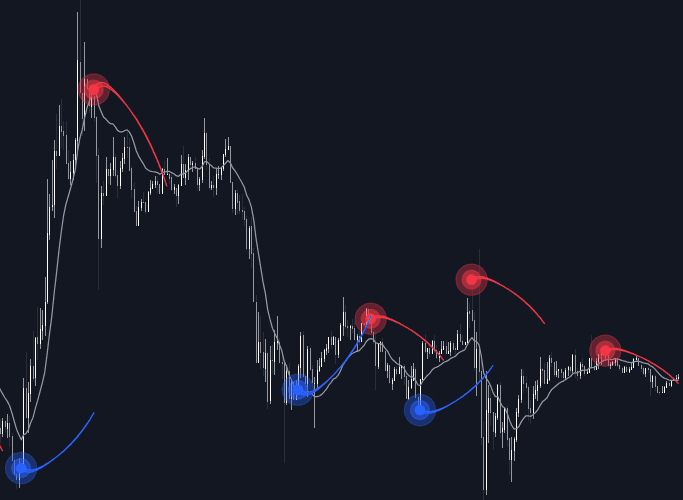
What is Trend Acceleration/inflection?
Trend acceleration/inflection is the study of a trend's second derivative: not whether price is rising, but whether the rise is speeding up, slowing down, or bending over. Raw price slope is too noisy for this, so the measurement is usually taken on a smoothed proxy, such as the bar-to-bar slope of a moving average, a smoothed rate of change, or the change in slope itself. Acceleration is the slope growing in the trend's direction; deceleration is the slope fading toward zero while still pointing the trend's way; the inflection is where the slope's change crosses zero and the curve starts bending the other way.
The appeal is sequencing. Trends usually flatten before they turn, so curvature often shifts before a moving average crossover or a structure break confirms anything. The honest caveat: deceleration is not a reversal by itself. Trends routinely pause, decelerate, and re-accelerate, so inflection reads are generally treated as early trend exhaustion evidence and a cue to tighten risk rather than a standalone entry.
The measurement menu is short but varied. The plainest instrument is the slope of an EMA differenced again, its change per bar, usually smoothed a second time because differencing amplifies noise. MACD-histogram widening and narrowing is the same idea prepackaged, and curve-fitting approaches read the second derivative off a fitted arc. Tooling spans the same range: LuxAlgo's MA Sabres marks the moments a smoothed average's curvature turns, drawing sabre glyphs at the inflections, Drun30's Trend Reversal study smooths an EMA of slopes, and TradeStation's moving-average-speed work made the case that slope velocity shifts precede visible turns.
A useful mental model is the trend's life in curvature phases: young trends accelerate, mature ones hold a steady slope, aging ones decelerate into the inflection, after which the resolution is either consolidation or turn. Mapping management onto those phases is the discipline's real payoff, adding during acceleration, holding through steady state, tightening as deceleration sets in, rather than treating every uptrend bar as identical. The standing warning is statistical: every derivative doubles noise, so second-derivative tools demand heavy smoothing, and the smoothing guarantees the inflection you see printed later than the one that happened.
How to identify trend acceleration and inflection
The workflow is derivatives of a smoothed line, with the smoothing doing as much work as the math.
- 1Choose the proxy: a moving average of a length that matches the trend you manage, since raw price slope is unusably noisy.
- 2Take the first derivative: the proxy's change per bar, which gives signed slope, the trend's speed.
- 3Take the second: the change of that slope, smoothed again, which gives curvature, the trend's acceleration or deceleration.
- 4Mark the zero-crossings of the curvature series; these are the inflections where speeding-up turns into slowing-down or the reverse.
- 5Phase-label the move, accelerating, steady, decelerating, and let the label modulate management, because the phases warrant different behavior long before any level breaks.
How it's calculated
First and second differences of a smoothed trend measure, showing whether the trend is speeding up, slowing down, or flipping curvature.
This is the standard discrete first and second derivative applied to a smoothed series, not a single named indicator; implementations differ in the smoothing choice and k, and some use a linear regression slope over a window instead of point differences.
Differencing amplifies noise, so Accel_t is usually computed on a well-smoothed input or smoothed again before reading signs.
A zero cross of Accel_t marks an extremum of Slope_t, a curvature flip in the trend measure, not by itself a price reversal.
How traders use it
- As an early-warning overlay: flattening slope on the trend's smoothed proxy prompts tightening stops or scaling down before any level actually breaks.
- As entry timing within an established trend: re-acceleration after a decelerating pullback is read as the trend re-engaging, a curvature version of classic continuation logic.
- As a late-entry filter: initiating only while the move is still accelerating avoids entering during the mature, decelerating phase, though it cannot rule out sudden reversals.
- As a scaling policy: pyramid additions are restricted to acceleration phases and trimmed or frozen once curvature flips, tying position growth to the trend's demonstrated vigor rather than to its age.
- As a curvature divergence read: price printing a new extreme while the proxy's slope decelerates is an early, structural hint of a possible reversal, acted on only when structure subsequently confirms.
Acceleration/inflection vs related trend reads
MA Slope Filter: The slope filter reads the first derivative: which way and how steeply the average points. Acceleration analysis reads the second: whether that steepness is building or fading. The slope says what the trend is; the curvature says what it is becoming.
Moving Average Crossovers: A crossover is a lagging confirmation that two smoothed speeds have swapped order; curvature shifts upstream of it, flagging the fade before the lines meet. The pairing is natural: inflection warns, the crossover confirms, and the gap between them is where risk gets tightened.
Trend Exhaustion: Exhaustion is the broad diagnosis, drawing on divergence, volume character and sequence counts; deceleration-into-inflection is one instrument inside that orchestra, the purely kinematic one. Curvature can flag exhaustion no other signal shows yet, and vice versa.
Concept family
Trend
100 concepts mapped · 100 in the Library
Trend Acceleration/inflection FAQ
Turn Trend Acceleration/inflection into a trading strategy.
Take the implementation from this page into Quant, then build on it, backtest it on real data, and keep refining it in conversation.