Concept
Rolling VWAP
Rolling VWAP is a Volume & Order Flow concept. The Library holds 1 implementation, a working definition you can pull into Quant.
Top Rolling VWAP indicator
The top custom implementation, built on the original standard Rolling VWAP formula.
1 total
The Rolling VWAP implementation below can become a backtested trading strategy — describe your rules and Quant writes the code.
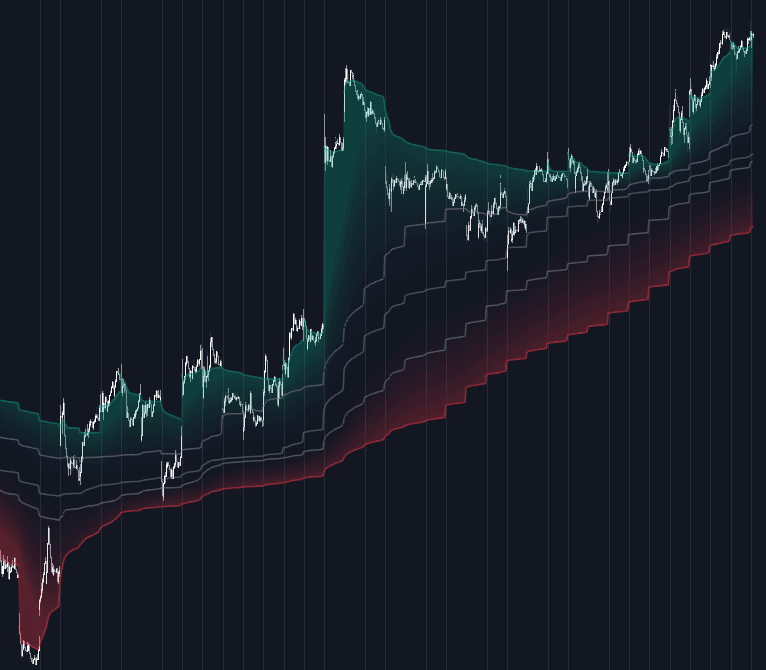
What is a Rolling VWAP?
A rolling VWAP is a volume-weighted average price computed over a sliding window of fixed length, such as the last 24 hours, the last 7 days, or the last N bars: the sum of price times volume across the window divided by the sum of volume, recalculated as the window slides forward. Unlike a session VWAP or periodic VWAPs, it has no anchor and never resets, so it carries a constant memory length instead of an expanding one, and there is no early-session stretch where a handful of bars whip the average around.
That design solves a specific problem: markets that never close. On 24/7 venues such as crypto there is no natural open to anchor to, so a rolling day or week of volume-weighted trade gives a continuous average-price proxy without an arbitrary reset time. The trade-off is interpretive. An anchored calculation means something specific, the average price paid since the anchor; a rolling window is just a smoother, and when its length is defined in bars it is computationally the same thing as a VWMA. What you gain is continuity; what you lose is the auction story that gives anchored VWAP its logic.
Implementation details shape behavior more than they look. Time-defined windows sum price-times-volume over the trailing clock period regardless of bar count, which keeps the line's meaning stable across chart timeframes and is what separates the label from a plain VWMA; band construction wraps the line in envelopes scaled by the rolling deviation of price around it, the channel builds that grade stretch the way session-VWAP bands do intraday; and the constant memory produces the family's smoothest handoffs, no reset discontinuities, no young-average jumpiness, just a window whose oldest contents quietly age out each bar.
Usage settles into two patterns. On around-the-clock markets a one-day rolling VWAP is the de facto bias line, with weekly and monthly windows layered above it in ladders that substitute for the session and period structure clock-driven markets inherit for free; and inside automated systems the never-resetting line is the engineering choice, crosses and slope reads free of boundary artifacts. The reading grammar is familiar, side and slope for bias, band position for stretch, with the one standing caveat that the line describes recent consensus rather than anyone's cost basis, a distinction that matters exactly when the two stories disagree.
How to identify a rolling VWAP
A sliding window, a weighted division, and a bands option: the window definition is the identity.
- 1Fix the window in time, 24 hours, 7 days, or in bars, noting that time-defined windows keep their meaning across chart timeframes.
- 2Sum price times volume across the trailing window, and separately sum the volume.
- 3Divide the sums each bar as the window slides, the oldest contents aging out continuously with no resets.
- 4Add bands if stretch grading is wanted: envelopes at multiples of the rolling deviation of price around the line.
- 5Read it like the smoother it is: side and slope for bias, band position for stretch, with no auction anchor story attached.
How it's calculated
The volume weighted average price of the last n bars, sliding forward one bar at a time instead of resetting each session.
Session VWAP anchors at the session open and resets; the rolling form replaces the anchor with a fixed lookback window.
Some implementations use close or (H + L + 2 × C) / 4 in place of typical price, or define the window as a fixed time span converted to bars.
Optional bands add and subtract multiples of the volume weighted standard deviation of price around RVWAP over the same window.
How traders use it
- As a bias line on 24/7 markets: price holding above or below a one-day or multi-day rolling VWAP stands in for the session-based reads that clock-driven markets get for free.
- As a pullback anchor in trends: the line tracks the recent average traded price, so trend traders treat tags of it as potential continuation entries, often with standard-deviation bands around it to grade the stretch, accepting that no touch is obligated to hold.
- As a system-friendly baseline: because it never resets, crosses and slope readings produce no artifacts at session boundaries, which makes it cleaner than session VWAP inside always-on automated logic.
- In laddered windows: a 24-hour line for tactical bias stacked under weekly and monthly rolling windows rebuilds the timeframe hierarchy that anchored variants get from the calendar, entirely from sliding memory.
- Through its channel form: rolling-deviation bands around the line frame stretch and reversion continuously, the fade-the-rails and ride-the-trend split governed by the same regime judgment session-VWAP bands demand intraday.
Rolling VWAP vs other VWAP variants
Session VWAP: Session VWAP anchors at the open and expands until the close, answering what the average participant paid today; a rolling VWAP answers what the average price was over the last N hours, regardless of session.
VWMA: When the window is a bar count, rolling VWAP and VWMA are the same formula. The label rolling VWAP usually signals a time-defined window (a day, a week), which keeps its meaning stable across chart timeframes.
Anchored VWAP: Anchored VWAP fixes its start at a chosen event and accumulates everything since; a rolling VWAP forgets everything older than its window. One measures cost basis from a moment, the other recent consensus.
Concept family
Volume & Order Flow
88 concepts mapped · 88 in the Library
Rolling VWAP FAQ
Turn Rolling VWAP into a trading strategy.
Take the implementation from this page into Quant, then build on it, backtest it on real data, and keep refining it in conversation.