Naked POC
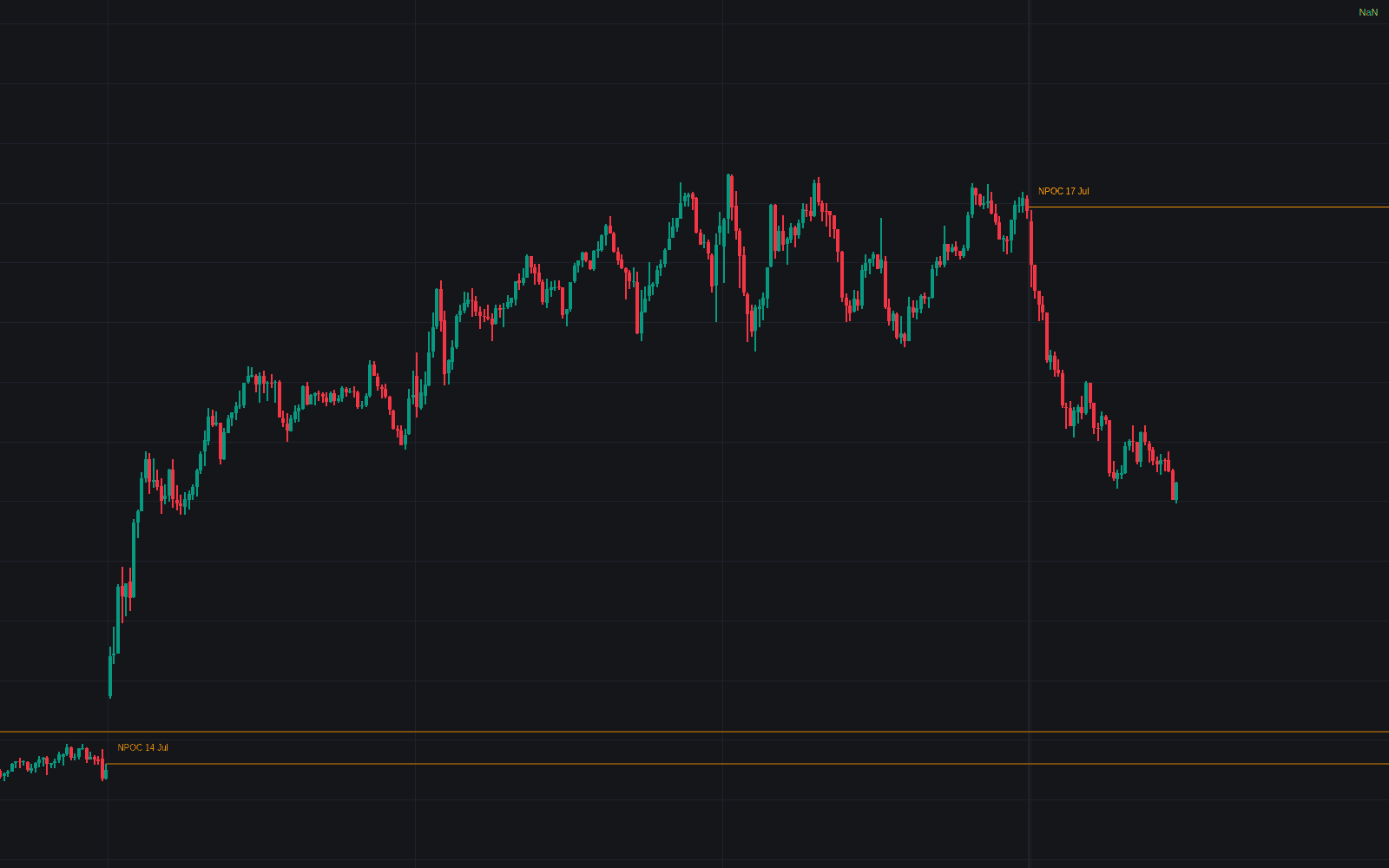
A naked POC (also called a virgin POC, or NPOC) is a prior session's point of control that price has not traded back through since that session ended. Naked POC, also known as virgin POC, is a Volume & Order Flow concept. The Library holds 1 implementation, ready to run on Vela.
Top Naked POC indicator
The top custom implementation, built on the original standard Naked POC formula.
1 total
From studying Naked POC to trading it: open the implementation below on Vela, then build a strategy on it with Quant and backtest it.
What is a Naked POC?
A naked POC (also called a virgin POC, or NPOC) is a prior session's point of control that price has not traded back through since that session ended. The point of control is the price where the most volume traded in a volume profile, or the most time in a TPO profile, so it marks the level that session treated as fairest. If later sessions move away and never return, the level is left naked: untested since the day it was built.
Profile traders keep naked POCs marked because heavily traded prices retain reference value: when price finally rotates back, the first touch often draws a reaction, and open NPOCs above or below act as natural destinations when the market leaves balance. That is a tendency, not a rule; some naked POCs fill within a day or two, others sit untouched for months or never trade again.
The vocabulary comes from the Market Profile tradition, where the time-based version was called a virgin POC long before volume profiling went mainstream on retail platforms. The distinction still matters: a TPO profile crowns the price where the session spent the most time, a volume profile the price where it traded the most contracts, and on rotational days the two usually agree while on stop-run days they can sit noticeably apart. Tools like benb1122's TPO Levels study track NPOCs alongside related unfinished structures, poor highs and lows and single prints, because all of them mark auction business left incomplete.
The honest framing is a prioritized watchlist, not a prediction engine. An NPOC says: this price mattered enough to anchor a whole session, and the market has not re-examined it since. Recent, nearby NPOCs in the direction of travel are live candidates for targets and reactions; distant ones from another volatility regime mostly document history. Public claims about how reliably NPOCs get filled rest on anecdote and cherry-picked examples rather than audited statistics, so the level earns a plan, entries, invalidation, and a defined risk, rather than blind faith.
How to identify a naked POC
Finding NPOCs is bookkeeping over completed profiles; the discipline is in maintaining the list honestly.
- 1Build the prior session's profile, volume-based or TPO-based, and mark its point of control; decide which profile type you track and stay consistent.
- 2Confirm nakedness: scan every subsequent session and verify price has not traded through the level since the session that created it closed.
- 3Extend the level forward on the chart with its date attached, and repeat for each completed session so open NPOCs accumulate into a dated ladder above and below price.
- 4Watch the first revisit closely: responsive trade at the touch, a bounce or a fade with participation behind it, is the level doing its job.
- 5Retire the level once price trades cleanly through it; it is no longer naked, and leaving spent levels on the chart buries the ones that still matter.
How it's calculated
A naked (virgin) POC is a past session's point of control that price has never traded back through since that session ended.
Also called virgin POC.
TPO profiles pick the POC by TPO count instead of volume; the naked test is identical.
Touch rules vary by implementation: some require a trade exactly at the level, others count any overlap with a later bar's range.
How traders use it
- As targets: when price breaks from balance, open naked POCs in the direction of travel are candidate destinations for the move.
- As reaction levels: the first return to an NPOC is watched for responsive trade, a bounce or a fade; once traded through, the level is no longer naked and most traders retire it.
- As a prioritized list: recent naked POCs usually get more weight than stale ones, an application of level freshness and decay.
- As confluence: an NPOC that overlaps a high-volume node from a longer composite, or sits at a session's VWAP area, is treated as a stronger destination than a lone dated line.
- For trade management: on breakout trades, the next open NPOC serves as a natural scale-out price, and on first-touch fades the level itself anchors the stop placement just beyond.
Naked POC vs related profile concepts
Point of Control: Every completed profile has a POC; naked adds one condition, that price has never returned through it since. The POC describes where the session concentrated; the naked qualifier describes what the market has done about it since, which is nothing yet.
High/Low-volume Nodes: Nodes are zones read from a composite profile: high-volume nodes attract and hold price, low-volume nodes get traversed quickly. An NPOC is a single dated price from one session. A naked POC sitting inside an untested high-volume node is the two ideas agreeing.
Value Area: The value area is the span holding roughly seventy percent of a session's activity, with the POC as its center of gravity. Value-area edges frame acceptance and rejection; the NPOC is the finer-grained magnet inside that framework, one exact price the auction crowned and never revisited.
Naked POC FAQ
Turn Naked POC into a trading strategy.
Open the implementation from this page in Vela. Quant, our coding agent, builds the strategy with you and backtests it on real data.
Browse this familyVolume & Order Flow91 concepts mapped · 91 in the Library
- 80% Rule
- Absorption & Exhaustion
- Accumulation/Distribution Line
- Anchored VWAP
- Auction Failure
- Auction Market Theory
- Balance vs Imbalance
- Better Volume Classifications
- Bid/ask Imbalance
- Bill Williams Market Facilitation Index
- Block Trades
- Chaikin Money Flow
- Chaikin Oscillator
- Churn
- Climactic Action
- Cumulative Volume Delta
- Day-type Taxonomy
- Delta Divergence
- Delta Profile
- Demand Index
- DOM
- Ease of Movement
- Excess
- Execution Algo Footprints
- Footprint Concepts
- Force Index
- Herrick Payoff Index
- High/low-volume Nodes
- Iceberg Detection
- Initial Balance
- Intraday Intensity
- Klinger Volume Oscillator
- Manipulation Footprints
- Midpoint/half-back of Session
- Money Flow Index
- Naked POC
- Negative Volume Index
- No-demand / No-supply Bars
- OBV
- OBV Divergence
- One-timeframing
- Open Types
- Order-book Imbalance
- Periodic VWAPs
- Pocket Pivot
- Point of Control
- Poor High/poor Low
- Positive Volume Index
- Price Volume Trend
- Price Zone Oscillator
- Profile Shape Taxonomy
- PVO
- Relative Volume
- Responsive vs Initiative Activity
- Resting Liquidity / Liquidity Heatmap
- Rolling VWAP
- Rotation Factor
- Session VWAP
- Single Prints
- Smart Money Index
- Spike Rules
- Stopping Volume
- Strength/weakness Background
- Sweep Detection
- Tape Reading
- TPO Profile
- Trade Volume Index
- Twiggs Money Flow
- Unfinished Auction
- Unfinished Business
- Up/down Volume Ratio
- Value Area
- Value Migration
- Volume at Breakout
- Volume Delta
- Volume Divergence
- Volume Dry-up
- Volume Flow Indicator
- Volume Oscillator
- Volume Price Trend
- Volume Profile
- Volume Spike
- Volume Spread Analysis
- Volume Zone Oscillator
- VPCI
- VSA Test Bar
- VWAP Bands
- VWAP Mean-reversion vs Trend Regimes
- VWAP Pinch
- Weis Wave Volume
- Williams A/D